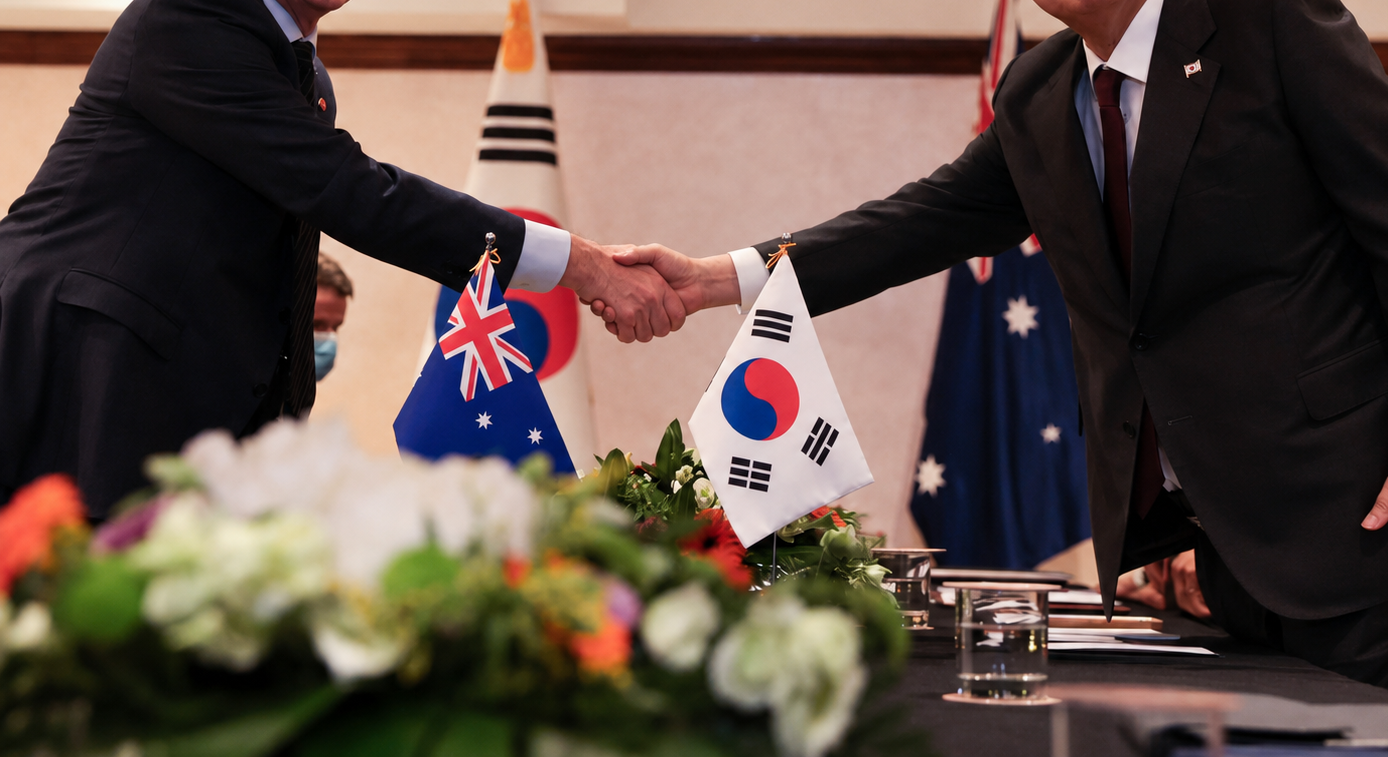
Five years after Korea and Australia upgraded ties to a Comprehensive Strategic Partnership—the first such elevation for Seoul beyond Washington—both leaders have reaffirmed the relationship’s value. But beyond the anniversary milestones, the real question is what has substantively shifted between the two countries since then?
This year marks the 65th anniversary of diplomatic relations between the Republic of Korea (ROK) and Australia, as well as the 5th anniversary of the Comprehensive Strategic Partnership (CSP), signed by then-President Moon Jae-in and Prime Minister Scott Morrison. For the ROK, Australia was the second country, after the United States (US), to be elevated to a CSP. More recently, President Lee Jae-myung and Prime Minister Anthony Albanese reaffirmed the importance of the bilateral relationship during their meeting on the sidelines of the 2025 APEC Summit hosted in the Republic of Korea. It is worth asking: what has actually changed over the past five years?
The most significant shift is that the relationship has moved from economy-centred cooperation to a broader security and strategic partnership. Prior to the CSP, ROK–Australia relations were anchored in trade and resources, alongside their shared identity as US allies shaped by joint involvement in the Korean War. While the relationship was friendly, it had not yet reached a level where both countries viewed each other as central partners in their broader diplomatic and security priorities.
Over the past five years, however, the regional environment has become significantly more complex, driven by intensifying US–China strategic competition, the Russia–Ukraine war, and wider disruptions to global supply chains and economic security. Consequently, the CSP has provided a framework to institutionalise defence and security cooperation between the ROK and Australia.
Deepening Security Cooperation
Defence cooperation has deepened in both scope and structure, moving beyond traditional military exchanges toward a more operational and industrial partnership. The ROK’s expanded participation in Exercise Talisman Sabre reflects growing interoperability between the two forces. Additionally, Australia’s acquisition of Korean defence platforms such as the AS9 Huntsman self-propelled howitzer and the Hanwha Redback infantry fighting vehicle shows that the relationship is no longer limited to training or procurement, but the two countries are becoming defence partners embedded in each other’s capability ecosystems.
The scope of cooperation has also widened significantly. This was highlighted at the 2024 Australia–Republic of Korea 2+2 Foreign and Defence Ministers’ Meeting, where both sides agreed on a joint agenda covering Indo-Pacific stability, freedom of navigation, economic security, cyber security, protection of critical technologies, and supply chain resilience. This expansion reflects a clear shift: both countries now see each other not only as bilateral partners, but also as stakeholders in regional order-making. As a result, cooperation is increasingly extending into third regions, including Southeast Asia and the Pacific Islands, signalling a gradual shift from a bilateral partnership to a regional strategic partnership.
Against this backdrop, the question becomes: what should CSP 2.0 look like? If the past five years were about institutionalising the CSP, the next five years should focus on building a technology- and innovation-driven partnership.
Building CSP 2.0
Economic cooperation has already begun to shift from traditional trade to supply chain cooperation. Historically, the relationship was based on a simple complementarity: Australia supplied iron ore, coal, and LNG, while the ROK exported automobiles, steel, and electronics. However, global security disruptions have elevated supply chain resilience into a core economic security issue.
In particular, critical minerals have become central to this shift. As demand for semiconductors, batteries, and electric vehicles grows, Australia has moved from being a resource supplier to a trusted partner in the supply chain. Cooperation on lithium, nickel, cobalt, and rare earths reflects this change. Australia’s resource endowment and the ROK’s manufacturing capabilities are forming an integrated value chain linking extraction, processing, and advanced manufacturing.
At the same time, the clean energy transition is opening new areas of cooperation in hydrogen, ammonia, and renewable energy. This provides a long-term foundation for deeper industrial collaboration in future energy systems and advanced technologies. If the past five years marked a shift from resource-based ties to supply chain-centred economic security cooperation, the next five years will likely be defined by expanded cooperation across emerging technology sectors.
Ultimately, the next five years could mark a turning point in ROK–Australia relations — from consolidating a strategic partnership to building a future-oriented innovation partnership. CSP 2.0 should reflect the changing technological landscape and innovation-driven growth. There is clear potential to deepen strategic collaboration across AI, quantum technologies, cybersecurity, and space. Realising this potential will require the partnership to evolve from resource-driven cooperation to innovation-driven co-development.
Expanding Cooperation in Critical and Emerging Technologies
Both countries increasingly view AI, quantum technologies, semiconductors, cybersecurity and space as critical and emerging technologies that will shape economic competitiveness and national security. This is reflected in long-term policy frameworks such as Australia’s 2023–2030 Cyber Security Strategy and 2019–2028 Civil Space Strategy, as well as the ROK’s First Master Plan for Developing Critical and Emerging Technologies (2024–2028). The next phase of the CSP should build on the same logic of complementarity that has driven cooperation in supply chains, creating a new pillar centred on emerging technologies. Such a partnership would combine the ROK’s strengths in advanced manufacturing and technology commercialisation with Australia’s research capabilities and innovation ecosystem.
If CSP 1.0 (2021–2026) was the consolidation phase—built on defence cooperation, critical minerals, supply chains, and high-level political engagement—then CSP 2.0 should be understood as the expansion phase into next-generation industries. Taken together, it could evolve into a multidimensional partnership spanning technology, energy, security, and people-to-people links.
Amid intensifying strategic competition and growing scepticism toward bilateral and multilateral cooperation, both the ROK and Australia are seeking to strengthen their resilience and diversify their partnerships while maintaining close alliance relationships. In this context, the CSP should evolve into a model of long-term cooperation among like-minded middle powers—one that not only adapts to a changing strategic environment but also helps shape a rules-based regional and international order.
Hannah Heewon Seo is Events Manager at The Australia Institute. She has experience across government agencies, NGOs, and think tanks in South Korea and Australia. Her professional interests focus on foreign policy and diplomacy, particularly engagement with the Asia-Pacific and non-traditional security issues. The opinions expressed do not represent those of The Australia Institute.
This article is published under a Creative Commons License and may be republished with attribution.