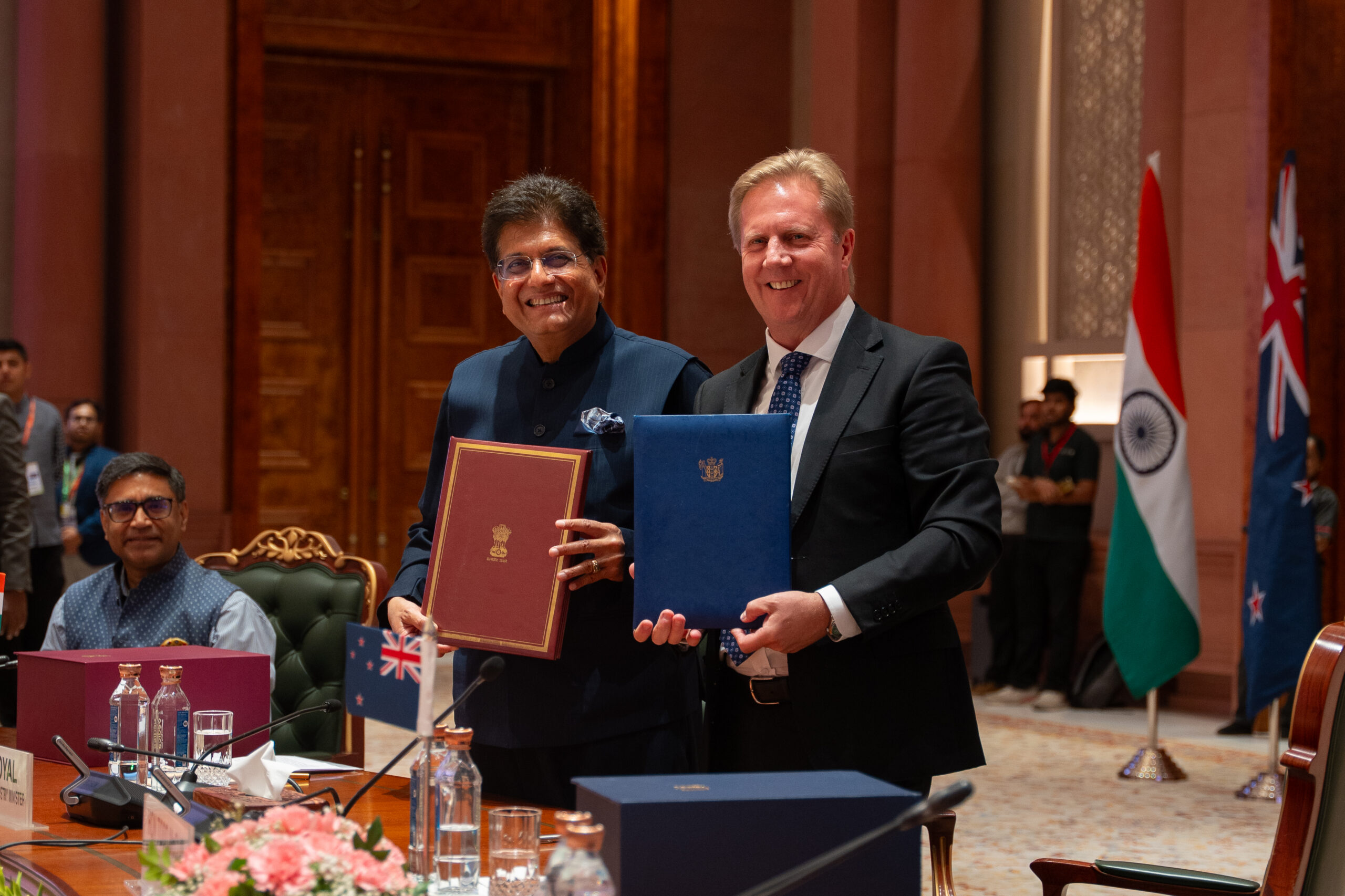
In April 2026, India and Zealand signed onto a Free Trade Agreement that works to deepened ties between their sectors and economies. However, the deal extends far beyond economic gains, signalling a broader strategic shifts of the two nations and their heightened engagements in the Indo-Pacific.
The India–New Zealand Free Trade Agreement (FTA) has implications beyond trade. It strengthens economic ties between two Indo-Pacific countries at a time when both are placing greater emphasis on the region. The agreement provides a framework for expanding commerce and investment, while it also preserves protections for sensitive sectors, particularly Indian agriculture. Over time, closer economic relations could support wider cooperation in areas such as defence, maritime security, and regional affairs.
Having signed the deal in April 2026—following a round of negotiations wrapped up in late 2025—both nations are finalising ratification.
Timing in the Indo-Pacific
This agreement comes at a time when both India and New Zealand want to play a bigger role in the Indo-Pacific region. India is currently the fastest-growing economy and is projected to become the world’s third-largest economy by 2030, with a GDP of around US$7 trillion. Its rapidly expanding middle class, expected to exceed 700 million people, presents significant opportunities for international businesses. For New Zealand, this creates strong potential to increase exports. While India and New Zealand have enjoyed warm diplomatic relations, economic ties remain relatively small when viewed against the scale of their trade with major partners.
In the year ending December 2025, New Zealand’s primary export markets were China, Australia, United States, Japan, and South Korea. Collectively, these countries purchased 57.1% of New Zealand’s total exports. In the same period, New Zealand exported NZ$2.03 billion worth of goods and services to India. This positioned India as New Zealand’s 21st-largest destination for goods exports and fifth-largest market for services exports, making it the country’s 11th-largest export market overall.
Based on India’s FY 2024–25 (April 2024–March 2025) merchandise export data, the United States, the United Arab Emirates (UAE), the Netherlands, China, and the United Kingdom were India’s five largest export destinations. These markets accounted for approximately 40.3% of India’s total merchandise exports. In FY2025, India exported approximately NZ$1.2 billion worth of goods to New Zealand. While New Zealand is a significant market for some Indian exporters, it represents only a small share of India’s global exports.
According to official data released by India’s Press Information Bureau (PIB), bilateral merchandise trade between India and New Zealand surged by 49% (FY 2024–25) to reach USD 1.3 billion. This growth occurred from a base of USD 873 million (FY 2023–24). The absolute trade value is still small compared with India’s trade with its largest commercial partners. However, the growth shows the potential policymakers see in this partnership.
Complementary Trade and Exercising Agricultural Sensitivity
India’s exports to New Zealand are concentrated in pharmaceuticals (leveraging India’s position as the “pharmacy of the world”), machinery and engineering goods, chemicals and manufactured items, and consumer staples and textiles.
New Zealand, meanwhile, primarily exports raw materials like wool, agricultural, forestry, and horticultural products, and metals to India.
Broad trade liberalisation was relatively straightforward given the complementary nature of both economies. Agriculture, however, has proven to be the most politically sensitive chapter. New Zealand is a major global agricultural powerhouse and granting it access to India, where farming is still a way of life for hundreds of millions, required careful calibration. To shield millions of small-scale Indian farmers, the Indian negotiators excluded sensitive agricultural items from tariff cuts. According to the agreement, the FTA protects Indian farmers through quantity limits, price floors, seasonal timing, and outright exclusions. The text describes how New Zealand gets market access in India for four specific products (apples, kiwifruit, Manuka Honey, and albumins) but with built-in safeguards: access is controlled through a Tariff Rate Quota (TRQ) system, meaning only a set quantity can enter at reduced tariffs; a Minimum Import Price is applied, preventing artificially cheap imports from undercutting Indian producers; and imports are seasonal, further limiting competition with domestic harvests.
In exchange, New Zealand must deliver on Agriculture Productivity Action Plans, tying market access to concrete commitments. Furthermore, a Joint Agriculture Productivity Council monitoring the whole arrangement needs to be established.
With nearly 650 million Indians dependent on farming — most of them smallholders with no alternative income — the FTA’s built-in protections ensure that market opening does not come at the cost of widespread impoverishment of rural communities.
From India’s Trade Strategy to Boosting the Investment Pipeline
This pact is a textbook reflection of India’s trade strategy. Over the last few years, New Delhi has been preferring mutually beneficial trade deals that can scale up export targets, attract Foreign Direct Investment (FDI), and integrate Indian businesses into global value chains. The deal with Wellington is very much a part of this blueprint to secure ties with trusted partners and de-risk commercial dependencies.
For New Zealand, the agreement provides better access to one of the world’s biggest and fastest-growing consumer markets. India’s booming middle class, rapid industrialisation, and appetite for premium products offer great opportunities for New Zealand’s businesses.
Beyond goods, the investment chapter in the FTA is a major highlight. New Zealand’s interest to place capital in India shows faith in India’s macroeconomic fundamentals, infrastructure push, and rising consumption power. We can expect joint ventures, and fund flows into high-growth areas like tech startups, advanced manufacturing, agribusiness, logistics, renewable energy, and core infrastructure.
By removing regulatory hurdles and ensuring transparency, the agreement will give corporates the confidence to explore big-ticket projects that were earlier written off as too risky.
Why It Matters for The Indo-Pacific
The India–New Zealand FTA is not just a trade deal but a strategic alliance between two democracies that are both looking to reduce their dependence on China. New Zealand’s own National Interest Analysis states that India is an increasingly significant global security actor with the potential to contribute to a stable and prosperous Indo-Pacific — with defence forces increasingly present throughout the region. Both countries signed a defence cooperation agreement in early 2025.
For India, the deal opens access to a region it has long wanted to engage more deeply. New Zealand is deeply connected — commercially and culturally — to the Pacific Islands. Getting preferred access to New Zealand opens a door for Indian exporters into that entire regional network.
The India–New Zealand FTA holds strategic weight. It aligns two complementary economies and underscores a shared vision for a stable Indo-Pacific. India’s Prime Minister Narendra Modi is set to visit New Zealand in July, focusing on trade, defence and Indo-Pacific cooperation. In a time where trusted partnerships have become top priorities, this FTA perfectly positions both countries to write a reliable and long-term growth economic alliance together.
Anna Mahjar-Barducci is a Project Director at the Middle East Media Research Institute (MEMRI). She has also contributed to think tanks and academic institutions such as TRENDS (UAE). Her writing has appeared in The New York Sun (USA), Osservatore Romano (Vatican), El Mundo (Spain), Maroc Diplomatique (Morocco), and Haaretz (Israel). She is currently a columnist for the Italian daily La Ragione. Mahjar-Barducci lectured at the U.S. State Department and has been part of several U.S. State Department-sponsored events through the Middle East Partnership Initiative (MEPI). She also worked as a researcher in South Asia, Tunisia, Senegal, and Zimbabwe.
This article is published under a Creative Commons license and may be republished with attribution.