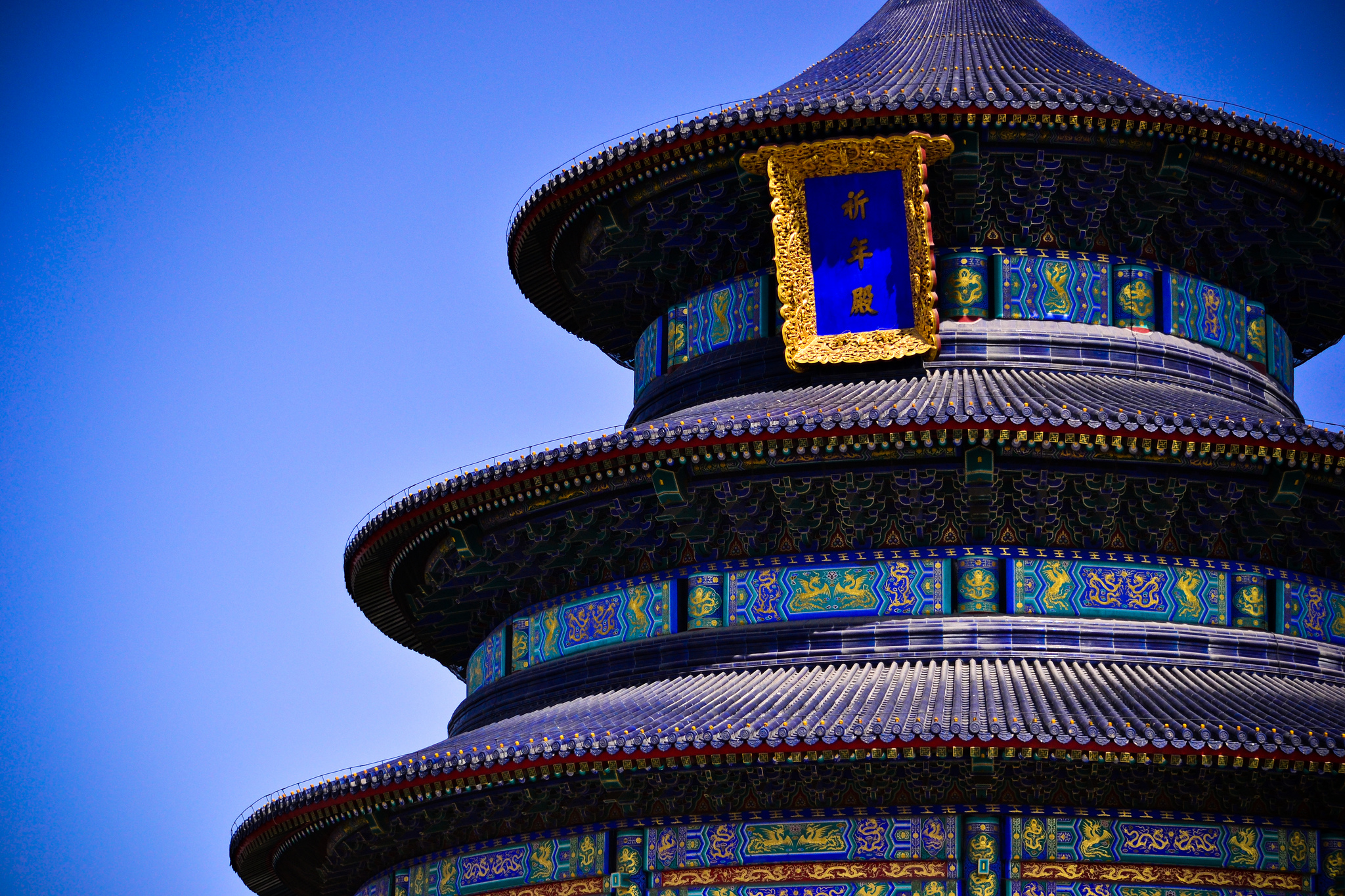
Two weeks after President Donald Trump and President Xi Jinping walked the grounds of Beijing’s Temple of Heaven and paused at the Hall of Prayer for Good Harvests, the image continues to resonate.
The majestic building, with its distinctive triple-eaved roof of deep blue glazed tiles soaring 38 meters above a forest of vermilion pillars, was never intended to be merely a scenic backdrop for a presidential handshake: for more than five centuries the Hall served as the sacred site where emperors performed annual rites to pray for rains and bountiful crops. The deliberate choice of venue continues to send a lingering diplomatic signal, namely that Beijing is framing the US-China relationship in explicitly historical terms, with clear implications for how powers in the Indo-Pacific, including Australia, should read great-power signalling today.
Chinese media framed the visit with emphasis on the temple’s motifs referring to “good harvests,” a metaphor for economic prosperity, wealth, and bilateral stability and cosmic harmony, which Beijing translates in modern diplomatic language as stable, orderly, and mutually beneficial great-power relations. The symbolism was hard to miss as the Temple of Heaven is not merely a tourist landmark but the historic stage where emperors, as Sons of Heaven, reaffirmed their divine mandate to rule through public ritual.
Notably, Trump became only the second US president to tour the complex, following Gerald Ford’s visit in December 1975. The choice of venue therefore carried a clear message about how Beijing views the contemporary US-China relationship: not as ordinary diplomacy, but as an encounter between two poles whose decisions will shape the “harvests” of the 21st century.
Mandate of Heaven
The Temple complex was built in the early 15th century by the Ming emperors and later expanded under the Qing. For more than 500 years it served as the sacred venue for the empire’s most solemn annual rites: the winter solstice sacrifice at the Circular Mound Altar and the spring prayers at the Hall of Prayer for Good Harvests. These were not private devotions, but elaborate public ceremonies in which the emperor, titled the Son of Heaven, acted as the sole legitimate intermediary between the celestial realm and humankind.
At the heart of these rituals lay the ancient doctrine of the Mandate of Heaven. The ruler’s authority to govern was granted from the Heavens, yet that authority was conditional as it endured only so long as cosmic harmony, the proper alignment between Heaven, Earth and human society, prevailed, demonstrated by timely rains, bountiful harvests, and social stability. In other words, the emperor took care of his subjects. By performing the rites at the Temple, the emperor publicly reaffirmed his receipt of this mandate, demonstrating to his subjects and the Heavens alike that he remained worthy of rule.
Trump’s State Visit
How is all this ancient symbolism connected to a state visit in 2026? China’s cultural legacy runs exceptionally deep and far from being historical nostalgia or a handsome photo opportunity, the deliberate choice of the Temple reflects Beijing’s enduring practice of embedding the cosmology of China’s past into contemporary diplomacy. Paradoxically, the Chinese Communist Party, founded on Marxist internationalism and once fiercely hostile to traditional culture has, since the early 1990s, increasingly positioned itself as the foremost defender and inheritor of Chinese civilisation. Through the Patriotic Education Campaign launched after Tiananmen and subsequent ideological adjustments, the Party now portrays its rule as the seamless and eternal guardian of the Chinese nation’s five-thousand-year heritage, while quietly downplays the radical iconoclasm of the Mao era. As a result, while remaining staunchly Marxist-Leninist, the Party and Xi Jinping have consciously been drawing upon elements of China’s traditional culture and political thought. Concepts of harmony, central authority, and the Party’s and the Premier’s responsibility for maintaining order have increasingly been integrated into the narrative of legitimacy and, consequently, foreign policy. This is most clearly seen in Xi Jinping’s “Community of Shared Future for Mankind”, which reframes great-power relations as a quest for harmonious coexistence and shared responsibility rather than zero-sum struggle.
Trump’s tour of the site, therefore, carried unmistakable weight, especially as Russian President Vladimir Putin, who visited Beijing just four days later, was not afforded a visit to the Temple. For his part, President Trump, long known for his appreciation of grand diplomatic pageantry and historic settings, appeared to relish the moment, describing the Temple as “great,” “incredible,” and China as “beautiful.” Beijing’s choice of venue deliberately evoked historical tradition, framing the encounter not as routine diplomacy but as a meeting of consequential powers whose relationship will shape the “harvests” of the current century: strategic stability, technological primacy, economic interdependence and the shape of global governance.
International Stability & Diplomacy
This matters for the Indo-Pacific because Beijing is not only signalling to Washington—it is also signalling to regional states that its preferred order is one in which China occupies a central position and others calibrate themselves accordingly. This framing reflects a distinctly Chinese conception of international order, one that places greater emphasis on functional centrality and structural consequence than on formal equality. Beijing positions the US-China relationship as the central axis upon which the stability of the broader global system depends. The two powers are seen as sharing a special responsibility to manage their competition and cooperation with care, so that their interactions contribute to, rather than undermine, international stability. The sharper message is that Beijing views the bilateral tie as a cooperative hegemonic arrangement, one in which both sides must act responsibly to maintain stability between the two states and the global system.
The Temple of Heaven symbolism thus points to a more nuanced reading of Beijing’s intent: great-power diplomacy as a continuation of hegemonic responsibility for the international order. Under this lens, the bilateral relationship becomes a form of stewardship with global ramifications. Success or failure in managing it will reverberate across the Indo-Pacific, where countries stand to gain or lose from the resulting harmony or discord. For them, the key takeaway is that Beijing views the US-China relationship as the central axis of regional order, one in which the two leading powers bear special responsibility for maintaining stability and harmony in their interactions. This bilateral framing has direct implications on how smaller states navigate great-power rivalry in the region – whether this symbolism translates into substantive progress or remains performative will shape the strategic environment for the coming years
Dr Gerald Mako is a Research Affiliate of the Cambridge Central Asia Forum at Cambridge University. His research focuses on artificial intelligence, cybersecurity, and great power competition in Asia.
This article is published under a Creative Commons License and may be republished with attribution.