Since 2009, Australian maritime security policy has rested on four interlocking pillars: practical engagement with Indo‑Pacific partners; regional defence cooperation through initiatives such as the Pacific Maritime Security Program; contributions to United Nations‑ and US‑led operations in support of maritime access and rule of law; and sustained diplomatic advocacy of maritime security at the highest levels.
The surge of piracy off Somalia between 2008 and 2011 marked a decisive turning point in global awareness of maritime security. Risks to international trade pushed the concept firmly onto policy agendas, including Australia’s. Since 2009, Australian maritime security policy has rested on four interlocking pillars: practical engagement with Indo‑Pacific partners; regional defence cooperation through initiatives such as the Pacific Maritime Security Program; contributions to United Nations‑ and US‑led operations in support of maritime access and rule of law; and sustained diplomatic advocacy of maritime security at the highest levels. Together, these elements provided Australia with a consistent strategic rhythm – a blend of regional activism, alliance assurance, and contribution to the global commons.
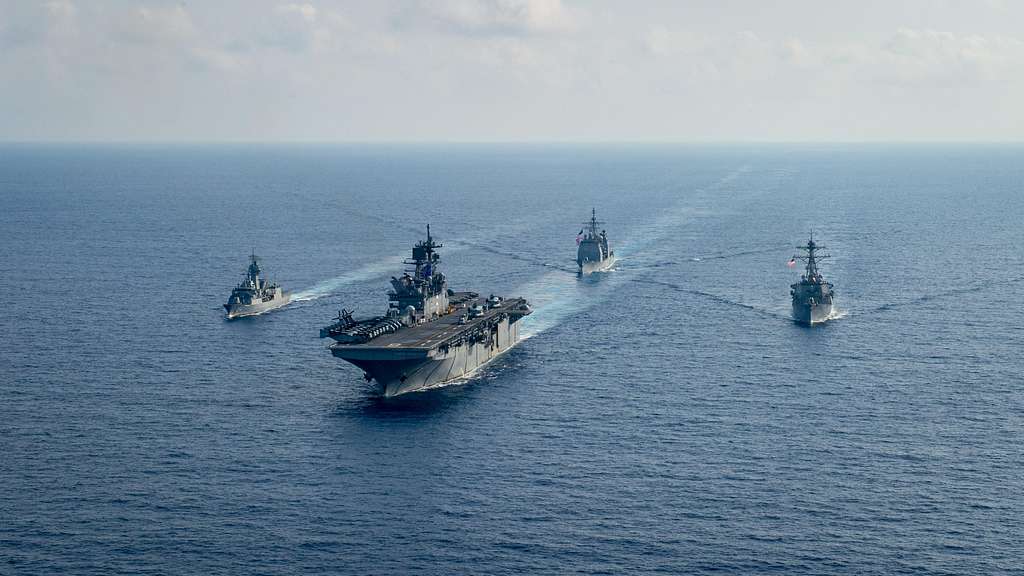
Over the past two years, however, a quiet recalibration has taken place. Without formal announcement or doctrinal change, Canberra’s maritime security posture has narrowed – shifting from global contribution toward regional preservation. In isolation, such decisions might be read as prudent force management. Taken together, however, they form a discernible pattern. The decision not to deploy a warship to support US‑led operations in the Red Sea in December 2023, followed by hesitation to even prepare for a possible deployment related to shipping security in the Strait of Hormuz, represents more than operational restraint. It marks a retreat from one of the four longstanding pillars: participation in coalition operations in support of good order at sea. For a maritime middle power, where and how naval forces are committed function not only as directed naval operations, but as strategic communication.
Official justification has framed this as strategic prioritisation. In December 2023, Defence Minister Richard Marles described the need to redirect finite naval resources “to our immediate region.” At face value, such focus is understandable. The Indo‑Pacific is increasingly congested and contested. Grey‑zone coercion, illegal fishing, and expanding surveillance demands necessitate a sustained regional presence. The 2023 Defence Strategic Review rightly calls for a force posture aligned to the immediate strategic environment.
That logic, while internally coherent, sits uneasily with Australia’s longer‑standing conception of maritime security as spatially and functionally indivisible. For more than a century, Australia has treated maritime security not as a bounded perimeter but as a continuum. Australia’s naval posture has long resembled an “away game” – the assumption that stability in adjacent seas and oceans contributes directly to prosperity and security at home. The distinction was never rhetorical: it reflected an understanding that maritime insecurity travels, even when navies do not. Disruption in the global commons, even far from Australian shores, has always carried domestic consequences. That logic underpinned decades of Australian contributions to coalition maritime operations.
Nowhere is this interdependence clearer than in the current global trade environment. Disruption to shipping transiting the Strait of Hormuz – a chokepoint through which significant volumes of the world’s oil and refined fuels pass has driven up shipping costs and contributed to inflationary pressure. Approximately half of Australia’s imported diesel transits this waterway. Given diesel’s centrality to freight, agriculture, and critical infrastructure, instability in distant seas increasingly shapes domestic economic outcomes. While the costs are borne by Australian households, the current maritime posture leaves disruptions outside the Indo‑Pacific largely to others.
Economic exposure, however, is only one dimension of the shift. There is also a reputational cost that accumulates more quietly, but no less consequentially. Participation in US‑led maritime operations in the Middle East and western Indian Ocean – from the two Gulf conflicts to counter‑piracy off Somalia – once embodied Australia’s role as a credible maritime middle power. The issue is not the absence of a single ship, but the gradual thinning of a once‑routine presence. These deployments reinforced freedom of navigation under international law, protected the sea-based global operating system, and signalled that Australia was a net contributor to global security. When Canberra quietly declined to deploy a ship to the Red Sea, that diplomatic layer was peeled back. Absence, in maritime coalitions, is noticed.
Capability constraints partly explain this posture. The current paucity of surface combatants and workforce pressures leaves the Government with few naval surge options. Yet scarcity has increasingly been reframed as prudence. Staying close to home is portrayed as a strategic discipline rather than a structural necessity. To govern is to choose. Yet the message it projects internationally is indistinguishable from deliberate policy – that Australia now defines its interests narrowly, that good order at sea is someone else’s problem.
Domestic political incentives may reward restraint, but global maritime interdependence makes this approach risky. The strategic risk emerges precisely at this point – when constraint hardens into narrative, and narrative into expectation. Disruption in distant waters feeds directly into Australian supply chains via shipping insurance, fuel prices, and inflation. The effects are not abstract; they cascade into household budgets and national resilience.
None of this implies a binary choice between overextension and withdrawal. Reconnecting maritime policy with national interest does not require Australia to participate in every coalition at sea. Nor does supporting good order at sea equate to participation in regional conflicts. While Washington has argued that Iranian naval capabilities have been degraded, Australia’s interest lies not in combat operations. Australian interests lie in sustaining a maritime environment in which commercial access is predictable, insurable, and governed by accepted norms. A coalition focused on maintaining navigational security in the Strait of Hormuz would align with long-standing Australian interests without implying involvement in broader regional conflict.
Such an approach requires clarity about what maritime security means for Australia. At its core, Australian maritime security encompasses operations undertaken by maritime forces, in collaboration with other agencies, allies, and partners, to counter unlawful activity, maintain good order at sea, and protect shared interests in the maritime domain. Emphasising the constabulary and regulatory character of these activities underscores their purpose: preserving the conditions for the peaceful and lawful use of the sea can be maintained. This tradition has long allowed Australia to contribute to stability without escalation.
For Australia, this is not an abstract preference but a geographic condition. Australia’s geography ensures that good order at sea is not a rhetorical flourish but an existential condition. To decline even to prepare for potential operations to safeguard critical trade routes is to reveal a narrowing of ambition and capacity, an inertia that risks eroding the influence accumulated over decades of steady maritime contributions. Maritime security, once a framework for cooperation, increasingly risks serving as a justification for passivity.
The question, then, is not whether Australia can afford to think globally about maritime security, but whether it can afford not to. Reasserting its global dimension would not require overstretch. It would require recognising, as Shakespeare’s Merchant of Venice observed, that ”thou know’st all my fortunes are at sea” – and that Australia’s prosperity and security remain bound to the oceans that connect the nation to the world. The sea has never stood outside politics – it is politics in motion. Through its shifting currents flow the forces that shape and unmake our world. The question is whether Australia can adapt to the order the sea has already imposed.
Dr Sean Andrews, CSC, is a retired Royal Australian Navy officer and maritime strategist, currently Senior Fellow at the Strategy, Statecraft and Technology – Changing Character of War Centre, Pembroke College, Oxford University. He has led Australia’s Sea Power Centre, commanded ADF operations in the Middle East, and publishes widely on Indo-Pacific sea power, maritime security, and the global oceanic order.
This article is published under a Creative Commons License and may be republished with attribution.