Indonesia has more Muslims than any other nation, so it’s logical to assume it should be involved in the US-Israel war against Iran, advising and warning. That won’t happen because of a conflict over succession 14 centuries ago, ensuring today’s President won’t become a world peacemaker on this stage.
There are more than 7,000 km between Jakarta and Tehran, and right now neither is a holiday destination: one is flooded with mud, the other with munitions.
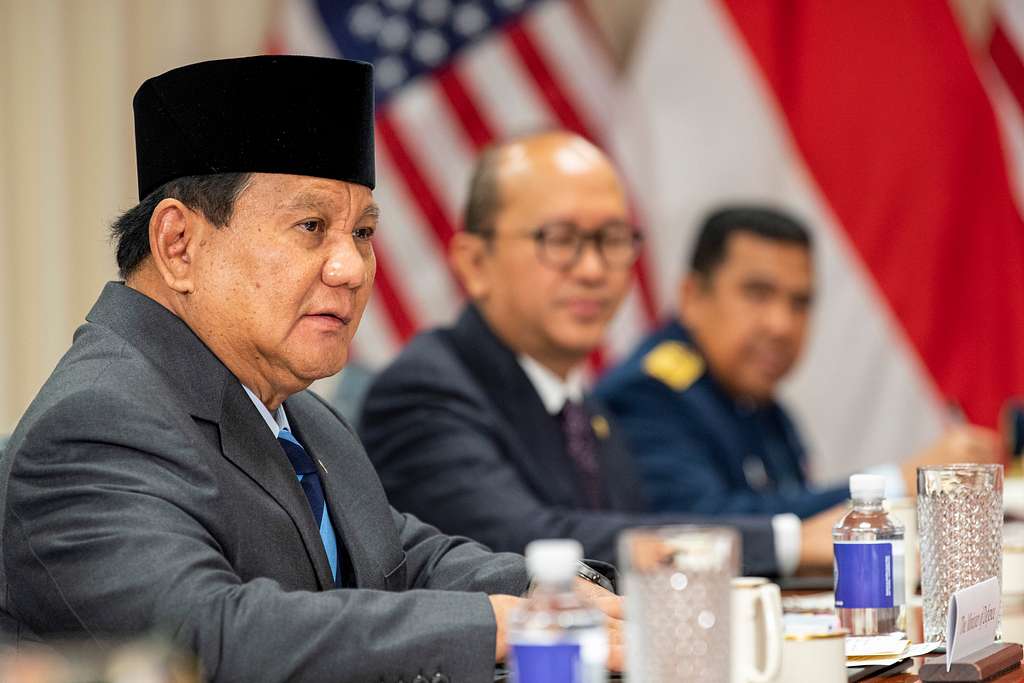
Prabowo Subianto reportedly says he wants to be in the Middle East’s smoking city to offer his imagined truce-making skills and presumably be nominated for a Nobel Peace Prize. Indonesia has never won a Nobel in any category, so any gong would be a coup. But Prabowo’s ambitions have been spiked by the most powerful force in Indonesia after nationalism – Islam.
A General’s Ambitions
The President hasn’t been asked to intervene in the Middle East conflict but hankers for action anyway. Generals sometimes experience symptoms of relevance deprivation upon retirement.
In 1988, Prabowo was booted out of the military for disobeying orders after more than three decades in uniform. He fled to exile in Jordan and, for a while, was banned from the US and Australia for alleged human rights abuses.
With such an ignoble background, shamed men would have crept out of public life, but Prabowo has an excess of self-confidence.
The military colleges he attended in the US (Fort Benning) and Australia (Duntroon) taught tactics and weaponry but not the pedestrian skills of civil administration. Prabowo, 75, prefers jeeps and the ‘smell of napalm in the morning.’ He likes wearing portly safari suits, fatigues, and big boots to remind cheering electors of his glory days of the last century, when drones were boring friends.
He’s now the Republic’s democratically elected eighth president, head of the world’s fourth-most populous country, and predicted to be the world’s fourth-largest economy by 2045. How a cashiered general got the top job of running a nation of around 280 million people is a long and complex story, best researched in this history from the Australian National Archives. To understand why Prabowo thinks he can play statesman, it helps to understand who he actually is — and who he isn’t.
The Man Behind the Uniform
For all his bravado, Prabowo is a complicated figure even within the faith he now claims as his platform. He’s not acclaimed for his piety as a Sunni Muslim; he was raised to follow the faith of his national economist father, Sumitro Djojohadikusumo, rather than the Christianity of Mum Dora Marie Sigar, a nurse and activist, and is the only Muslim among four siblings. Last year, he performed the Umrah pilgrimage at the Grand Mosque while in trade talks with Saudi Arabia.
Prabowo doesn’t seek wisdom through Javanese spiritual retreats like Soeharto, his former father-in-law. He prefers foreign parade grounds to the flooded landslides of his homeland’s highlands. In his first year in office, Prabowo made 30 official overseas visits.
He can’t carry a holstered pistol in the reception rooms as he is alleged to have done when confronting acting President BJ Habibie following Soeharto’s dismissal in 1998. Research by Singapore’s Yusof Ishak Institute claims opinion polls repeatedly show the Indonesian National Army is the state institution Indonesians trust most — but that trust doesn’t translate to the palace. So how to get a grip?
His answer, it turns out, is to look outward — and to Washington.
Cozying Up to Trump
He’s close to Donald Trump, a fact angering many Indonesians. He was caught on a hot mike asking Trump for an intro to his son Eric. The US President reportedly has land investments and golf courses in Indonesia.
It’s widely believed that Jakarta can’t take sides with big powers, “a thousand friends and zero enemies,” said an earlier president. But the Constitution allows that “with the approval of the House of Representatives, the President may declare war, make peace, and conclude treaties with other countries.”
Pak P is going Washington’s way by offering 8,000 military personnel to join the US President’s Board of Peace (BOP), conceived last year with an Indonesian as deputy commander.
So far, 20 mostly Muslim-majority countries in the Middle East are reported to have joined. Israel is a member, but not Palestine. Negotiating peace without a key party insults reason in any culture, and Prabowo has caught on. He’s now vowing to quit if the BOP goals aren’t achieved. The left-wing US non-profit NGO The Intercept claimed its analysis found “ every single BOP member state has been rebuked for human rights violations.”
Now it’s being ridiculed as an organisation worthy of George Orwell’s dystopian novel 1984, in which departments were named the opposite of their purpose.
The ABC’s Americas Editor, John Lyons, commented: “Based on Trump’s own speech to launch the board, it increasingly appears to be an unaccountable vanity project that takes the US even further from its traditional allies.”
Prabowo offered to be a BOP top donor, apparently without the approval of the House of Representatives, holding a public referendum or generating mainstream media discussion.
Islam Says No
What he skipped in parliament, he sought in the mosque. He consulted the nation’s Islamic scholars from the civil organisations Nahdlatul Ulama and Muhammadiyah. Together, they claim a membership of more than 140 million — and their initial approval gave Prabowo’s ambitions a veneer of legitimacy. Once the war with Iran started, the peak Islamic authority Majelis Ulema Indonesia (Islamic Scholars’ Council) laid down its law: Indonesia must quit the BOP, stating: “The organisation (MUI) condemned the offensive, saying it runs counter to humanitarian principles and the Indonesian constitution, which commits the nation to helping build a world order based on freedom, lasting peace and social justice”.
The scholars’ objection pointed to a far more fundamental problem with Prabowo’s peacemaking ambitions– the Sunni-Shia divide that has fractured Islam for 1,400 years.
A Sunni in a Shia War
The idea of Prabowo, a Sunni Muslim, bringing the armed Middle East feuders together is outlandish. Although Indonesia has more Muslims than any other nation, almost all are Sunni, the branch of the faith followed by 90 per cent of the world’s second most popular religion after Christianity.
The people and rulers of Iran are Shiite / Shia Muslims. The origins of the split are complex, but enough to know the enmity is ancient and alive — and almost entirely absent from Indonesian soil, where practising Shia number perhaps only a million. Prabowo has spent a lifetime among Sunnis. He is, in this conflict, a stranger to both sides.
Conclusion
Prabowo may need to forget his statesman plans, concentrate on today’s domestic issues, and don a peaceful batik instead of camouflage.
280 million Indonesians are dealing with floods, landslides, and an economy that needs tending if the 2045 dream is to be realised. That is the battlefield that actually needs a commander-in-chief — not the smoking ruins of the Middle East.
Old soldiers, it seems, never learn.
Duncan Graham is an Australian journalist in Indonesia.
This article is published under a Creative Commons License and may be republished with attribution.