When Anthony Albanese raised concerns in Beijing about the PLA Navy’s live-fire exercise off Australia’s east coast, Xi Jinping’s reply was blunt: Chinese ships will exercise where they like in international waters, just as others do. That answer has been treated in Canberra as a political irritant and a domestic “gotcha” moment. It is better understood as something else: a public Chinese endorsement of the very freedoms and customary naval practices that underpin Australian and allied sea power.
By telling the Prime Minister that China will conduct exercises “wherever it wants” in international waters, Xi implicitly accepted three propositions. First, that distant, high-seas deployments and live-fire drills by major navies are legitimate so long as they respect international law. Beijing is trying to normalise what its own strategists once denounced as US “gunboat diplomacy”, but in doing so, it re-legitimises those same practices for everyone else. Second, that Australia’s own patrols and exercises, including in and around the South China Sea, sit within that same category of accepted behaviour. It is difficult to argue that Chinese ships may circumnavigate Australia and operate in the Tasman Sea. Still, Australian and allied ships have no business in the northern hemisphere’s contested waters. Third, what is at stake is not legal but narrative. Xi carefully framed the Tasman exercise as routine; Albanese accepted that no law had been broken and focused instead on the lack of notice. Both leaders emphasised that global navies enjoy wide latitude to operate far from home.
This is the “green light” that Australian policy has been hesitant to acknowledge. If China wants to be treated as a normal blue-water navy, Canberra should bank on that precedent – then insist that “normal” also means accepting the same rules, constraints, and scrutiny as everyone else.
Sea Strength versus Maritime Power
To make sense of this moment, we need a sharper distinction between sea strength and maritime power. I use the term sea strength to denote combat capability at sea: hull numbers, weapons, bases, and readiness. China’s naval expansion has been spectacular by this metric – the PLA Navy now operates over 370 ships and submarines, with shipbuilding capacity about 200 times that of the United States.
Maritime power is something broader and more political. It is a state’s ability to use the seas to sustain profitable economic and political relationships with coastal, archipelagic, and island nations. The core instruments here are not just frigates and submarines, but access agreements, port calls, logistics infrastructure, training, intelligence sharing and habits of cooperation.
Crucially, maritime power cannot be expanded simply by building more warships. In some circumstances, adding sea strength can actively erode maritime power by alarming neighbours and driving those states towards rival navies for reassurance. This is exactly the trap Beijing is edging into. In East and Southeast Asia, Chinese naval build-up, amplified by coercive behaviour and inflated maritime claims, is driving states towards the United States, Japan, India, and Australia. In practice, that means more welcoming ports, better basing options, and richer maritime domain awareness for everyone except China. The more threatening China’s sea strength appears, the less useful it becomes.
Gunboat Diplomacy Without the Welcome
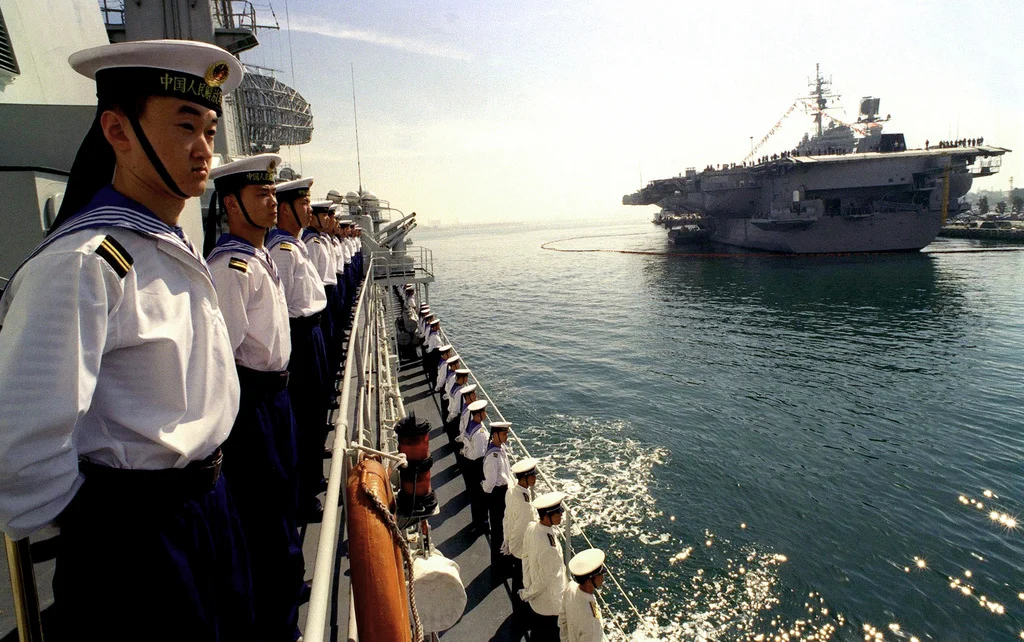
There is a neat contrast between the US Navy’s Great White Fleet of 1908 and the PLA Navy’s recent circumnavigations of Australia. Both were exercises in gunboat diplomacy. But one sailed into Sydney Harbour to cheering crowds; the other passed around the continent under a cloud of suspicion and domestic controversy. The contrast illustrates that the utility of gunboat diplomacy rests on its social reception. Where one port call reinforced trust and mutual assurance, the other operated as a coercive display intended to signal hierarchy rather than partnership.
Roosevelt’s Great White Fleet showcased American might, but it also cemented a partnership with Australia and built political support at home for naval spending. The symbolism was mutually reinforcing: a big stick, carried softly. China’s contemporary version is vastly different. When Chinese warships conduct live-fire drills under busy air routes, they maximise irritation and minimise attraction. They signal strength, but not suasion. Instead of building coalitions, they harden the resolve of existing ones.
The contrast is even starker when China’s unsafe operational behaviour is considered. On 4 March 2026, an Australian MH-60R helicopter launched from HMAS Toowoomba was intercepted by a PLA Navy helicopter in international waters of the Yellow Sea during UN sanctions enforcement operations. The Chinese helicopter matched the Australian aircraft’s altitude, closed to an unsafe distance, then accelerated ahead and “rolled towards” the Australian aircraft, forcing evasive action. This followed a May 2024 incident in which a PLA Air Force J-10 fighter released flares across the flight path of an Australian helicopter from HMAS Hobart, forcing the helicopter to perform evasive manoeuvres. These are not isolated events but patterns of reckless behaviour that undermine Beijing’s claims to responsible blue-water operations.
Middle Power or Merely Middling?
The question of whether Australia is a ‘serious middle power’ becomes substantive only when it is willing to enforce boundaries at sea rather than reinterpret coercion as misunderstanding or mistake, passivity for prudence. In the naval domain, enforcing boundaries does not mean keeping Chinese ships at arm’s length from our waters. It means setting and defending standards for all navies, including our own and allies, to behave: notification, safety protocols, respect for civilian traffic, and transparency about exercises that intersect with commercial routes.
Our posture risks incoherence: we assert our rights to operate in contested waters yet lapse into grievance when China exercises the same freedoms, object to lawful live‑fire drills, and then minimise unsafe conduct that is genuinely hazardous.
A serious middle‑power posture would do three things. First, it would treat the PLA Navy’s presence as confirmation that China values the same high‑seas freedoms Australia relies on and say so openly – including in multilateral forums – thereby strengthening, not diluting, our criticisms of unsafe conduct by tying Beijing more tightly to its own precedents. Second, it would invest in maritime power as practice, not just force structure: sustained naval engagement in the Indo-Pacific, regular port visits, training teams, coastguard cooperation, and maritime‑domain‑awareness projects that partners want. Third, it would use incidents to educate rather than alarm, levelling with the public that Chinese warships can lawfully operate near us just as ours do near them, that safety and communication standards will be enforced, and that the answer is not special pleading but a consistent rules‑based approach that protects our interests even when others are stronger.
If this is the age of gunboat diplomacy’s return, Australia has a choice. We can frame ourselves as a perennial victim, forever being pushed around and forever surprised when great powers act like great powers. Or we can take Xi’s words at face value and quietly cash in on the precedent. The PLA Navy’s blue-water presence is not going away. The question is whether Australia uses that reality to reinforce the norms that serve us – above all, the freedom to send our own ships, aircraft and submarines wherever international law permits. That requires confidence, not performative outrage, strategic patience, not reflexive indignation. Xi thought he was reminding Albanese of China’s strength. Inadvertently, he reminded us of our own options. A serious middle power would seize that opening and turn China’s quest for sea strength into an opportunity to grow Australian maritime power.
Dr Sean Andrews, CSC, is a retired Royal Australian Navy officer and maritime strategist, currently Senior Fellow at the Strategy, Statecraft and Technology – Changing Character of War Centre, Pembroke College, Oxford University. He has led Australia’s Sea Power Centre, commanded ADF operations in the Middle East, and publishes widely on Indo-Pacific sea power, maritime security, and the global oceanic order.
This article is published under a Creative Commons License and may be republished with attribution.