In an address to the Institute on Tuesday 30 September, long-standing peace activist and academic Professor Stuart Rees traced the measures taken ever since Israel’s establishment as a Jewish state to undermine any prospect of a separate Palestinian state.
He argued that public debate collapses nearly a century of Palestinian dispossession into a single word – “Hamas”. He traced a through-line from 1948 expulsions and village erasures to later “wars” which he described as asymmetrical “organised slaughter”. He described Hamas’s social-movement roots: Hamas had built on Muslim Brotherhood-linked welfare work in Gaza and had gained credibility by providing social services.
Rees suggested that more acknowledgements should be given to Hamas’s 2006 electoral win: he saw the continuing western condemnation of Hamas and the ensuing Israeli siege of Gaza as evidence that western democracies “only like democracy when it gets the result they want”. The siege, he added, trapped about 2.5 million people, roughly half of them children. He closed with a call for courage from governments, universities and the public, invoking the plea to “live to tell my story”.
In discussion with audience members, Rees urged putting Palestinian agency at the centre in any negotiations. On immediate protection mechanisms, he endorsed deploying a UN peace force and having Western navies escort humanitarian flotillas to Gaza. He likened inaction to watching a bully in a playground and emphasised that there is legal legitimacy to intervene, citing the 2005 Responsibility to Protect doctrine, the July 2024 ICJ advisory opinion finding the Israeli occupation illegal and calling for it to end, and the UN’s 1950 Uniting for Peace pathway when the Security Council is paralyzed. What’s missing, he concluded, is political courage.
Asked whether international peacekeepers and European naval escorts for humanitarian convoys might risk a wider war, Rees argued that intervention is necessary and legitimate to protect civilians, insisting that leaving decisions to the current US-Israel security nexus will not secure universal human rights: “there’s got to be intervention”, he said.
Report by Celestine Wang, AIIA NSW intern
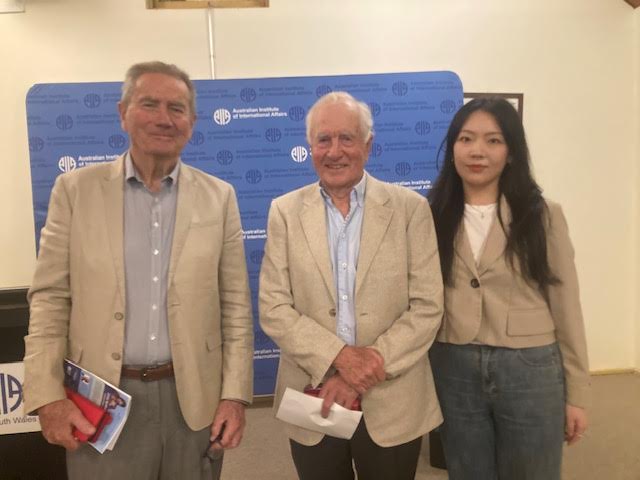
Professor Stuart Rees centre, AIIA NSW councillor Jeremy Webb left and intern Celestine Wang right.