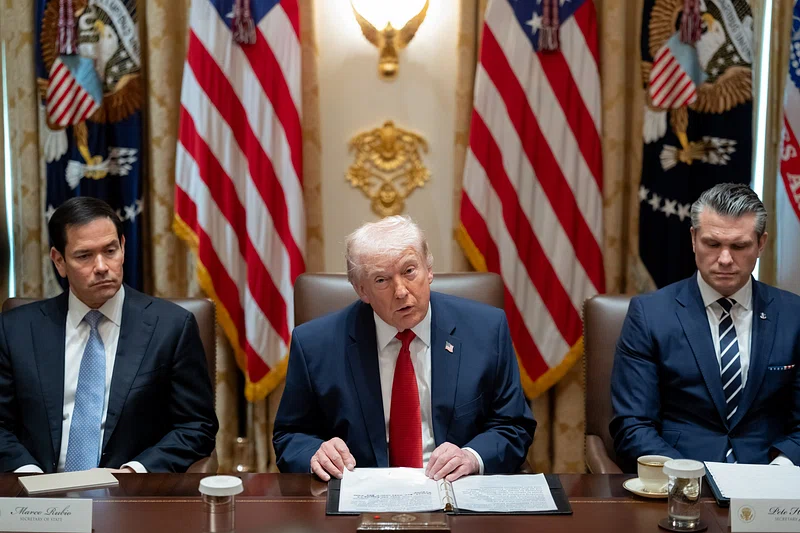
A New York Times article recently dubbed U.S. Secretary of State Marco Rubio the “de facto viceroy of Venezuela” on July 12th, adopting the term from what other officials have called him as well as his immense sway and control over the sovereign nation.
However, little has changed since January in the asymmetric power relationship between Venezuela and the United States. Control over Venezuela’s vast crude oil reserves, finances, trade legislation, as well as the leadership, was secured in the month after the operation, with President Trump stating in January that the U.S. intends to “run” Venezuela. Certainly, calling Rubio the viceroy of Venezuela is provocative, but it doesn’t grasp how Rubio’s growing influence and power in Venezuela reflect U.S. hegemonic decline. While, in the words of one commentator, the declared success of Venezuela’s U.S. global influence.
The point of departure with President Trump is not one based on U.S. hegemony, but on projecting U.S. strategic interests directly into the domestic politics of other states through bypassing the multilateral institutions that previously mediated such influence. What “America First” might really mean is that not only will the Trump Administration pursue a foreign policy that prioritises the current Republican Party’s policy goals, but further that all other countries must put America First as well.
Venezuela, the Bitter Fruit
There are two main reasons that make Venezuela a key turning point for how the Trump Administration is moving beyond hegemony as its dominant form of international relations and is instead relying on direct. The first reason is its success defined in terms of U.S. national interests in the Western Hemisphere reframed under the Trump Administration. The operation successfully deposed President Nicolás Maduro, replacing him with the Vice-President, Delcy Rodríguez, without extensive damage to the capital and minimal loss of lives.
The real success, however, lies in the growing bilateral relations between the U.S. and Venezuela, as well as the opening of Venezuela’s markets by modernising the energy sector infrastructure and increasing oil exports. In the span of a few months, the U.S. achieved a key objective of its 2025 National Security Strategy: expansion through “cultivating and strengthening new partners,” while bolstering the nation’s appeal as the Western Hemisphere’s “economic and security partner of choice”. U.S. hegemonic decline and the rise of China had created a choice for peripheries when choosing their key allies. Now, the Trump Administration is conscious of the consequences of decades of ignoring China and wants to reassert its “pre-eminence” in the Western Hemisphere.
Local Intermediaries & Influence
The second reason for why Venezuela highlights a change in U.S. foreign policy is its shift in the instruments of U.S. power projection. It might be argued that the U.S. has far superior technological and informational advantage when it comes to military intervention, and that this was the basis on which the U.S. succeeded in achieving strong diplomatic ties. This is only part of the picture; the other part is that the U.S. is using a well-documented strategy of binding to local intermediaries to manage its periphery. This tactic involves maintaining Venezuela’s nominal sovereignty: the U.S. actively monitors, issues threats of coercion, and, as Marco Rubio highlights, manages another state’s political and economic functions.
This is best exemplified by President Trump’s negotiating tactics with Delcy Rodríguez, threatening punishment, a “price bigger than Maduro”, or reward based on her compliance with U.S. interests. Aware of the consequences, Rodríguez followed through discussion with Marco Rubio in purging Mr Maduro’s family and business partners. Furthermore, controlling revenue from oil exports through U.S.-managed accounts is another strategy of controlling the economic autonomy of Venezuela. The implications of these are twofold: while stronger diplomatic ties have indeed been achieved through coercion and credible threats of punishment, the U.S. under the Trump Administration is showing that it is shifting from diplomacy and economic influence channelled through multilateral institutions (IMF, tariffs) toward creating stronger structural ties of dependency with states in its sphere of influence.
What Comes After Hegemony?
Why is the model used in Venezuela different, then, from what the U.S. has been doing under its hegemonic power? The U.S. has, throughout its post-WWII history, leveraged international organisations such as the IMF, NATO and the U.N. towards its own international interests through its hegemonic power. However, the strategy in Venezuela — deposing an incumbent government and leveraging successor leadership to ensure compliance with U.S. interests — differs from typical definitions of hegemony. Indeed, the model of binding world leaders and international organisations towards U.S. interests through direct coercion and structural leverage may very well become the norm.
Over weeks, the U.S. managed to effectively gain control over Venezuela’s domestic and foreign policy. After the intervention, China, Venezuela and even much of Latin America’s key partner of choice over the U.S. in the Western Hemisphere could do nothing as Venezuela’s economic relations with the republic faded into nothing. Trump’s imperial tactics in Venezuela created new structural sources of asymmetric power that prevent peripheries from cooperating with each other unless permitted. Asymmetric power does not simply denote the ability to make peripheries do what cores (China and the U.S.) want due to economic and military power imbalances, but instead it denotes diminishing peripheral autonomy through controlling local intermediaries, Rodríguez, through a core intermediary, Rubio.
Trump’s “America First” Rebrand
Furthermore, the Venezuelan model is informative, not because it is entirely new to the U.S. foreign policy toolkit, but because it is being rebranded under Trump’s “America First” policy. The Reagan and Clinton-Bush II era of military interventionism and unilateralism came with already declining U.S. economic hegemony that saw various uses of asymmetric power relations and military interventions with Panama, Afghanistan and Iraq. Various greater efforts to reinstate regional presence (in the Middle East) and economic dominance (against rising Europe and Japan) through unilateral state interventions. However, each intervention involved sustained military and political presence, worsening diplomatic relations, and failures to maintain economic and political stability. The Trump Administration is experiencing the same decline in hegemony as its predecessors, but what makes Venezuela a turning point is the effectiveness of the model and the complete control over Venezuela’s domestic and foreign policy. Whether the current regime and relations between the U.S. and Venezuela, even if called one of “empire to colony“, will remain stable is a question of time and the Administration’s management. What is clear, however, perhaps more in words, is that the U.S. under Trump will default to using coercion, as it did with Iran, and threats, as it did with Greenland, to get what it wants without needing to use its hegemonic dominance and maintain the rules-based order.
Peripheries no longer have the luxury of seeking out other allies and economic partners without consequences. Venezuela did that with China, and now President Trump is “running” Venezuela. Strategic and diplomatic realignment with Venezuela, through the re-establishment of U.S. pre-eminence in the Western Hemisphere, was deemed necessary; therefore, direct coercion was deployed to bring the Venezuelan government into alignment with U.S. interests. Whether this approach will be replicated elsewhere remains to be seen, but the structural logic is clear: as U.S. economic hegemony continues to erode and states increasingly seek partnerships with China, the Trump Administration appears willing to substitute institutional incentives with credible threats — and, as Venezuela demonstrates, with force. The question for the international system is not whether great powers will continue to shape the choices of smaller states — they will — but who will do so next, by what means, and whether the answer to those questions will be more or less legible than what is currently unfolding in Caracas.
Ali Ramezaniotaghvar is an undergraduate student at the Australian National University, studying a PhB (Humanities and Social Science) Honours, majoring in Political Science. He currently researches and studies American geopolitics, political philosophy and comparative politics. He currently interns as Assistant Editor to Australian Outlook at the Australian Institute of International Affairs.
This article is published under a Creative Commons License and may be republished with attribution.