After 26 years of negotiations, the EU’s Partnership Agreement with the South American bloc Mercosur (Argentina, Brazil, Paraguay, and Uruguay) was expected to be a geopolitical win for the European Commission. Instead, it turned out to be a test to overcome the EU’s institutional complexity, while exposing deep political divisions and hindering the EU’s trade agenda.
A long-anticipated partnership between the EU and Mercosur was signed on 17 January. Its negotiations began in 1999 as a counterbalance to the US’s bilateral engagement in the region. Its signature coincided with the US’ intervention in Venezuela (once a member of Mercosur but suspended in 2016), signalling two opposed approaches to international relations: the rule of power vs. the rules-based international order.
However, the conclusion of this Partnership is far from over. Only a few days after the high-level signing ceremony in Asunción, the European Parliament (EP), instead of voting to ratify the agreement, used its procedural powers to request an Opinion from the Court of Justice of the EU (CJEU) on its legality under the EU Treaties. The Parliament’s move puts the European Commission in a precarious political, if not legal, position.
Politics vs. Legality
The EU’s agreement with Mercosur was initially envisaged as an association agreement, establishing a special trade and political relationship with the partner country. These agreements are “mixed”, covering both exclusive EU competences and those shared with its Member States, and thus require ratification by the EP and by all Member States’ national parliaments. In addition, association agreements must be signed and concluded after approval by unanimous vote of the Council of Ministers, which comprises all EU Member States. In contrast, most other agreements require only qualified majority voting in the Council.
To overcome this procedural rule of unanimity, the Commission decided to split what would otherwise have been a single association agreement into two agreements along trade/political lines. The broader EU-Mercosur Partnership Agreement (EMPA), which establishes a framework for enhanced cooperation on political, human rights, security, and economic issues, is based on EU competences in development cooperation, as well as in economic, financial, and technical cooperation. The narrower interim Trade Agreement (ITA) covers trade provisions typically found in EU free trade agreements and is based on the EU’s exclusive competence in the Common Commercial Policy. The trade agreement could thus be applied quickly and later replaced by the EMPA, once it is ratified by all Member States, a process that can take up to a decade.
When Italy, which had initially opposed the agreement(s), came onboard due to last-minute concessions, the qualified majority in the Council was secured, approving the signature of the agreement(s) despite the strong opposition from France and several other Member States, namely Poland, Austria, Ireland, and Hungary (Belgium abstained).
The split of agreements was the Commission’s pragmatism in action. However, the CJEU will determine whether, in doing so, the Commission exceeded its powers under the EU Treaties. The Parliament’s motion requesting the Court’s Opinion could be seen as the rule of law in action – the core EU value, habitually invoked by the Commission. Nevertheless, the EP’s key rationale had more to do with politics than with law.
Euroscepticism vs. Geopolitics
Strong political opposition to the EU’s trade deal with Mercosur comes from both the right and the left. Member States that voted against it have been concerned about the disadvantages for their agricultural sector, particularly beef, stemming from the intensive agro-industrial model of Mercosur countries, which is largely supported by deforestation and lower social and environmental standards. Farmers across Europe have been protesting for months, fearing that cheaper South American imports could flood the market. Concerns of civil society groups relate to the trade agreement’s impact on climate change, particularly deforestation in the Brazilian Amazon.
On the other hand, the European Commission has been strongly pushing for the agreement, emphasising its economic, diplomatic and geopolitical importance. Covering almost 20% of global GDP and more than 700 million people, the agreement sends a clear message that rules-based trade and cooperation are preferred to tariffs and trade wars, even if some analysts claim the economic benefits may be limited. In addition, the signing of the agreement coincided with renewed US pressure on Europe, adding urgency to EU’s trade negotiation efforts. The EU’s engagement with Mercosur also seeks to counter Russia’s and China’s influence in the region.
To assuage the fears of stakeholders, the Commission strengthened the trade and sustainable development provisions, provided additional safeguard measures for agricultural products, and political concessions, including an early access to €45 billion for the Common Agricultural Policy from the next EU budget – a major win for the sector, whose funding reform is long overdue.
Legitimacy vs. Efficiency
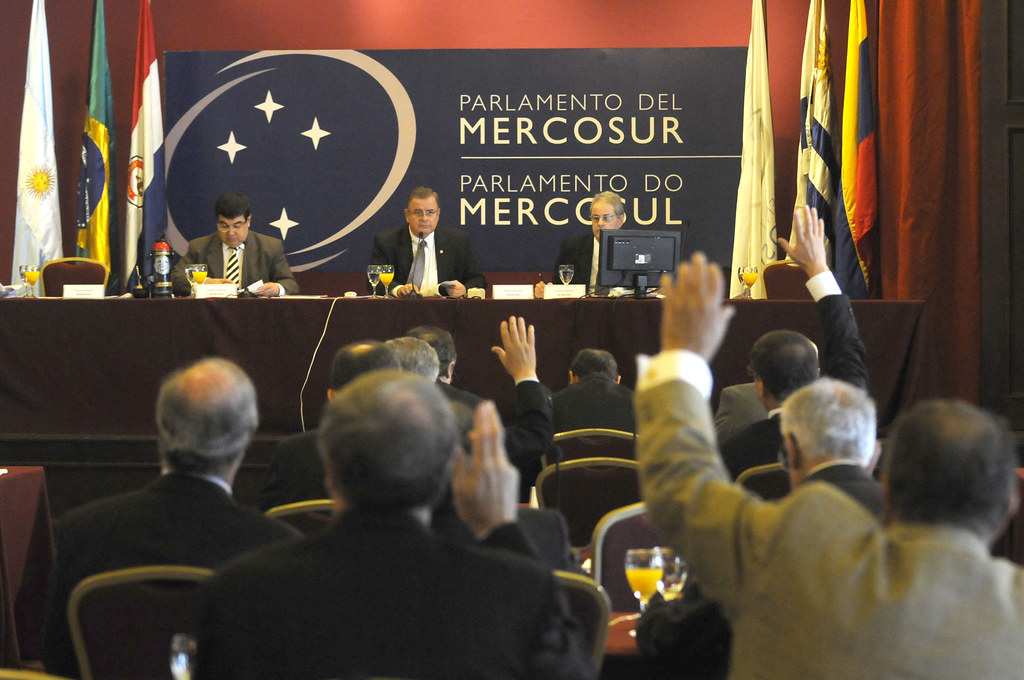
The European Parliament’s motion postpones the ratification of the agreement(s) until the Court’s decision, which can take up to two years. The motion was passed with a narrow majority (334 to 324, with 11 abstentions), secured thanks to votes cast in line with national politics rather than party positions.
Nevertheless, EU Treaties empower the Council to authorise the provisional application of an agreement concerning exclusive EU competences, without having to wait for Parliament’s ratification (or the CJEU’s opinion). Its Decisions authorising the signature of Mercosur agreement(s) refer to such provisional application. Accordingly, the trade agreement could enter into force once the first Mercosur State ratifies it. Among the EU Member States, Germany and Spain have been particularly in favour of advancing with provisional application. However, sidelining the European Parliament would be seen as a “democratic violation” that imposes the Commission’s agenda on national capitals and their citizens. It could provoke further tensions between Germany and France.
Disagreements are generally not about political matters but rather trade, which falls exclusively within the EU’s competence. However, tracing back to the 1999 negotiating mandate, confirmed in 2018, the Council envisaged that trade aspects of the agreement would be intrinsically linked to the political part in one single “mixed” agreement. To an outside observer, this confusing difference might seem trivial; however, the CJEU might disagree. On the other hand, provisional application of the trade agreement could place the Court before a fait accompli. It is the classic trade-off among legality, legitimacy, and efficiency in EU trade policy, now only in the mix with geopolitics.
What Are the Wider Implications?
The good news for Australia is that these legal questions will not come into play, as Australia’s FTA with the EU deals exclusively with trade, making it an EU-only agreement. This requires a qualified majority in the Council but would still need ratification by the European Parliament.
However, it is unclear what political consequences the Mercosur trouble could have for the ongoing EU-Australia trade agreements. Until the Mercosur agreement is out of the way, it will be more difficult to conclude an FTA with Australia – its main contentious issue also concerns beef quotas, albeit on a smaller scale compared to Mercosur’s 99,000 tonnes, which should nevertheless have a minimal impact on the EU’s beef market – roughly one steak per EU inhabitant per year. For now, the Commission does not appear to be backing off its agenda of completing trade negotiations with India; however, it is excluding the liberalisation of sensitive agricultural products (including beef) from that agreement.
The EU’s Mercosur saga exposes institutional power clashes, Member States’ political divisions, stakeholders’ diverse interests, and the difficulty of achieving compromise as overarching themes. It not only hinders the European Commission’s “geopolitical” ambitions but also calls into question the EU’s ability to function effectively when decisiveness is most needed. If the EU cannot do trade, what can it do?
Dr Ivana Damjanovic is Associate Professor of Law at the University of Canberra and Jean Monnet Research Fellow at the ANU Centre for European Studies.
This research is part of the Erasmus+ Programme of the European Commission: Project 101239183 – EUOzWorld – ERASMUS-JMO-2025-HEI-TECH-RSCH. The views expressed are solely those of the author and are independent of sources providing support.
This article is published under a Creative Commons License and may be republished with attribution.