Spain’s intelligence services saw the Ceuta surge coming and identified the social media groups driving it. The government’s fatal mistake was not speaking up in those spaces before scattered crossing attempts tipped into a massive crisis.
Between the 30th and 31st of July, more than 70,000 people crossed from Morocco into the small Spanish enclave of Ceuta, resulting in the deaths of dozens and continued tensions. However, the surge was not a surprise. As declassified documents would later reveal, Spain’s intelligence services detected the Ceuta surge before it happened. Recognising that scattered attempts to cross the border could arise quickly and become unmanageable, they had also warned Moroccan and Ceuta authorities of numerous social media groups encouraging the mass crossing a day prior.
Spain’s failure then was not one of foresight, but the absence of any decisive response in the digital spaces where the mobilisation was spreading and gaining momentum.
Crowds, like the ones in Ceuta, tend to stay dispersed and hesitant until a critical density fuelled by stimulus, in this case social media posts, is reached. At that point individuals and groups move almost at once, each for their own reasons. The window for an effective counter-messaging, however, closes well before that threshold, and it can only be used if the message reaches people where they are actually talking.
What Termites Might Reveal About Coordinated Action
To understand of how sporadic individual acts might turn into self-coordinated mass behaviour, a 1959 entomology study could provide an unexpected, yet helpful analogy. Pierre-Paul Grassé watched termite workers rebuild a nest after he placed them in an artificial environment. For the first few minutes, chaos. Workers glued pellets of earth wherever they happened to stand, abandoned half-built pillars, wandered off, groomed each other, started again somewhere else.
Grassé called this the ‘incoordination phase’, and it looked entirely random. Then, as the termites’ actions cumulated, he observed that rules guiding a shared pattern started emerging. Workers began building toward the same structure, in the same direction, not through any direct contact or central command system but instead through changes in their shared environment. He named the mechanism stigmergy. Each pellet placed in the environment became a stimulus that shaped how a worker acted and then, by leaving a trace marking a change in the shared environment, the same or next worker is instructed on how to proceed to the next logical action. So, the structure itself, not any individual termite, ended up indirectly coordinating the termites’ behaviour.
Of course, this does not mean to equate people to termites but rather provide a way for understanding how behavioural patterns emerge and adapt in seemingly chaotic and spontaneous security crises through shared environments.
In a security context, Professor Tony White, in his report to Canada’s Department of National Defence, highlights that stigmergic algorithms can help authorities manage decentralised control problems without relying on centralised command. For instance, a large number of drones flocking autonomously through an adversarial space and changing their position, speed and number which then serve as environmental signals for subsequent adaptive responses. Furthermore, Dr. Rodrigo Nieto-Gómez, from the Institute for Regional and International Security, discusses how stigmergic coordination plays out in the US-Mexico border by becoming a geopolitical ‘self-organising environment’; since actions by U.S. law enforcement push drug traffickers to devise newer and better smuggling methods, which in turn makes the drug supply chain more resilient.
However, the question remains, when does an un-coordinated movement turn into mass behaviour that is decentralised and self-organised? And how can authorities know when that line has been set or crossed?
The Threshold Between Apathy and Contagion
The question the Ceuta files implicitly raise is one Grassé had already tackled. How many workers does it take for randomness to give way to self-coordination? In his experiments, Grassé observed that small groups started slowly and abandoned their task before completing anything coherent.
Grassé found that the incapacity to build was due to insufficient social stimulation. Below a certain threshold, the insects grew apathetic, working in short discontinuous bursts with long gaps between them. Above this threshold, something he defined as ‘contagion of work’, he observed that the more workers were active, the more new workers joined. Each additional participant making participation easier for the same and next agent.
How Ceuta Crossed the Line
In late June and early July, irregular crossing attempts into Ceuta stayed in the single digits and low double digits most days, exactly the discontinuous, low-energy pattern Grassé described in his experiments. However, as more people started attempting to cross the border late July, intelligence officers recognised the emerging risk, stating them in official notes.
That mechanism behind the emerging risk is the one Grassé had already observed. He noticed that apathy is not a fixed condition but a function of how many agents are exposed to a stimulus. And the number of people willing to cross the border was growing fast.
One Facebook group carrying a following of one hundred sixty thousand users and a WhatsApp channel specifically created to excite users to the border crossing were adding many interactions. Each new post functioned the way each new pellet worked in Grassé’s experiment, a reinforcement trace that made the next act easier and more attractive for whoever encountered it, and was predisposed to react to it, which is how recommendation algorithms are designed for. The feedback loop spreads misinformation because highly engaged users like and share posts far more often, so the ranking rewards those highlights with greater visibility, and the added clicks and shares on those posts push moderate, truth-adjacent content down, ‘crowding out the truth’.
Once that online density crossed a threshold, which I call metamark, as a signal that something is changing in a shared digital environment, in my research on human stigmergy, contagion of work took over. The Guardia Civil’s numbers show that attempts to cross the border swimming had been steadily rising from 77 on July 23rd, 91 on July 24th, 162 on July 25th, 194 on July 26th, 242 on July 27th, 245 on July 28th before the peak of 468 on July 29th. This is when apathy gave way to contagion.
The Answer That Never Came
Authorities had access to the exact groups generating and stimulating the contagion. They named, counted and quoted them in their files. However, unlike the British police who acted decisively on social media to refute rumours during the August 2011 riots, Spanish officials did not enter those critical digital spaces with information or messaging of their own.
A traditional risk management approach of placing more patrol boats at the border cannot interrupt a contagion of work happening on a phone screen. Only timely, clear and authoritative messages placed inside the same channel, featuring the same force and emotional charge where the contagion is building, has any chance of countering it.
Spanish authorities had the chance to mitigate those risks, but they failed to act decisively in the same digital environment they had identified as scaling toward that critical mass. In these shared digital environments, authorities should monitor trends closely, prioritise posts with high engagement and respond swiftly and directly to debunk rumours. The excited youth predisposed to cross the border was responding to what the social media metamarks were signalling for them to participate in. Spain could have had a voice in that space but, inexplicably, never did.
Dr Marvin Starominski-Uehara teaches at Temple University Japan and researches emerging intelligence in complex systems. He is an interdisciplinary scholar, AI literacy consultant and the principal investigator of the Stigmergy Network Theory project. Marvin is a guest editor for an upcoming special issue of Interface Focus (Royal Society) titled ‘Metamarks and Collective Coordination Spanning Biology to Digital Society’. His research sits at the intersection of how individuals and organizations make decisions under uncertainty and what it takes to design conditions where genuine capability becomes visible. He is the creator of Trace Pedagogy and holds a Ph.D. in Risk Management and Public Policy from the University of Queensland and a Master’s in Public Administration with a certificate in Disaster Management and Humanitarian Assistance from the University of Hawaiʻi at Mānoa. He is an alumnus of the East-West Center. Marvin’s research findings, applications and insights have been featured in World Economic Forum, The Conversation, LSE Blogs, The Scholarly Kitchen, EDUCAUSE Review, The Diplomat, Society & AI, among others.
This article is published under a Creative Commons Licence and may be republished with attribution.
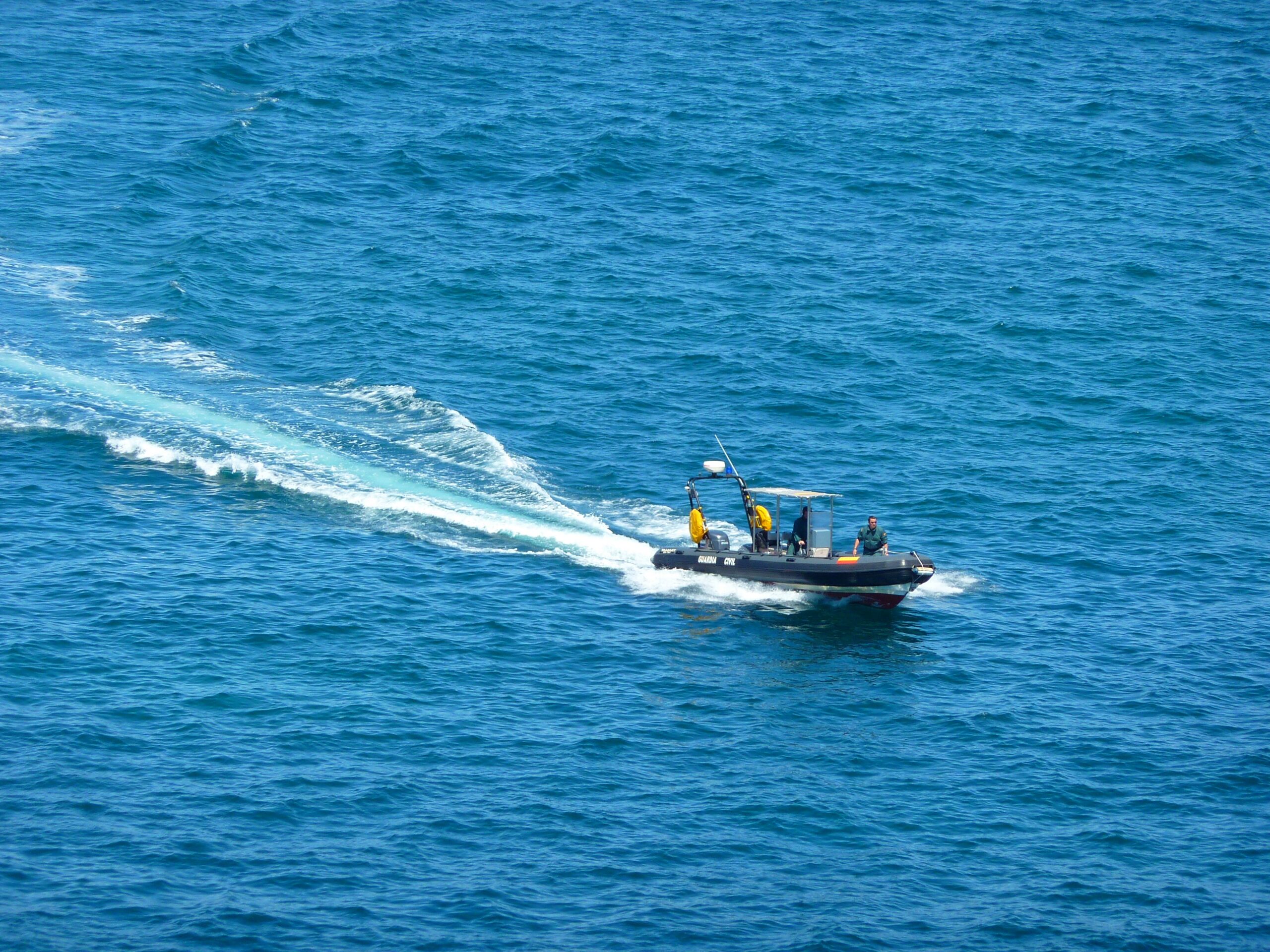
Photo: “Semirrígida del Servicio Marítimo de la Guardia Civil“, Wikimedia Commons (CC BY-SA 3.0)