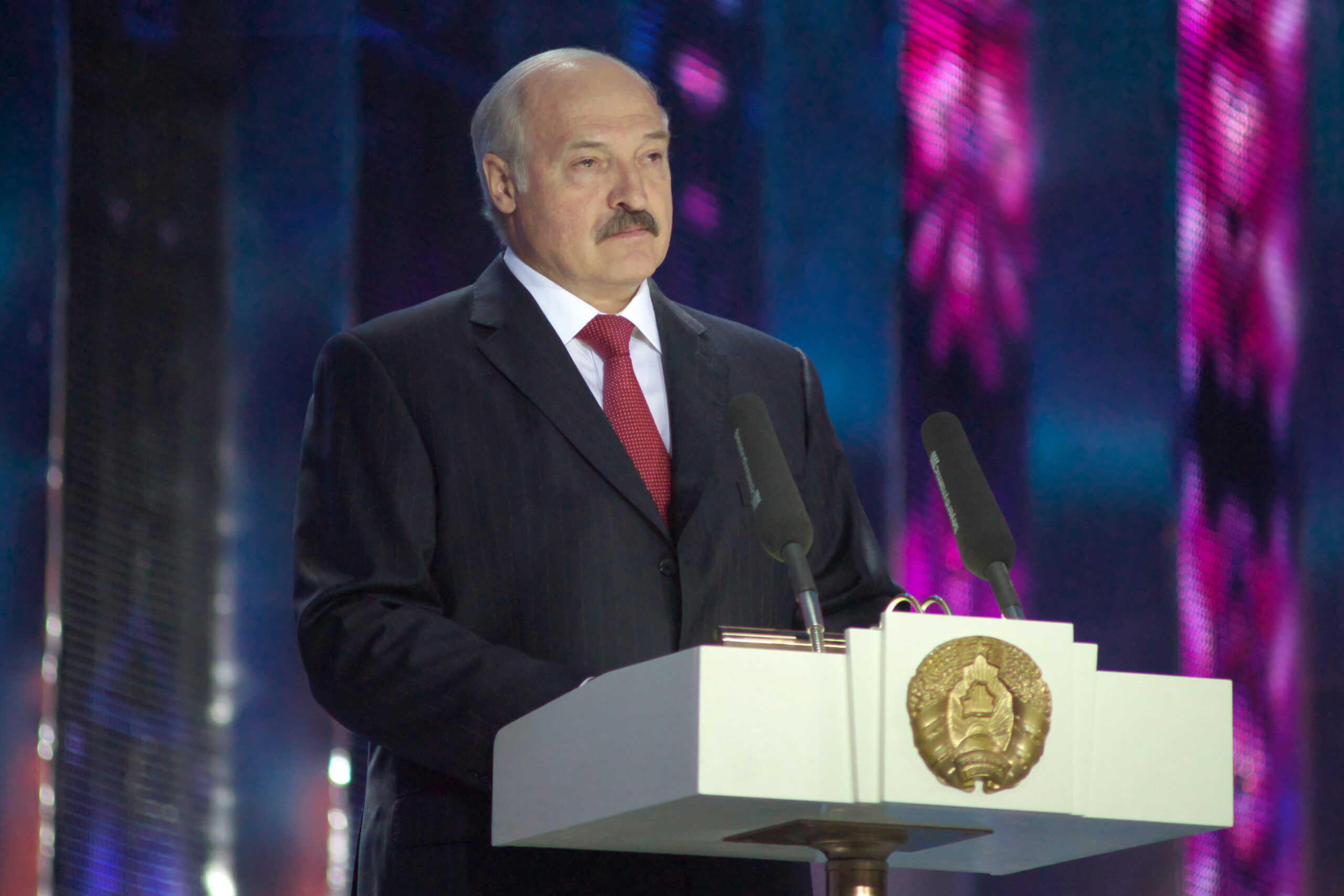
Alexander Lukashenko, who ruled Belarus for nearly 32 years through extremist state terror is now trapped by inescapable forces. Between his economic and military dependence on Moscow and the existential threats from his own population, he finds his survival at the mercy of factors beyond his clutch.
Belarus-Russian Relations
His cooperation with Russia has allowed his regime to prevail. However, doing business with Russia comes with costs.
Protest and claims of election fraud occurred after the 2020 presidential election that handed Lukashenko his seventh consecutive term. These challenges were countered with a sweeping violent crackdown on dissent. In response, the West imposed sanctions that forced Belarus to pivot toward Russia for energy subsidies and preferential loans. Its economic integration with Russia turned Belarus into a destination for massive Russian export absorption.
The West sees little use for Lukashenko as a back channel since he has turned his country into an extension of Putin’s grand strategy to rebuild the former Soviet empire. His vassalage compelled Emmanuel Macron to issue a warning over recent cooperative military maneuvers. Repercussions could mean additional economic and financial bans, and possible military retaliation.
The military operations that provoked Macron’s call include conducting joint Russian and Belarusian tactical nuclear weapons exercises and allowing Russia to use Belarusian communication towers to enhance the strike capabilities of drones inside Ukraine. Co-mingled with these threats are increasing efforts by Moscow to expand Belarus’s role in its hybrid war (non-kinetic operations) against Europe.
Lukashenko’s Choice
Reports are that over 80% of all Belarusian defense companies have been fully integrated into fulfilling Russia’s state defense orders and armaments programs. According to Ukrainian Intelligence, factories have been repurposed to bypass Western sanctions. Restricted technologies find their way into Russia through Belarusian facilities. There, repairs and modernisation retooling take place for damaged Russian armored vehicles, aircraft, and automated command systems.
At the same time, Lukashenko has steadily resisted committing Belarusian troops in the ground campaign. He understands, as does Moscow, that turning Belarus into a joint combatant could ignite domestic backlash and destabilise the regime. It is also reasonable to assume that if faced with options most Belarusian troops would likely defect instead of being used as fodder for Russia’s catastrophic war of attrition. Therefore, the decision to maintain Belarus as a secure support base rather than an unreliable ally in the field is a sign of Minsk and Moscow’s anxieties, not a mark of strength or confidence.
Since the manipulated election in 2020 approximately 5,000 Belarusian men have defected to Ukraine. They formed several combat units within the Ukrainian army. The Kalinouski Regiment is one such unit that is heavily armed and has its own recruitment and training structures.
With a mutinous military of some 50,000 active duty members and a restive population of 9 million, Lukashenko would need help from Moscow to survive. At this point, it is doubtful that Russia could muster enough reserves for an additional security force to quell internal unrest in Belarus. Equally questionable is whether Russia would be able to find enough personnel to support Belarusian troops in a ground war in Ukraine if a northern front were to open.
An insurrection against Lukashenko would be catastrophic for Minsk and Moscow. It could essentially create a second Ukraine war along Russia’s border. Such turn of events comes at a time when an already disastrous military campaign is severely overstretched for material resources and manpower. Russia’s own finance officials and lawmakers warned that the war has become unaffordable and unsustainable. An unstable Belarus would divert more precious resources away from the war in Ukraine and stress the current, tenuous equilibrium between Russia and Belarus.
Zelensky put his finger on the scale by formally hosting Sviatlana Tsikhanouskaya. Tsikhanouskaya is the Belarusian opposition leader. According to widespread consensus and accounts of independent observers, she won the 2020 presidential election. Her visit in May underscored Ukraine’s solidarity with the opposition by publicly drawing a line between the regime’s authority and the will of the Belarusian people.
Zelensky also appointed Yaroslav Chornohor as ambassador-at-large to act as envoy to the Belarusian democratic forces. The appointment creates an official channel between a sovereign Ukraine and the opposition movement within and outside Belarus. This is no mild riposte or symbolic gesture. It is a strategic move intended to hit a gaping vulnerability.
A New Power Configuration
Lukashenko has always been obsessed in ensuring domestic politics remain durable, foreseeable, and controllable. Yet by becoming Moscow’s “Governor of Minsk”, he has ceded control. As David Kirichenko and Alexander Motyl have rightly observed: “…the vassalage that brought Lukashenko stability and sustained his presidency now threatens to undermine him.”
Having lashed himself to Putin’s fate, he is consigned to waiting for events to unfold. Lukashenko and Putin’s fate are inextricably enmeshed. If one should fall, it is very likely the other will follow. The future for both presidents is unpredictable at best.
Lukashenko’s previous balancing act between Moscow and the West has long collapsed. Because of his growing economic dependence and entanglement with Putin’s war as a staging ground and platform for military industrial support, his future is not under his control.
He has often hinted at retirement. His latest insinuation was in August, 2025. But that might not be a decision for him to make alone. Putin cannot afford any further geopolitical volatility at his door step. Having seen Viktor Yanukovych, Bashar al-Assad, and Viktor Orban depart the field, Putin finds himself increasingly cut off from the West as Armenia, Kazakhstan, and Moldova pursue closer ties with the European Union. Sweden and Finland broke with their long-standing traditions of neutrality to join NATO. Poland and the Baltic states have significantly invested in hardening their eastern borders.
However, among the greatest disasters in Putin’s quest for empire is the transition of Russia into a vassal state of China. For Lukashenko, this could dispatch him to an even lesser status as the new feudal system east of NATO and the European Union takes form. Regardless of his conscience or consent, Lukashenko is subject to Putin’s political paranoia, dreaded fear of color revolutions and the humiliating miscalculation of his “special military operation” in Ukraine.
A metaphor for what awaits Putin and Lukashenko might be the final scene of Putin’s meeting with Xi Jinping in May. Despite his desperate need to strengthen ties with the PRC, Xi sent Putin back with no major agreements or accords, only photo ops and grand promises.
The coda to their meetings was a concert. The final piece – Tchaikovsky’s Swan Lake. In modern times, Swan Lake has become a symbol for political upheaval. During moments of national crisis its leitmotif plays and airs regularly. The ballet represents an ikon for impending political doom and a society waiting for change.
Considering the steep loss in blood and treasure of the war in Ukraine, do we ask; is there a Swan Lake in Putin’s and Lukashenko’s future? Was Xi giving us a wink and a nod?
Dr. Jack Jarmon served as USAID Technical Advisor for the Russian government during the mid 1990s. He has taught international relations at the University of Pennsylvania and Rutgers University where he was Associate Director and Research Professor at the Command Control and Interoperability Center for Advanced Data Analysis. He is currently editorial board member and contributor at PostPravda.info, a Ukrainian and Polish news organisation.
This article is published under a Creative Commons license and may be republished with attribution.