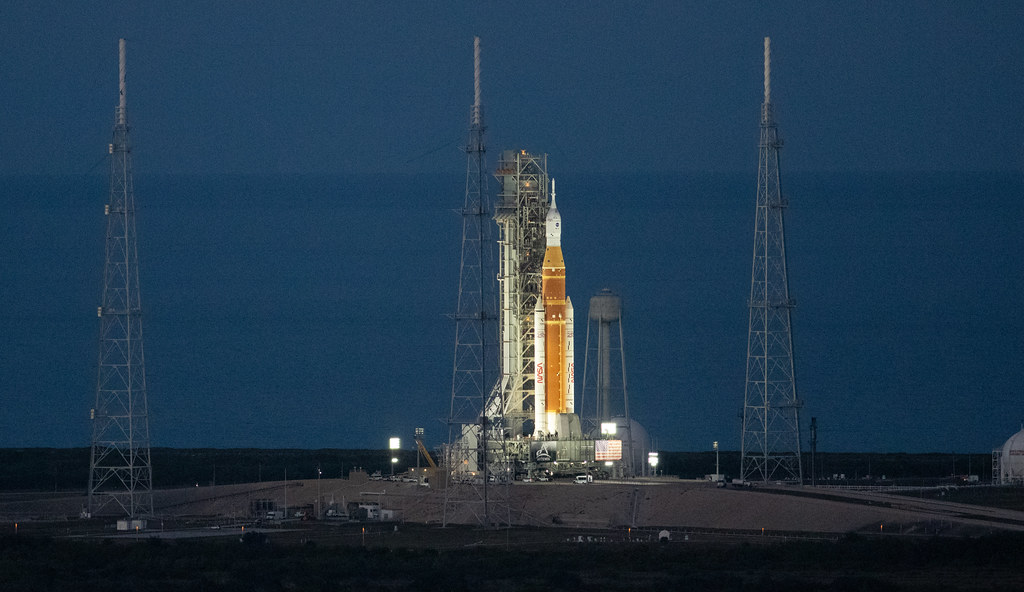
Artemis II has returned humans to deep space for the first time in fifty years — but the forces that brought us back are the same ones that kept us away. Until scientific discovery displaces geopolitics and profit, the next fifty years will look just like the last.
On April 1, 2026, NASA’s Artemis II mission launched from Kennedy Space Centre, sending four astronauts on a 10-day journey around the Moon. This is the first time since 1972 that humans have travelled beyond low Earth orbit. NASA Administrator Jared Isaacman said that the independent agency of the U.S government is “committed to achieving the near‑impossible once again, to return to the Moon before the end of President Trump’s term, build a Moon base, establish an enduring presence, and do the other things needed to ensure American leadership in space.”
But the real question is not why we are going back now — it is why it took more than 50 years to return at all. The answer is not a lack of technology or ambition — humans reached the Moon in 1969 with far less advanced systems, and plans for further lunar missions existed even before Apollo ended. Instead, the answer lies in something far more human: geopolitics.
“One Giant Leap” Was Never Just About Science
Space exploration has always been closely tied to geopolitics. During the Cold War, the United States and the Soviet Union competed for global influence across multiple domains: military, economic, and ideological. Space became one of the most visible stages for this competition. The launch of the world’s first artificial satellite, Sputnik, in 1957 signalled Soviet technological capability, while subsequent milestones such as the first human in orbit further intensified pressure on the United States to respond. The Apollo program must be understood in this context. It was a demonstration of national power and technological superiority. When Neil Armstrong stepped onto the Moon on July 20, 1969, he said, “That’s one small step for [a] man, one giant leap for mankind” These now-famous words marked more than a scientific milestone; they symbolised the culmination of a geopolitical contest
However, after the end of the Cold War and the collapse of the Soviet Union in 1991, the United States no longer faced a direct peer competitor in space, as in the earlier rivalry. In the final years of the Soviet Union, space activity declined sharply due to economic crisis and political instability, with launch rates falling significantly between 1989 and 1999.
The decline in interest in space exploration due to the lack of a ‘rival’ highlights a broader concern: that strategic interests are insufficient to sustain scientific enquiry.
Beyond Scientific Discovery
Following the end of the Cold War, the pattern of keeping knowledge on the periphery has taken different forms. This can be seen in the present-day space programmes, which focus on newer forms of economic and strategic agendas.
For instance, the Artemis Accords, a non-binding set of principles established in 2020 by NASA and the U.S. State Department, aim to set the rules for how countries operate in space. It explicitly supports the extraction and use of space resources and introduces mechanisms such as coordination systems and “safety zones” to manage activities.
“The Signatories note that the utilisation of space resources can benefit humankind by providing critical support for safe and sustainable operations,” Section 10 of the Artemis Accords states. These provisions point to a deeper objective: shaping governance, enabling economic activity, and securing strategic influence.
Similarly, China’s official space white paper makes it clear that exploration is only one part of a much broader agenda. The programme is described as a “critical element” of national strategy, linking space activities directly to economic development, technological advancement, and national security. Alongside scientific goals, it emphasises the expansion of space-based industries, the strengthening of state capabilities, and the enhancement of China’s global standing. This shows a similar pattern to that of the Apollo Accords; the space programme is primarily underpinned by interests other than curiosity and the expansion of human knowledge.
Moreover, private space companies frame their missions in ambitious, almost civilisational terms. SpaceX, founded by Elon Musk, focuses on ‘making humanity multiplanetary’ according to its mission statement, driven by lowering costs and scaling access to space through reusable technology. At the same time, its business model is heavily anchored in revenue-generating systems like Starlink, which now accounts for a large share of its income and global satellite infrastructure. Similarly, Blue Origin, founded by Jeff Bezos, presents its mission as building a ‘road to space’ so that ‘millions of people can live and work in space.’ Its activities, from space tourism to competing for lunar contracts, show a strong focus on developing commercial markets and infrastructure.
These examples show that space exploration is no longer a purely scientific endeavour but a domain shaped by overlapping state and market interests. Governments are using space to project power, set rules, and secure strategic advantages, while private companies are turning it into a site of economic expansion and technological competition. Scientific discovery still plays an important role, but it increasingly operates within these broader priorities.
These interests risk marginalising the curiosity-driven purpose, thereby gradually shifting the focus to commercial and strategic objectives. As history has shown from the Cold War-driven space programmes, this skewed purpose could slow overall technological advancement.
Long-Term Space Progress Depends on Prioritising Science
Sustained public funding is crucial if scientific discovery is to remain at the core of space exploration. Historical evidence shows that breakthroughs have relied on state investment rather than market incentives. The Apollo Programme, supported by unprecedented levels of U.S. government funding, led to significant advances in computing, engineering, and planetary science. At its peak in the 1960s, NASA’s budget reached nearly 4.5 per cent of the total US federal budget in 1965-1966, allowing it to pursue high-risk, long-term missions without immediate commercial gains. Although these investments were partly driven by Cold War competition with the Soviet Union, the scale of scientific progress achieved demonstrates that increased public spending can significantly expand the frontiers of exploration. This indicates that continuing government commitment to funding space research can lead to exponential technological advancements, which we may be missing out on due to a shift in priorities.
Advancing scientific knowledge requires stronger commitments to international collaboration and open data-sharing. While many countries, including the United States, Japan, and Canada, actively share space data through collaborative frameworks, this openness is structured around competing geopolitical blocs. The U.S.-led coalition, centred on the Artemis Accords, now includes over 60 countries such as the UK, Japan, India, and much of Europe, creating a large network aligned around shared norms and data-sharing practices. In contrast, China operates within a parallel network, working closely with Russia and a smaller group of partners. Moreover, the United States legally restricts direct cooperation between NASA and China under the Wolf Amendment, thereby limiting data sharing between the two major space powers. Research on international space cooperation has shown that competition between states can lead to secrecy, restricted data flows, and institutional distrust, all of which undermine effective collaboration. Thus, the reluctance of states to collaborate may put the brakes on collective technological advancement.
Ultimately, safeguarding the future of space exploration requires more than funding and collaboration; it calls for a return to the spirit that originally inspired it. When millions watched the Apollo 11 moon landing unfold, space was seen as a shared human achievement driven by curiosity and wonder. That moment captured a collective imagination that crossed national borders. Recreating that sense of purpose — in which exploration is motivated by the pursuit of knowledge rather than by strategic or commercial interests — is vital if space is to remain a domain that benefits all of humanity.
Akshit Tyagi is an intern at Australian Outlook at the Australian Institute of International Affairs. He is a postgraduate student in International Relations at the Australian National University, Canberra, and holds a Bachelor’s degree in Business Administration as well as a Postgraduate Diploma in Journalism. He previously worked as a business reporter in New Delhi and has written for The Canberra Times, Woroni (ANU student media), The Hill, and other publications.
This article is published under a Creative Commons License and may be republished with attribution.