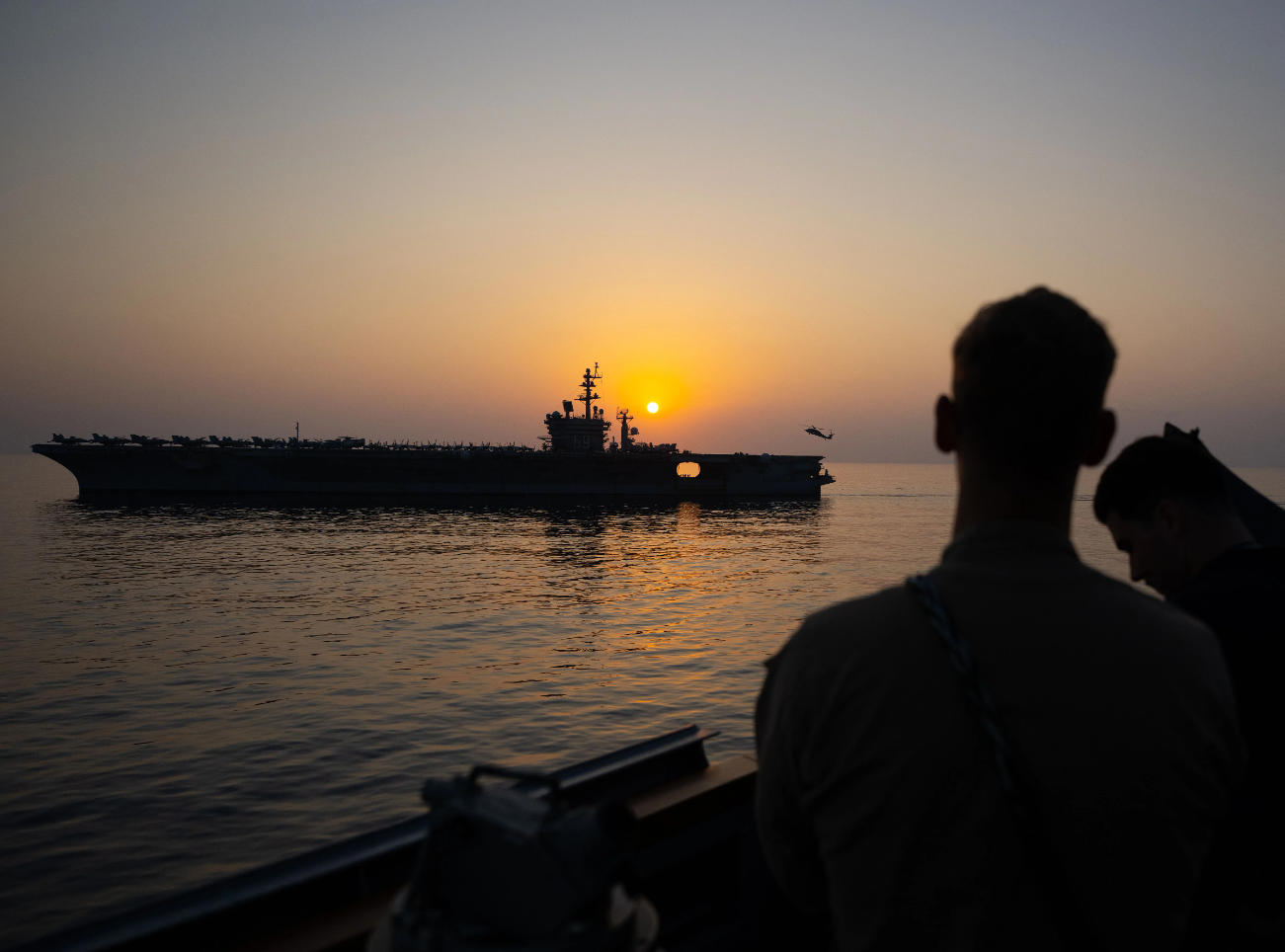
The disruption of Gulf and Red Sea routes is remaking the geography of energy and trade. Australia’s exposure is transmitted through Asian refineries, export markets and maritime networks, making the security of distant corridors a strategic concern for Canberra.
A tanker need not be bound for Australia to affect the price of diesel in Perth. Oil passing through the Strait of Hormuz feeds Asian refineries that supply Australian motorists, farms and freight operators. In 2025, around 20 million barrels of oil and products a day crossed the strait, about a quarter of seaborne oil trade; roughly 80 per cent went to Asia, according to the IEA chokepoint assessment. The 2026 Middle East conflict has turned that structural dependence into an immediate test of economic security.
The scale of the shock is no longer hypothetical. The IEA September assessment puts August 2026 Hormuz flows at 7.6 million barrels a day, 13.1 million below their pre-war level. Saudi Arabia and the United Arab Emirates increased shipments through Yanbu on the Red Sea and Fujairah on the Gulf of Oman, but combined exports from those outlets fell from a June high of 7.8 million barrels a day to 5.5 million in August. Attacks on the Saudi East–West pipeline in early September further constrained the bypass. Alternative capacity exists, but it is not equivalent to an open strait.
Nor is the Red Sea a frictionless escape route. Houthi attacks have exposed ships approaching Bab el-Mandeb, while diversions around Africa stretch voyages and tie up vessels. Even before this year’s escalation, UNCTAD reported that Suez Canal tonnage in May 2025 remained 70 per cent below its 2023 level. The IEA September oil report describes renewed attacks around both the Gulf and Bab el-Mandeb in 2026. A shipment rerouted away from one chokepoint may still face another; distance, insurance and port capacity become part of the security equation.
This is why Gulf states are revisiting the map. Pipelines to coasts outside Hormuz, Omani ports facing the Arabian Sea and proposed rail links to Mediterranean markets promise some redundancy. The India–Middle East–Europe Economic Corridor (IMEC), announced in 2023, is better understood as a framework for connecting projects than as an operational replacement for shipping. The Atlantic Council analysis notes progress on separate rail and port investments but also the need for cross-border customs coordination and political support. Geography alone cannot move cargo: a new corridor needs functioning infrastructure, commercial scale and dependable rules. Overland routes can supplement seaborne trade, not make maritime risk disappear.
For Australia, the most direct transmission channel runs through Asia. In a March interview with Sky News, Assistant Minister for Foreign Affairs and Trade Matt Thistlethwaite said that most imported Australian fuel came from South Korea and Singapore, even though much of the feedstock for their refineries passed through Hormuz. His distinction matters: the last port of loading is not the full supply-chain origin. A government that monitors only direct imports from the Gulf will miss its exposure to upstream crude, refining capacity and the availability of product tankers.
Australia also sits on the other side of the energy ledger. DFAT identifies Japan as a major buyer of Australian natural gas and South Korea as a major buyer of Australian energy and resources. A prolonged Gulf disruption can make Australian gas more valuable to Asian buyers, but it can also strain those partners’ industries, budgets and ability to supply refined fuel. Higher export prices are therefore not an unqualified national windfall. Australia’s prosperity depends not just on selling energy into Asia, but on an Asia capable of processing inputs, producing goods and sustaining demand.
The emerging strategic shift is from protecting individual routes to managing a network of dependencies. An extra pipeline outlet may reduce exposure to Hormuz while creating a concentration at a Red Sea terminal. A new Indian Ocean port may avoid two straits but still depend on rail, customs and insurance. Resilience should be judged by how a whole chain performs under simultaneous disruption, rather than by whether a route looks shorter or safer on a map. The present conflict demonstrates that markets can redistribute some oil, but the IEA finds those adjustments have required stock drawdowns, additional non-Gulf production and reduced demand.
First, Canberra should map the crude origins and chokepoint exposure behind its refined-fuel imports, not merely record the country from which each cargo sails. It should then stress-test prolonged interruptions to Hormuz and Bab el-Mandeb together, including effects on shipping capacity and Asian refinery output. Such testing would make stockholding, domestic distribution and emergency procurement decisions more realistic, without pretending that inventories alone can replace sustained imports.
Second, Canberra should turn its energy interdependence with Japan, Korea, Singapore and India into practical coordination: early warning of export restrictions, transparent information on refinery outages, and arrangements to keep essential cargo moving. Maritime diplomacy in the Indian Ocean should focus on navigational safety, information-sharing and commercial confidence, not on the mistaken assumption that Australia can secure distant corridors alone. Engagement with Gulf and Omani partners should distinguish credible operating capacity from projects that remain proposals.
The lesson is not that Australia should abandon trade through the Middle East, or choose a single new corridor to back. It is that Middle Eastern connectivity now shapes the cost and reliability of Australia’s Indo-Pacific economy. When one region’s oil must pass through a contested strait, another region’s refineries and Australia’s fuel consumers share the risk. Treating that interdependence as economic security is the starting point for a more durable response.
Abolfazl Hosseini Nik holds an M.A. in Political Science from Kharazmi University, with research interests in geopolitics, geoeconomics, economic corridors, and sustainable security and development in the Middle East. His work focuses on the strategic and political-economic implications of regional connectivity, trade corridors, and infrastructure competition. He has contributed analytical articles on Middle Eastern political economy and economic corridors to international and regional policy platforms.
This article is published under a Creative Commons Licence and may be republished with attribution.
Photo: “USS Dwight D. Eisenhower (CVN-69) in the Red Sea” by US Navy, United States Government Work (CC0)


_USS_Dwight_D._Eisenhower_(CVN-69)_Operation_Properity_Guardian_in_Red_Sea_8_January_2024.png)