The veto has paralysed the Security Council again and again, yet scrapping it is all but impossible. A more realistic path is to make sure no permanent member can cast one without consequence.
On Monday 28 September, the general debate of the 81st UN General Assembly officially concluded. One concerned featured repeatedly: the Security Council’s inability to act and the role of the veto in that paralysis. Malaysia’s foreign minister, Mohamad Hasan, stated it should be abolished. Brazil’s Luiz Inacio Lula da Silva opened the debate with deep indignation at how the “use of veto powers” and geopolitical paralysis had weakened the UN’s credibility. Their concern is understandable, yet abolition would need the consent of the very powers the veto protects, making it a weak basis for reform.
The veto is a 1945 bargain. When the winning powers of the Second World War built the UN, the permanent members, or P5, would only join a collective security system that could not be turned against them. Article 27 gave each the power to block any substantive resolution. Without that deal there may have been no organisation at all.
The price has been steep. P5 have repeatedly used the veto when a resolution cut across their own interests or those of their allies. The Council is meant to keep the peace, yet it can freeze when interests of permanent members are directly engaged. The vetoes can therefore hinder the peaceful resolution of conflicts.
The call for abolishing the veto is unwise and, in practice, impossible. The veto should remain, but its exercise must be accountable. As the Security Council’s ineffectiveness persists, states may increasingly turn to alternative multilateral platforms to advance cooperation. Initiatives outside the UN, such as the Partners for Multilateralism, launched by the European Union, together with Australia, Barbados, Brazil, Canada, India and Kenya, reflect broader efforts to strengthen multilateral cooperation and the UN-centred international order. Although the initiative does not specifically address veto power, its emergence underscores the need to make existing UN institutions more effective. Rather than allowing frustration with the Security Council to weaken the UN’s centrality, the P5 should justify each veto publicly and help mitigate its consequences, including increased humanitarian assistance.
At the same time, holding a veto does not make the P5 untouchable. A privilege this large is the best argument for more scrutiny, and the P5 are best placed to show what responsible leadership looks like. Adding on this, abolition is unrealistic, and it misses the actual problem. Under Article 108, any Charter amendment needs ratification by two-thirds of members, “including all the permanent members of the Security Council”.
The damage is worst when a state who is in the dispute also holds a veto power. In February 2022 Russia vetoed a draft resolution on its own invasion, with 11 votes in favour, one against and three abstentions. Eleven of fifteen Council members wanted action, and Russia stopped it. The harm comes from vetoes cast without anyone having to account for them.
The UN already has tools to build on. Article 27(3), which requires parties to a dispute to abstain from votes under Chapter VI and Article 27(3), has existed since 1945 but is rarely applied. Uniting for Peace, adopted in 1950 after Soviet vetoes on Korea, lets the Assembly act when the Council is blocked. In 1956, after Britain and France vetoed a draft on Israel’s withdrawal from Egypt, the Assembly used it to create the first armed UN peacekeeping force.
Since resolution 76/262 was adopted in 2022, the General Assembly is required to meet within ten working days when a veto is cast, and the vetoing state is given priority to explain its position before the wider membership. By November 2025, 17 vetoes had triggered 17 such meetings. Another followed in April 2026, after China and Russia vetoed a draft on the Strait of Hormuz.
These tools add scrutiny without removing the veto. However, if the Security Council continues to fall short of its mandate, states may increasingly pursue their interests through alternative multilateral platforms. Definitely, it risks gradual fragmentation of the UN-centred international order. Initiatives such as Partners for Multilateralism strengthen broader multilateral cooperation, but they do not directly address the accountability of permanent members for exercising their vetoes.
Reform works best inside existing institutions, and a power with special privileges has special responsibilities. The aid idea is a proposal and not established UN practice, but it follows the same ethic. Those who block action should help repair the damage.
The strongest objection is that accountability without consequences is weak. The 76/262 debates have produced no binding outcome, and Malaysia still wants abolition. That is fair. The current tools are limited, and a debate that changes nothing can become one more ritual.
Still, accountability can be strengthened step by step, for example by applying Article 27(3)’s abstention requirement more consistently in Chapter IV disputes involving the vetoing state itself. Finland’s President Alexander Stubb has called for single-state veto abolished, yet it also proposes suspending the voting rights of any member that breaks the Charter, which suggests even abolition’s backers are reaching for consequences. Making a state justify and offset its veto adds consequences that abolition would never deliver. The argument holds in most cases, though compensation remains a proposal, and the Assembly still cannot bind anyone.
The Security Council would keep its authority to impose sanctions and authorise force, and nobody would have to rewrite the Charter. The P5 would also get a chance to show what the word permanent is meant to stand for. Without that, the next General Assembly will bring the same speeches in the same hall. The aim should be to ensure that exercising the veto carries consequences beyond explanation alone.
Muhammad Izzuddin Al Haq is the Executive Director of World Order Lab, a youth-led think tank based in Jakarta. His research interest lies in global governance, covering debates on the UN and ASEAN affairs.
This article is published under a Creative Commons Licence and may be republished with attribution.
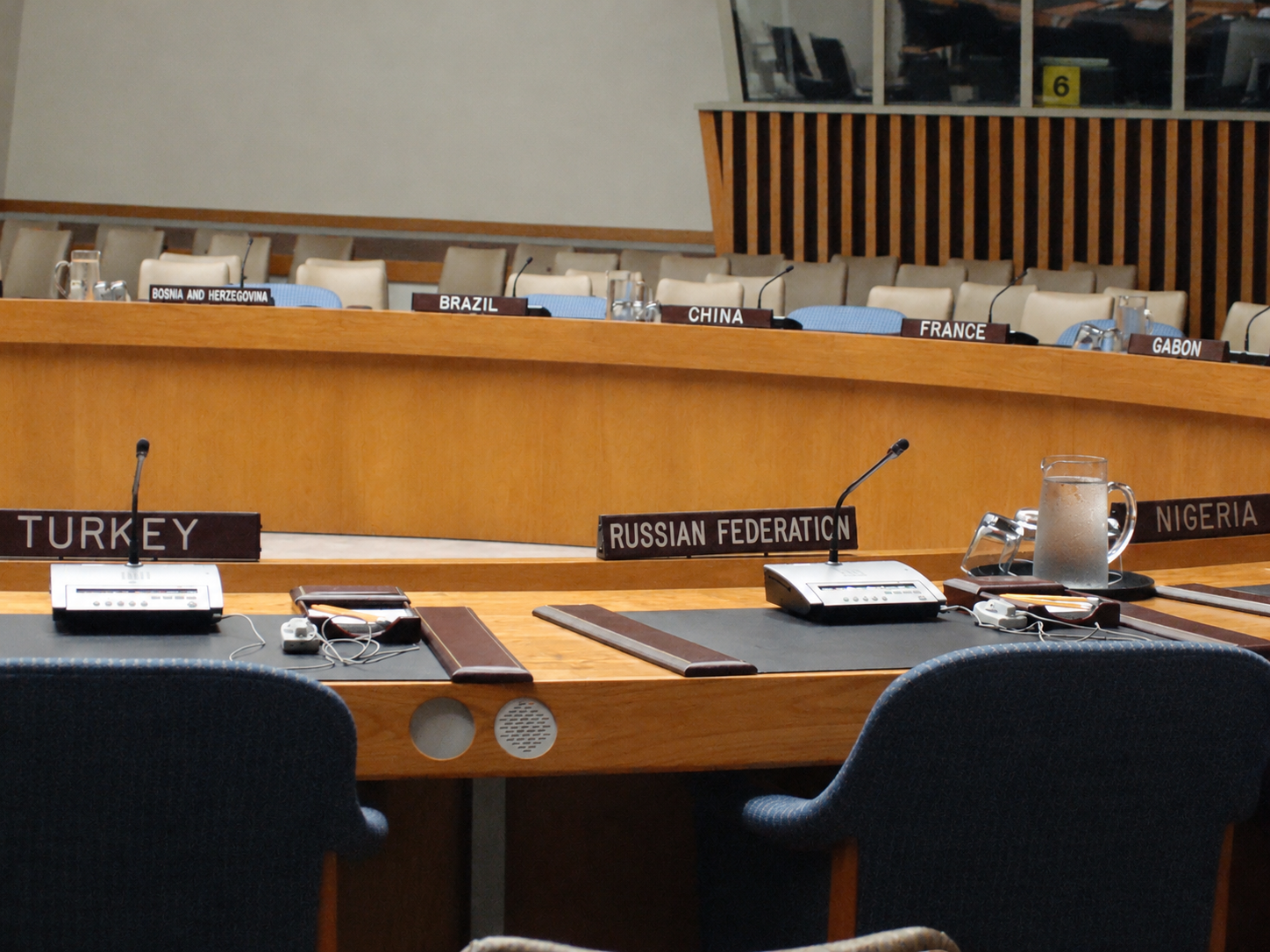
Photo: “inside the UN Security Council” by Matthew, CC BY-SA 2.0