By breaking away from rules, the United States seeks to leverage deep seabed mining beyond the accepted multilateral governance framework. To safeguard the common heritage of humankind, the international community must hold its ground to ensure that the rules-based international order remains intact against any unilateral actions.
A signature move of the Trump’s administration’s “America First” policy has been withdrawing the United States from international organisations and multilateral treaties. Similarly impactful is the trimming down of its financial contributions to the United Nations. The administration has also challenged parts of the rules-based international order it previously orchestrated with members of the international community. In this way, the US reduces some of its legal and financial commitments, while forcing other states to step up. Washington seems keen to re-shape the international order on its own terms to one that prioritises US national interests. What does this look like if the US breaks away further from the rules?
In maritime policy, the US has long remained outside one important part of the maritime legal framework: the United Nations Convention on the Law of the Sea (UNCLOS), known as the “constitution for the oceans.” At the same time, it justifies its actions as being aligned with the Convention or with customary international law. This may offer a glimpse of a new order it intends to create. By remaining outside a treaty regime, the US avoids treaty obligations and dispute-settlement areas that bind States Parties, although customary international law may still apply. For Washington, this is beneficial as it can promote its own national interests without constraint from international and multilateral treaties. How the US navigates this environment might offer some insights into what it seeks to benefit by not signing up to the UNCLOS.
In April 2025, Trump signed the Executive Order on Unleashing America’s Offshore Critical Minerals and Resources. Anchored on the Deep Seabed Hard Mineral Resources Act, this is a unilateral move that permits the exploitation of critical mineral resources found in the Area – referring to the seabed, ocean floor, and subsoil beyond any State’s national jurisdiction. It is in this maritime zone that deep seabed mining (DSM) activities are being explored, which involve retrieving mineral resources such as polymetallic nodules, cobalt-rich ferromanganese crusts, and polymetallic sulphide deposits found on the deep ocean floor. These contain valuable metals such as nickel, copper, and cobalt needed by various industries. Within the ambit of the Executive Order, Canadian-based The Metals Company (TMC), through its US subsidiary TMC USA, applied for a commercial recovery permit from the US National Oceanic and Atmospheric Administration. It expects to obtain the permit to start mining by 2027. This would move the US closer to commercial mining in the international seabed, which bypasses the UNCLOS-based multilateral governance framework. The question arises as to how such domestic legislation on DSM affects UNCLOS.
Regulating DSM falls under the mandate of the International Seabed Authority (ISA), established in 1994 under UNCLOS. Under this international law framework, the Area and its resources are considered the “common heritage of (hu)mankind,” whereby any activities must be carried out for the benefit of humankind as a whole, through an equitable sharing of financial and economic benefits. Therefore, any DSM activities must be approved via contracts from the ISA. So far, exploration contracts have been awarded to 22 contractors. No commercial contracts, also referred to as exploitation contracts, have been awarded yet as the ISA works to finalise the regulations. More than 40 states even call for a moratorium on DSM.
This generates a fundamental tension between the US domestic permitting regime and the UNCLOS-based international model. Whether the US can lawfully authoritise unilateral mining in the Area remains a disputed topic. Washington argues that, as a non-party to UNCLOS, it is not restrained by the Convention’s deep-seabed mining regime, while the ISA maintains that unilateral exploitation outside its framework violates international law.
This approach is consistent with the Trump’s administration’s broader “America First” policy. If TMC succeeds in finding a commercially viable way of doing business in the Area, other companies may follow suit. This sets a precedent that there is a greater gain in breaking away from the rules than by staying within the rulebook.
Given this context, the question for the State parties to UNCLOS is whether they can file a case against the US. As the US is not a party to UNCLOS, States Parties cannot simply bring it before the Seabed Disputes Chamber under the Convention’s compulsory dispute-settlement provisions. Any contentious case would require an independent basis for jurisdiction.
Without the limitations imposed by international rules, the US may be able to do more to promote its national interests. Nevertheless, the international community and individual states face a dilemma: either stay within the bounds of existing rules and defend them, or step outside them in the name of national interests.
Breaking away from the rules is a serious risk to take, especially when the common heritage of humankind is at stake. Whether the Executive Order is a fleeting policy under the current administration or not, the international community must hold its ground to ensure that the rules-based international order remains intact against any unilateral actions of deep seabed mining outside the multilateral model.
Alynna M. Carlos is a Master of Maritime Policy candidate at the University of Wollongong under the Australia Awards Maritime Security Scholarship Program. In 2025, she completed her master’s degree in International Studies from the University of the Philippines, where her thesis focused on minilateralism in the Sulu-Sulawesi Seas. She previously served at the Presidential Office for Maritime Concerns and also supported the work of the National Maritime Council of the Philippines.
This article is published under a Creative Commons Licence and may be republished with attribution.
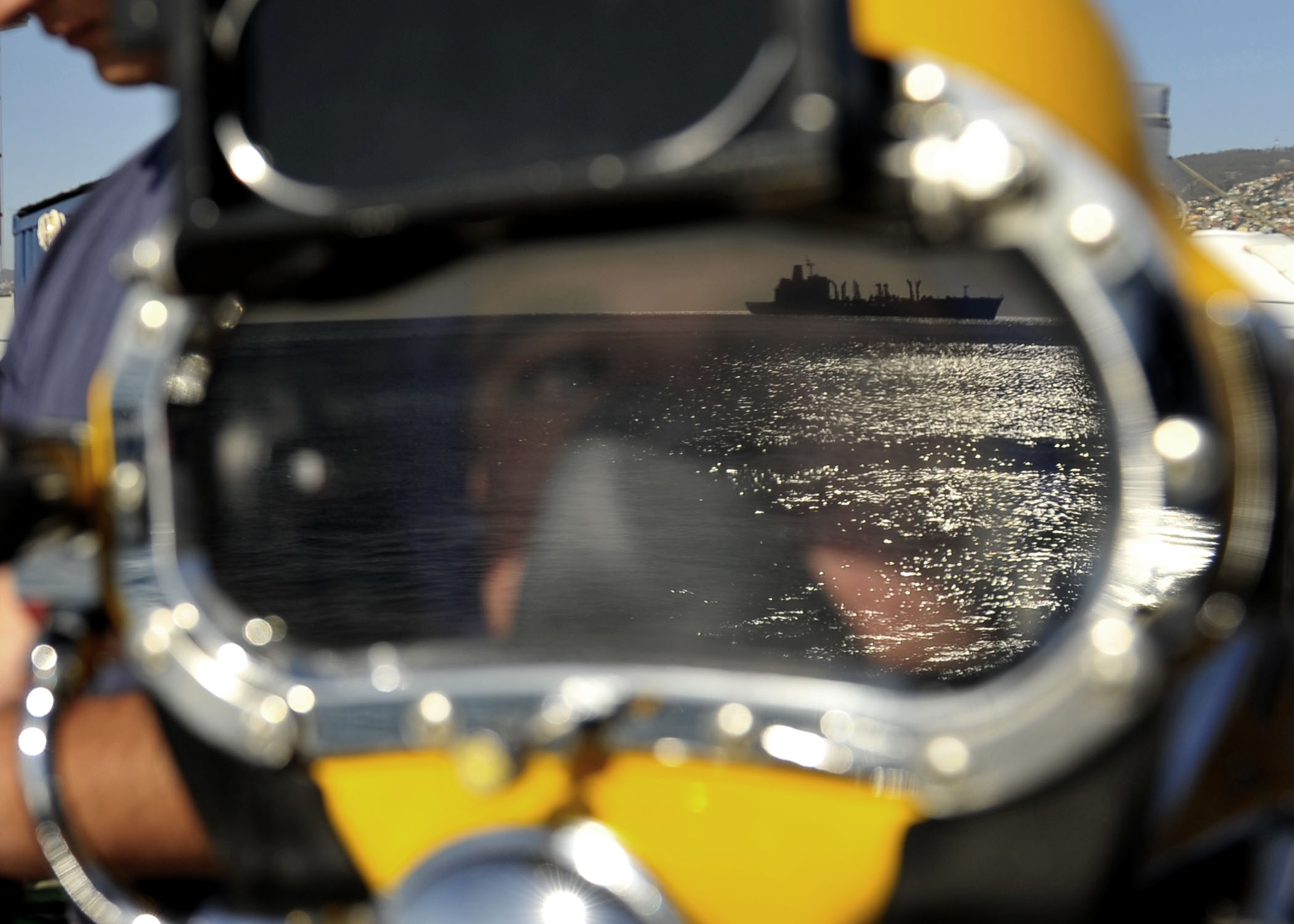
Photo: Mass Communication Specialist 2nd Class Gregory N. Juday, U.S. Navy photo (CC0)




.jpg)