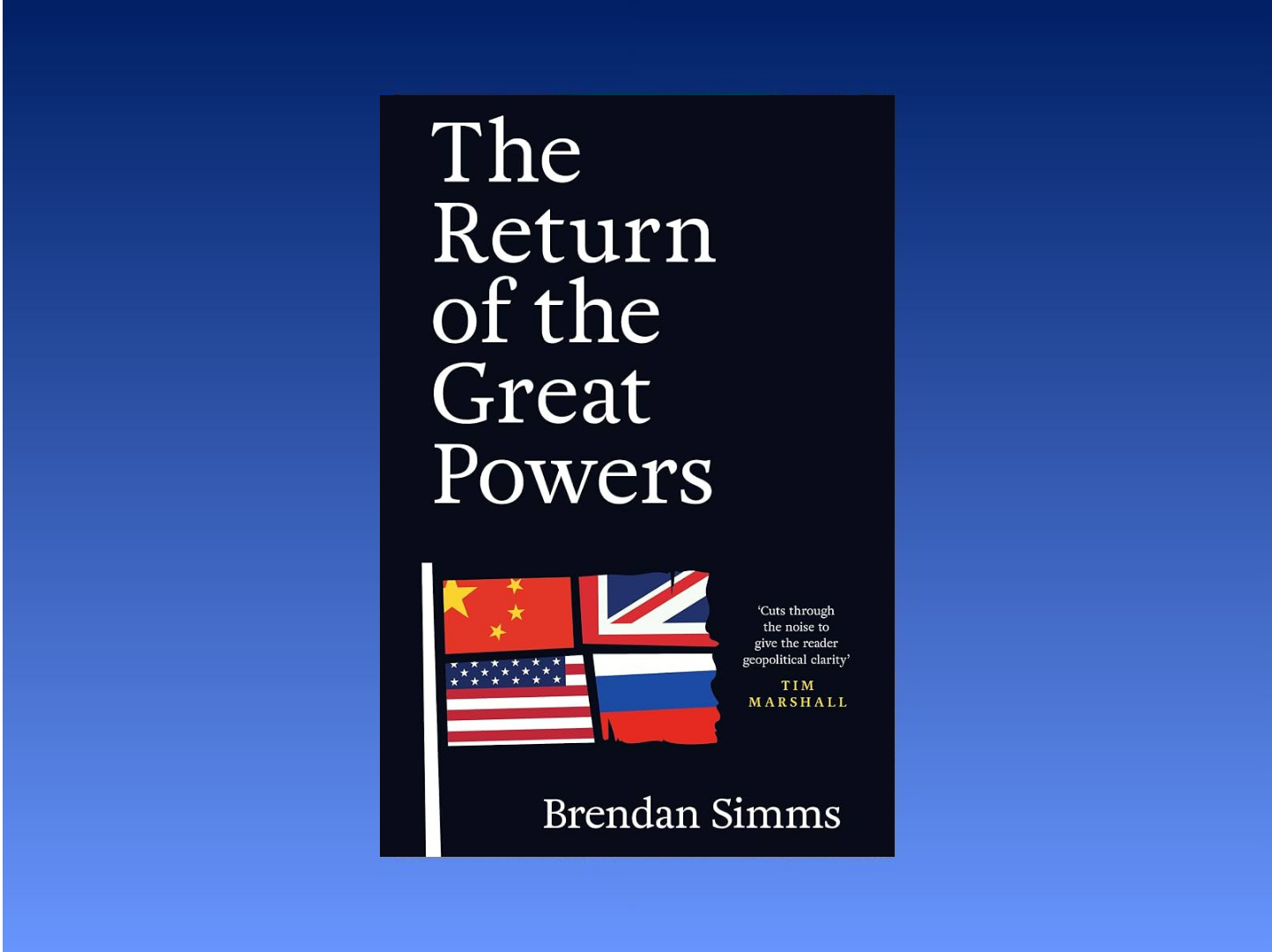
Brendan Simms’s The Return of the Great Powers arrives with an ambition matched by few recent works in the genre: a single-author sweep of five centuries of great-power competition.
International politics inherently constitutes an inquiry into the global distribution of power. Given that this distribution is not at equilibrium, states compete for the largest share of it, which in turn results in some states having more than others. When a state acquires system-shaping capabilities – such as setting norms in international institutions, controlling chokepoints, dictating the terms of engagement (whether in cooperation or in conflict) – and global norms and rules are considered according to that state’s preferences, that state becomes a great power in realist literature. History is full of evidence of how the states with such immense capabilities have shaped the global order for centuries. Professor Simms begins his most recent book, The Return of Great Powers (2026), at this juncture: history is shaped by great-power competition. Among the numerous works he has published, this one keeps the tradition of realism alive; it’s a chronicle of history viewed through the lens of great-power competition.
This book was set against the backdrop of the argument that the last few decades have produced no profound literature in this discipline. The book’s central claim is a diagnosis of post-Cold War ‘hollowness’ at the stage of great-power competition. For the Cambridge historian, the timeframe of 1989-2000 presented itself as an anomaly compared with the rest of history, a holiday from the great power rivalry. Simms goes after the three mainstream Cold War prognoses one by one: the realist expectation of NATO’s dissolution and balancing behaviour towards the sole hegemon at the time, the liberal triumph of Western democracy and the convergence on democratic capitalism, and the liberal-institutionalist faith in a self-enforcing rule-based order. He establishes very early in his pages that all three had failed (adamantly) in their diagnosis of the post-Cold War global order. He goes to great lengths to point out that liberal optimists across all three camps underestimate how much great-power rivalry shapes the global order.
In this book, to establish a parsimonious reading of the past great powers and the current contenders, Simms does not really define a great power; instead, he lays out a set of “characteristics with which they are associated, historically and today.” Great powers are not just regional hegemons; they are expected to shape the global order, value their sovereignty highly, and care little for others. In essence, they are not just rule-makers; they are the rule-breakers as well. It was truly profound to see the extent of Washington’s influence on the international order during the unipolar era. It was truly a great power. However, is the best assessment of post-Cold War development the way Simms presented it in this book? An argument could be made that, although the great power competition was absent during this time period, international politics was not all smooth sailing. Numerous unconventional wars and conflicts support this argument. Nonetheless, Professor Simms’ main contention in this work is that, to whatever extent the American hegemony and unipolarity existed, that era is over, and the validity of this claim is reestablished in hindsight of the war in Iran this year.
For the purpose of establishing great-power status, the book draws on four characteristics to determine the “superior capabilities” termed resource, reach, reputation, and resilience. He meticulously examines the case for each of the nine states in a dedicated chapter. It goes at great length to press and examine these four ‘R’ in each of the cases. While the United States and China clearly stand out, the case for Russia and, particularly, the United Kingdom is where the most scrutiny came. A Cambridge-based historian positioning the United Kingdom as a great power and France in an ‘almost’ category is a stark analytical distinction. The five other contenders listed as almost great powers are Japan, France, India, Germany, and the European Union collectively.
The effectiveness of Professor Simms’ work lies in its ability to let the actors speak for themselves until their defining characteristics converge, then he has to take the lead and make the argument on behalf of some states. One major point of contention among structural realist scholars concerns Simms’ argument that life under the American-led liberal international order has become risky for China and Russia. How great power emerges on the global stage is not necessarily the result of a declining hegemon or some structural changes in the global order; it’s not a causal factor for emergence but a consequence of the emergence of another great power.
As the title suggests, the book does not hesitate to call the present global order as it is: a rivalry between great powers. His scepticism towards the capabilities of middle powers and global power coordination to make a dent in the order is well noted among sceptics. The book is a page-turner because history is not a burden for Professor Simms. He tells a fabulous story about past great power competitions. It presents itself as a cautionary tale for the future global order, in which each state competes for dominance in its sphere. The manuscript went to the galleys before a war involving Iran reshaped the year’s geopolitics, a reminder that any ‘state of the world’ book is a photograph, not a film, however good the photographer.
This is a review of Brendon Simms‘ The Return of the Great Powers. John Murray Press, 2026. ISBN: 9781399816953
Nitish Kumar is an Assistant Professor at Munger University, Bihar. He is also a Senior Research Fellow at the School of International Studies, Jawaharlal Nehru University, New Delhi. His research interests focus on the strategic culture of revisionist great powers.
This article is published under a Creative Commons License and may be republished with attribution.