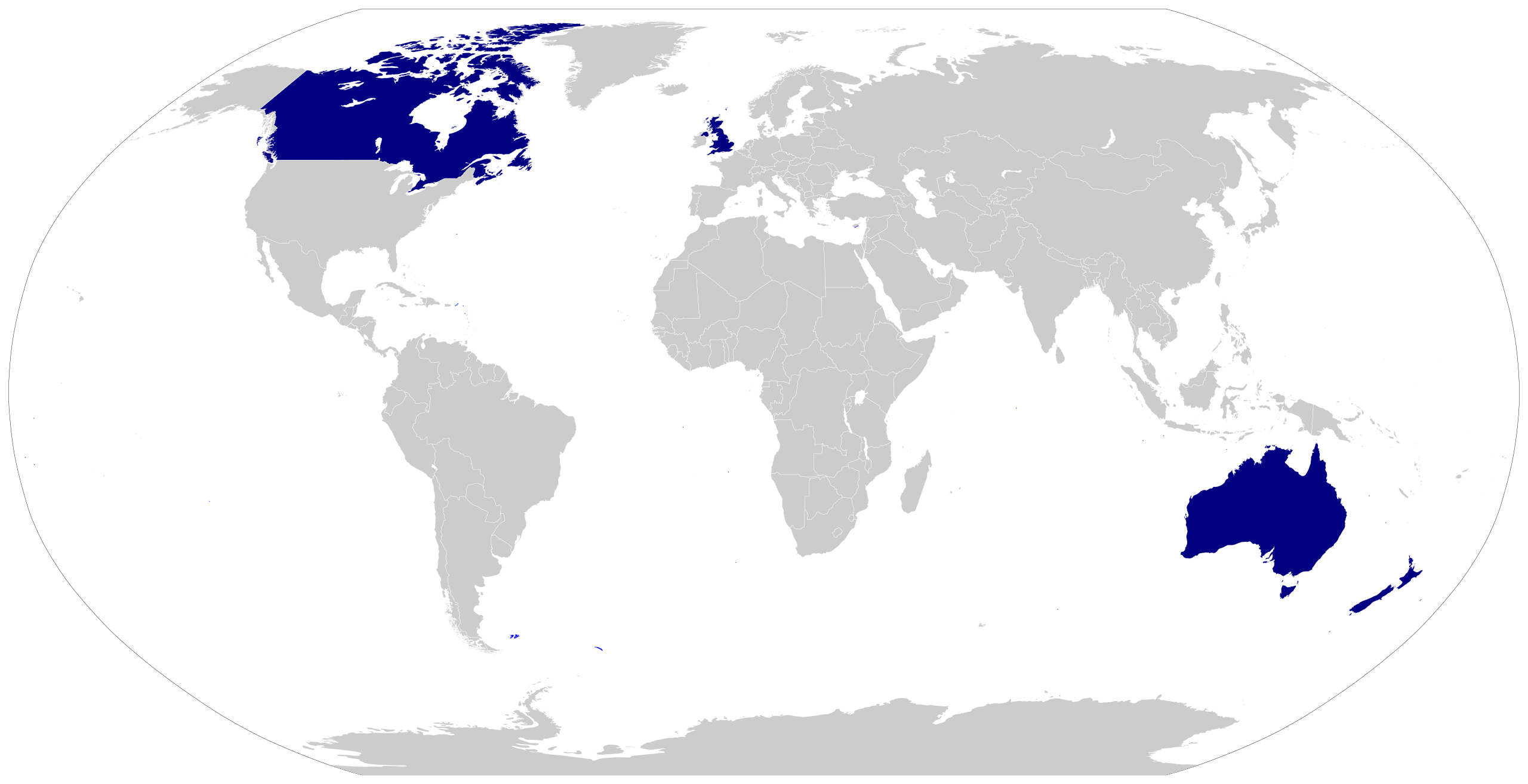
A much-publicised speech by Canadian Prime Minister Mark Carney at the 2026 World Economic Forum in Davos, as well as his recent visit to Australia, have highlighted the need for joint leadership by middle powers in a volatile world of rogue superpowers. Most like-minded nations, including Australia, agree that middle powers should play a greater collective role to protect their economic stability and prosperity, which are threatened by unregulated economic coercion and the erosion of rules-based order.
What institutional form might such coordination among middle powers take? Many participate jointly in free trade agreements, including the Comprehensive and Progressive Agreement for Trans-Pacific Partnership (CPTPP), which includes Canada and Australia, as well as New Zealand and, more recently, the UK, along with many Asia-Pacific countries.Thus, there is already a great deal of convergence among these nations regarding their interest in preserving economic openness and rules-based trade. However, this is not enough in today’s world, given the severity of economic nationalism, threats to global value chains (GVCs) and the global leadership vacuum.
What is necessary today is a genuine geo-economic partnership to help middle powers coordinate their foreign economic policies beyond trade, covering cognate policy areas essential for economic security. In other words, there needs to be geo-economic proofing to hedge against the powerful states threatening to undo decades of globalisation with coercive unilateral measures. A new geo-economic agreement among Canada, Australia, New Zealand, and the UK (CANZUK) could serve as a vehicle to achieve this. It would allow more robust collective responses to the reckless economic coercion exercised by the US under Donald Trump and send a strong signal to other nations, including China and those in the Global South, that economic nationalism is not inevitable and will be met with appropriately tough measures. In the words of Carney, ‘if you’re not at the table, you’re on the menu’.
What could such a geo-economic CANZUK look like?
For a working template, one could look at the first explicitly geo-economic agreement, the Indo-Pacific Economic Framework (IPEF), negotiated by the US under the presidency of Joe Biden in 2022. IPEF was intended to be the cornerstone of America’s Indo-Pacific strategy, and since it was signed,it has been largely dormant (although not repealed). It consists of 14 nations in the Indo-Pacific, including Australia and New Zealand. Importantly, it is not a traditional trade bloc and does not confer market access;instead focusing on economic resilience, the security of GVCs, the transition to clean energy, and fair, regulated commerce. It has a four-pillar structure, with Trade as one pillar (though never enacted). The other three are Supply Chains (enacted in 2024), Clean Economy and Fair Economy.
A similar-style CANZUK agreement could build on this template and address a host of related economic security and environmental issues. Focusing on jointly managing sustainable GVCs through a rules-based framework could help build resilience to external geo-economic shocks and manage vulnerability stemming from unilateral trade policies and economic coercion. It could help businesses and policymakers coordinate transnationally and work together to foolproof their early responses to various economic and security threats. CANZUK could be further used to coordinate various economic security measures, including nationalindustrial policies, to ensure they do not lead to old-school protectionism via export restrictions and ‘buy national’ requirements and are open to like-minded partners willing to play by the rules. CANZUK could also serve as a platform for coordinating security and defence across government procurement and technology trade, especially given that a great deal of intelligence sharing already occurs within the Five Eyes, which the four countries participate in.
Australia’s Leadership in Advancing CANZUK
Negotiating an IPEF-style agreement that is less deep and less domestically controversial than most FTAs should be feasible and face little opposition from powerful interest groups. Australia could play a leading role in this arrangement, given it is already a member of IPEF (along with New Zealand) and participates in the CPTPP with the other three CANZUK nations. It is also at the centre of other security-oriented partnerships, including the Quad and AUKUS, and has the right diplomatic resources to lead such efforts. CANZUK could be conceived as an open plurilateral agreement open to other interested parties, especially countries in the Asia-Pacific. Countries could choose which pillars to join and which to opt out of, and this institutional flexibility should make the agreement attractive, allowing for gradual policy learning. Even the EU, which is keen on engaging more deeply with the Indo-Pacific but lacks a coherent middle-power strategy, could become a party. The EU and Australia have not successfully negotiated a free trade deal so far (although the negotiations have been re-launched, and a more volatile geo-strategic environment changes the calculus).
To continue thriving amid global uncertainty, middle powers must cooperate geo-economically, but they do not need to reinvent the wheel. Building on the IPEF template could help CANZUK nations realise their joint leadership, and a new open plurilateral agreement could become the foundation of their collective strategy. It will improve resilience to external geo-economic shocks and translate a nebulous concept of middle powers into a more robust bulwark within the post-liberal order. Mark Carney’s diplomatic efforts show that the time is now ripe.
Evgeny Postnikov is Senior Lecturer in International Relations at The University of Melbourne. His interests revolve around international trade policy and politics, especially trade agreements and labour and environmental provisions. He has published widely on these topics and is the author of Social Standards in EU and US Trade Agreements (Routledge 2020). His most recent research, funded by the ARC, is on the politicisation of trade agreements.
This article is published under a Creative Commons License and may be republished with attribution.