On Tuesday 22 September, AIIA NSW hosted an engaging presentation from Madison Cartwright on the “new rules of globalisation”, shedding light on what is going on in the international economy. Currently senior geo-economics analyst at the Commonwealth Bank of Australia and a senior lecturer at USW, Dr Cartwright has previously researched and taught at universities across Australia and Canada.
Cartwright began with LSE economist Susan Strange’s model for structural power, where security, production, finance, and information allow powerful actors to shape and determine the rules of the global political economy, within which others must operate. Following WW2, the United States built an international economy which, despite some subsequent changes, placed itself at the epicentre. This, Cartwright observed, has been altered by change both in the global balance of power and in other countries’ preferences and priorities.
Shifting Preferences
As globalisation has facilitated a shift in the balance of power away from the US, there has been a bipartisan effort to transition US foreign policy towards being more unilateral, transactional, and zero sum. This has not been idiosyncratic to Trump, but rather began when President Obama blocked new judicial appointments to the Appellate Body of the World Trade Organisation in 2011. This block continued throughout Biden’s presidency, along with an expansion of Trump I’s tariffs and export controls. This shift from structural power to instrumental power (tariffs, sanctions) represents a renegotiation by the US of the system of free trade it had itself set up years earlier.
Equally, there have been shifts in China’s economic priorities. First, China’s ascendance as the world’s largest exporter and second-largest importer grew largely out of its role as the “global factory”, with broad-based dominance in its earlier days over manufacturing low-value-add “toys and trinkets”. China perceived that the US domestic manufacturing base emanated from powerful US companies’ ownership of intellectual property such as semi-conductor technology (increasingly centered in Taiwan). In response, China has massively increased its patenting and focused on more sophisticated goods and high-value-add services – most famously now in electric vehicles. The second priority shift has been China’s drive for self-sufficiency. More generally, the global economy has shifted away from globalised economic efficiency to economic security.
The Global Reserve Currency
Another important topic Cartwright explored was the future of the United States dollar as the global reserve currency. Cartwright’s view was that, while there is certainly a ‘de-dollarisation’ trend, this is motivated more by countries hedging against political risk, and that the USD remains the unquestionably supreme currency for trade, international payments, and global reserves. This is not just due to tradition but also to US’s deep capital markets, which facilitate liquidity at scale, and to the USD allowing investment in highly-profitable American companies. As it stands, Cartwright saw no serious alternative to the USD: the EUR lacks the capital depth and centralised decision-making to respond to a debt crisis, while gold and crypto currency are both unrealistic.
As for China’s RMB, Cartwright acknowledged China’s recent selling off of US Treasuries and increasing use of RMB to settle its trading, but contended that ultimately the RMB faces several critical issues. First, the Chinese government tightly controls the RMB and wants it to remain relatively low in value. Secondly, while the US operates at a trade deficit (giving global access to USD), China runs a trade surplus. China needs to continue to export to grow its economy, and accordingly it is – for now – reliant on the US market.
In response to a question on China’s goal of supporting its own economy, Cartwright posited that China is not aiming to redistribute wealth or rescue any sector, but rather to raise productivity, incomes, and in turn consumption, alongside large-scale deployment of advanced robotics to maintain and scale output.
Asked about the EU’s economic future. Cartwright observed that, faced with the withdrawal of the US as a secure military and trading partner, the EU aims to build autonomy. One part of this is to expand its domestic defence spending. Another is to mount a united response to the intense competition its domestic industry is facing against Chinese imports, including by expanding relationships with countries such as Canada. But diversifying from both the US and China is incredibly difficult, stymied further by complex intra-EU politics.
For now, the world is doing a delicate dance, and the players in a heavily interconnected global economic order are all slowly seeking to build domestic self-sufficiency and supply chain security.
Report by Michael Glover, AIIA NSW intern
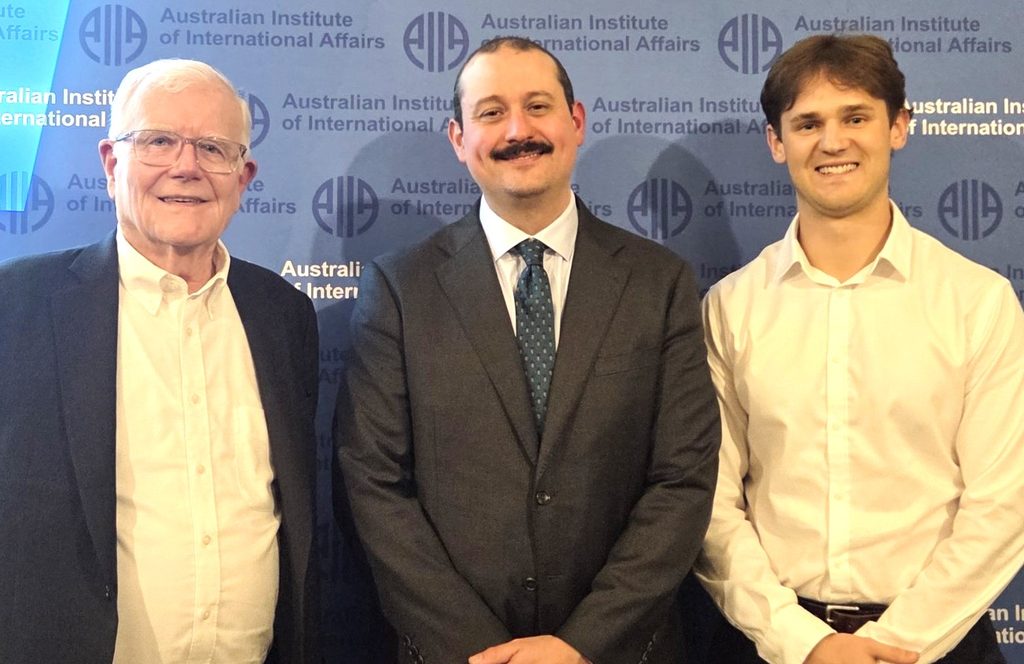
Speaker Madison Cartwright centre, AIIA NSW president Ian Lincoln left and AIIA NSW intern Michael Glover right.