On 4 August 2026, John West, economist and executive director of the Asian Century Institute, spoke to AIIA NSW about Australia’s relationship with the Philippines and the changing face of Philippine politics. A former senior official at both the OECD and Asian Development Bank, Mr West now resides in the Philippines.
West opened by noting the significance of the relationship between Australia and the Philippines. Having maintained relations for 80 years, the Philippines is one of Australia’s oldest friends, and the Filipino community is one of the largest migrant communities in Australia. In 2023, this relationship was elevated to a strategic partnership. West contextualised this within the Philippines’ wider shift towards becoming a middle power, having also strengthened ties with Canada, Japan, and India.
West focused on deepening military cooperation between the nations, including its implications for Australia’s ties with China. He pointed to the 2016 Arbitral Tribunal ruling, in which the Philippines rejected Beijing’s maritime claims in the South China Sea. Australia has expressed support for the decision, describing it as final and binding.
West grounded the Philippines’ changing role in the world order in the country’s political history. Once dismissed as the “sick man of Asia,” the Philippines officially became a democracy in 1986 following the overthrow of the Marcos regime. But West cautioned that the Philippines’ democracy remains flawed: it ranks 62nd of 167 on the Economist Intelligence Unit’s Democracy Index. The prevalence of dynastic politics partly constrains the nation’s capacity to function within the structures of a democracy. For example the current President, “Bongbong” Marcos, is the son of former dictator Ferdinand Marcos, whose years in power were marked by flagrant human rights abuses; and current Vice President Sara Duterte is the daughter of former President Rodrigo Duterte, who will face trial in the ICC later this year on charges of widespread brutality during his presidency.
Despite being Asia’s second largest economy in the 1950s, West noted that the Philippines today sits in the lower half of Asian economies; it has recently been overtaken by Vietnam in GDP. Remittances from the 10-12 million Filipino workers overseas are significant to the Philippine economy, making the country the world’s fourth-largest recipient of such remittances.
In discussion with the audience, West acknowledged the significance in Philippine domestic politics of Catholicism, which has, for example, negatively impacted access to birth control. An audience member then asked how Australia should sustain the relationship given the country’s entrenched corruption, which will be prominent in former President Duterte’s ICC trial. Here, West was pragmatic, arguing that, despite the Philippines’ internal turmoil, Australia’s priority should be to promote working-level cooperation. Asked how the ICC prosecution is viewed within the Philippines, West observed that many Filipinos disagree with Duterte being prosecuted before an international court.
A final audience question asked why dynastic politics have persisted despite democratisation. West pointed to the Philippines’ economic fundamentals, explaining that political dynasties in the Philippines rest in part on entrenched control over assets such as the nation’s sugarcane industry.
Report by Alexandra Kuo, AIIA NSW intern
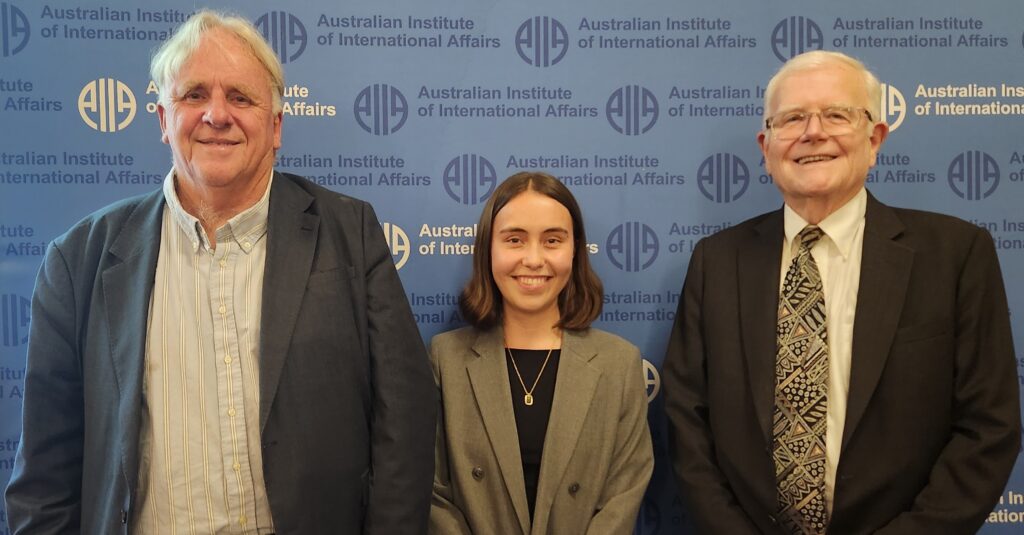
From left to right: John West, AIIA NSW intern Alexandra Kuo and AIIA NSW president Ian Lincoln