On 18 August at AIIA NSW, Jeremy Webb delivered “A Visitor’s View,” a reflection on his recent twelve-day visit to the Palestinian West Bank. Webb is a former diplomat with postings in Indonesia, South Korea, Paris and New Zealand, and a former journalist who wrote on economics for the Bulletin magazine. He now researches environmental economics at the Queensland University of Technology and contributes regularly to the blog Pearls and Irritations.
The presentation drew a full and engaged room, a sign of real appetite for understanding the conflict beyond remote, distant ceasefire negotiations; Webb offered something closer to the ground, an account of Palestinian life observed at close range.
Power, as Webb put it, is derived from the randomness of conflict, and that randomness operates as the instrument itself. Harm is designed to arrive unpredictably, and a population that cannot foresee when or where disruption will fall cannot plan around it, so daily life bends toward a permanent contingency that one side alone holds the power to decide. Roads close without warning and Israeli checkpoints severely disrupt Palestinian movement; one short journey he took had stretched by an hour and a half. Israeli police stand as security guards even at bus stops.
Among the people Webb met was a twenty-year-old Palestinian driver, seized and held for three months for posting criticism of Israel’s bombing campaign on Gaza, an imprisonment that treated his right to speak against a government as grounds for arrest. The young man recounted endless days of torture, describing the use of dogs and assaults by female IDF soldiers. Webb deplored the continuing global hesitation to name what is happening – to describe the crimes of genocide in Gaza and apartheid against Palestinians in plain terms.
The floor then opened to discussion, drawing Webb toward the longer arc of the conflict.
Asked how the conflict had changed over his years covering it, he replied that its ideological motivations have remained unchanged, and that what has shifted is the strength of Zionist institutions in public and political life – strength accumulated through financial and technological contribution.
Asked how Israelis regard Benjamin Netanyahu, Webb drew on conversations with Israeli university students. Their disapproval was personal, a judgement of the man whose policy toward Palestinians they nevertheless largely endorsed, underpinned by a settled perception that Palestinians were lesser and that the conflict after October 7 was fully justified as self preservation of the Jewish state.
On the prospect of a two-state solution, Webb noted that Palestinians felt strongly about its necessity while setting aside any reconciliation with Israeli negotiators. Their way of life has been so affronted, and their historical trauma runs so deep, that no such settlement can be simply achieved.
Webb’s account left the audience with a richer but more unsettling understanding of Palestinian lives. It was a visitor’s view, drawn from what he had seen.
Report by Mia Conway, AIIA NSW intern
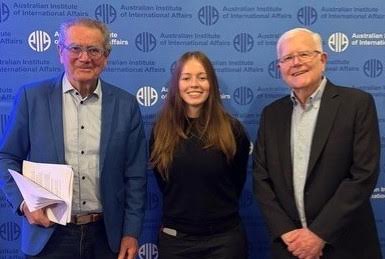
From left: Our speaker, Jeremy Webb, AIIA NSW intern Mia Conway and AIIA NSW president Ian Lincoln