Türkiye’s decision to join the US-led Artemis Accords comes just as its first home-grown lunar spacecraft enters testing. Rather than signalling a geopolitical realignment, the move fits Ankara’s wider strategy of using international partnerships to strengthen sovereign capability without tying its wider space ambitions to a single geopolitical choice.
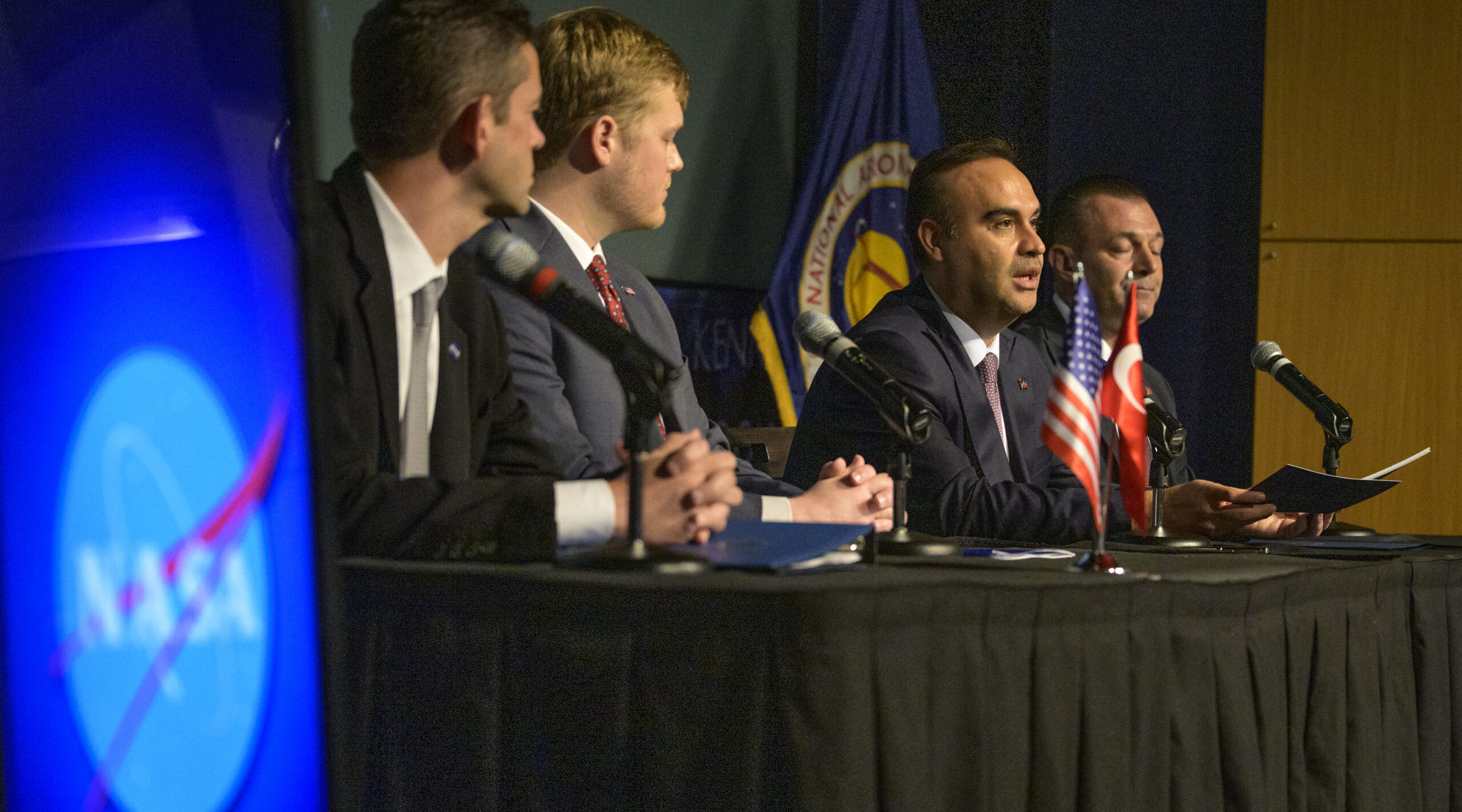
Türkiye became the 71st country to sign the Artemis Accords on 31 August. At first glance, joining the US-led framework for lunar exploration might look like a further step in Ankara’s alignment with Washington.
Two weeks later, however, Türkiye revealed what that choice really meant.
Industry and Technology Minister Mehmet Fatih Kacır announced that production, assembly and integration of AYAP-1, Türkiye’s first lunar mission, had been completed. The spacecraft has entered environmental testing ahead of a planned launch in early 2027. More than 80 per cent of it is domestically developed and produced, according to Kacır, including its software and hybrid propulsion system.
The timing is revealing. Signing the Artemis Accords does not make Türkiye a participant in NASA’s lunar missions; meanwhile, Ankara is building its own route to the Moon.
For now, those paths are fully compatible. The Accords do not prevent signatories from cooperating with non-signatories, and Türkiye has given no indication that joining the framework will constrain its other partnerships. The more interesting question is prospective: whether Artemis can remain attractive to strategically autonomous states if participation deepens into more concrete forms of lunar cooperation.
The attraction for Ankara is that these goals are not currently incompatible. The Accords may offer standards, scientific networks and opportunities for technical cooperation, while Türkiye continues to pursue localisation, strategic independence and home-grown capability through its own space program.
NASA has made participation potentially attractive. Artemis Accords signatories are increasingly offered opportunities to contribute to the emerging Moon Base through hardware, scientific payloads, technology demonstrations and other capabilities. Türkiye has already used US-led missions to build human-spaceflight experience: its first astronaut, Alper Gezeravcı, flew to the International Space Station on Axiom-3 in 2024.
At the 31 August signing ceremony, however, Ankara’s own explanation emphasised principles and cooperation rather than participation in a specific American lunar mission. Kacır highlighted transparency, data sharing and interoperability, saying Türkiye regarded accession ahead of its own lunar mission as a platform for taking international cooperation further.
That distinction is consequential. Cooperation is presented as a means of advancing Türkiye’s National Space Programme, not as a substitute for it.
The same logic is visible in Türkiye’s broader foreign policy. Only days after the Artemis signing, President Recep Tayyip Erdoğan returned from a Shanghai Cooperation Organisation summit with a clear vision that Türkiye could deepen relations with both West and East. Whereas Ankara continues to seek closer ties with an organisation whose members include China, Russia, India and Iran, Erdoğan insisted that this does not mean “turning our backs on the West”. His stated aim was a “360-degree vision” that increases Türkiye’s own geopolitical weight.
Artemis must be read through the same lens.
The apparent contradiction is precisely the point. Ankara can sign a US-led framework for lunar exploration while simultaneously insisting that its wider diplomatic and technological relationships remain its own choice. Artemis is useful to the extent that it expands Türkiye’s capabilities and influence. The test will come if deeper cooperation ever begins to create expectations about Ankara’s wider partnerships.
Türkiye has not joined the China–Russia-led International Lunar Research Station. Nor does signing the Artemis Accords require Ankara to align its wider space programme with Washington. The immediate domestic emphasis remains strongly focused on sovereign capability.
AYAP-1 will be Türkiye’s first deep-space mission. After reaching a 100-kilometre polar lunar orbit, the spacecraft is expected to conduct scientific observations before using its domestically developed hybrid propulsion system to descend towards the lunar surface. Kacır framed the mission as part of a wider drive for strategic independence and technological capability.
Türkiye is also developing a broader domestic space ecosystem. Ankara is planning a space-technology development zone involving the Turkish Space Agency, the country’s Scientific and Technical Research Council (TÜBİTAK) and Ankara’s Middle East Technical University. It is simultaneously pursuing a spaceport in Somalia, widely seen as a route towards independent access to space and a larger share of the global space economy.
That combination makes Türkiye a particularly useful test case for what the Artemis Accords are ultimately becoming.
The Accords were established in 2020 as principles covering peaceful activity, transparency, assistance, scientific-data sharing, interoperability and avoidance of harmful interference. With 72 signatories, the framework now includes states with very different strategic relationships with Washington. That makes Türkiye less an outlier than a test of how politically flexible Artemis can become.
That is important for Australia too. Canberra is deeply invested in Artemis and in the idea that common rules and principles can underpin safe, peaceful and sustainable lunar exploration. Its long-term interest is therefore not simply in adding more signatories but in ensuring that the framework remains attractive to capable partners whose foreign policies do not align automatically with Washington’s.
If Artemis evolves primarily into an extension of US geopolitical alignment, strategically autonomous partners such as Türkiye may resist being folded neatly into it. If instead it remains a framework to establish common rules and practical cooperation while allowing members considerable freedom over their wider relationships, its international reach may prove much more consequential.
For emerging space powers, that distinction is crucial. Cooperation matters most when it leaves stronger capabilities behind at home.
Artemis may offer Türkiye access to partners, knowledge and future opportunities for deeper lunar cooperation. AYAP-1, domestic propulsion and the ambition for independent launch access show what Ankara wants to retain at home.
Türkiye’s Artemis signature therefore says less about choosing Washington than about how Ankara sees space itself: another arena in which international partnerships can expand national options, provided the capabilities accumulated along the way remain Türkiye’s own.
Richard de Grijs is Professor of Physics and Astronomy at Macquarie University and former Executive Director of the International Space Science Institute–Beijing. He is a frequent media commentator on developments in international space programs, with a focus on the Asia–Pacific region.
This article is published under a Creative Commons License and may be republished with attribution.