Beijing’s new blockbuster casts the 1683 conquest of Taiwan as a preview of “unstoppable” unification—but the film has provoked backlash even among Chinese nationalists uneasy with its Qing-over-Ming framing. Taiwan should seize the opening with a film of its own: the story of Zheng Chenggong, a shared hero whose legacy lets Taiwan claim its history on its own terms.
The Battle of Penghu was planned for release in cinemas across mainland China on July 25. The historical war film dramatises the Qing navy’s 1683 victory over the Ming loyalist regime that ruled Taiwan, a defeat that brought the island under Qing control for the next two centuries. Every part of this film’s release draws a line from that conquest to Taiwan today, and asks audiences to read 1683 as a preview of Taiwan’s future. The analogy strains under its own weight, and Taiwan has a stronger story to tell about its place in Chinese history.
Twenty-one years before the Battle of Penghu, Zheng Chenggong, a celebrated military general, drove a European colonial power off the island, resisted foreign subjugation until his death, and introduced Han settlement, agriculture, and Confucian learning to Taiwan. A Taiwanese film about him would allow Taiwan to frame itself on its own terms, in a language that mainland audiences recognise as well.
Beijing’s 1683 Analogy and Why It Fails
The Battle of Penghu was released with a deliberate political calendar behind it. On October 25, 2025, the 80th anniversary of Taiwan’s retrocession from Japan, China Central Television released the first trailer. The film portrays the Qing’s conquest of Taiwan through the story of its naval commander, Shi Lang. A former Ming loyalist, Shi Lang defected to the Qing and led their Fujian naval fleet across the strait. His victory forced the Ming loyalist regime to surrender the island. The July 25 release date marks the outbreak of the First Sino-Japanese War, which ended with China ceding Taiwan to Japan. The trailer closes on the line that unifying Taiwan is “unstoppable,” and casts the Zheng regime as a faction “dividing territory and pursuing independence by force.”
Since the release of the trailer, the film has sparked fierce controversy among the very audience it was made for. The story asks Han Chinese viewers to identify with Manchu armies defeating the last major Han Chinese regime and its Ming remnants, and to view this as separatism. Han Chinese audiences have not accepted the framing. Popular memory casts the Qing conquest alongside massacres, the forced queue order, and the suppression of Han culture, while the Ming loyalists stand as the side that resisted foreign subjugation and protected Chinese culture. Criticism has spread across Chinese social media, and it has come from within the People’s Liberation Army itself. Xu Yan, a major general and professor at the National Defence University, has argued that Shi Lang is the wrong figure for Beijing to elevate. Shi Lang switched between the Ming and the Qing several times before finally turning to the Qing, and elevating a figure like this, Xu warned, “can only harm moral values.” He further argued that “‘independence’ and ‘separatism’ are concepts of sovereignty that only emerged after the formation of the modern nation state,” and forcing them onto the 17th century “provides historical grounds for the independence movement” in Taiwan today.
Taiwan Has a Better Story to Tell
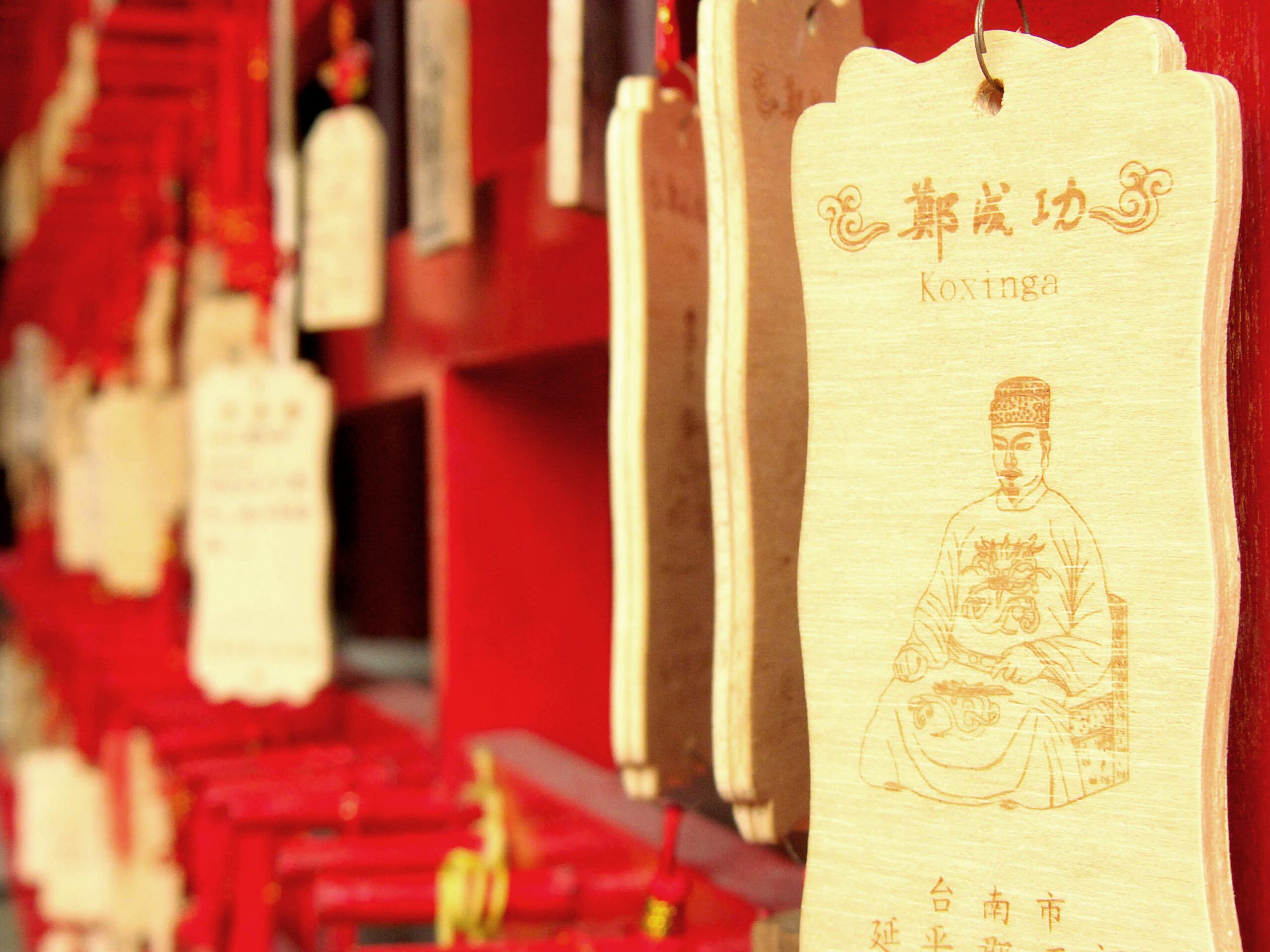
This backlash gives Taiwan an opportunity to respond with a film of its own about Zheng Chenggong, or Koxinga, the Ming loyalist commander who expelled the Dutch from Taiwan in 1662 and remained devoted to Ming restoration until his death. A well-made Taiwanese film about him would achieve two things at once. It would let Taiwan present itself as a legitimate heir of Chinese civilisation while staying distinct from Beijing’s narrative. And by speaking to mainland audiences who already call for greater recognition of Zheng Chenggong’s legacy, it would help those audiences see Taiwan’s position through sympathetic eyes.
The opportunity belongs particularly to the Kuomintang (KMT) under its new chairwoman, Cheng Li-wun. At her meeting with Xi Jinping in Beijing on 10 April, she stated that “people on both sides of the Strait are all descendants of Yan and Huang, all belong to the Chinese nation, all have been shaped by Chinese culture, and all are one family.” Zheng Chenggong is the strongest illustration of what that claim can mean. He drove a European colonial power out of Taiwan, brought Han settlement, agriculture, and Confucian education to the island, and died still refusing to surrender to the Qing. His memory is shared across the strait. Taiwan holds an annual state ceremony celebrating his landing at the Tainan Koxinga Shrine, and the mainland preserves his statues and memorial halls across Fujian, where he is honoured as a national hero by the Fujian Government.
The Implications of a Zheng Chenggong Film Made in Taiwan
A Zheng Chenggong film would give Cheng and the KMT a story that resolves the dilemma they currently find themselves in. Leaning too close to Beijing costs them Taiwanese voters who would interpret it as selling out the island. Adopting the DPP’s line would close the channel to Beijing that underwrites the party’s claim to manage cross-strait relations, and would abandon its own convictions in the process. Zheng Chenggong lets Cheng thread that needle. His story presents a Taiwan that fought off a colonial power and defended its people, a Taiwan that bravely stood as the last refuge of Chinese civilisation after the Ming fell, and a Taiwan that identifies with the zhonghua minzu (the Chinese nation) while keeping a distinct identity of its own. Through him, Taiwanese audiences can see what Cheng means when she calls Taiwan part of the zhonghua minzu, and see it on Taiwan’s terms, in its own chosen way of life.
Zheng Chenggong is one of the few historical figures both sides of the strait honour without much dispute. That shared status is what makes a Taiwanese film about him strategically powerful. Mainland audiences would encounter a Taiwan speaking their language of shared history, told through a figure they already know and admire. The film would counter Beijing’s narrative on ground Beijing cannot easily contest. Chinese state media would have little to attack a story that centres on Zheng Chenggong defending Taiwan against a colonial power, because that is the version Beijing itself recognises. And the film would carry a clear message to Beijing without antagonising it, that Taiwan recognises its shared history with the mainland, but wants to tell it from its own perspective.
Chinese civilisation was built over centuries and cannot be reduced to a narrow definition. Taiwan is part of that civilisation, and Taiwanese should be the ones telling their perspective on it. What that story looks like, what deserves emphasis in it, and from whose viewpoint it should be told, is a debate for Taiwanese to have among themselves. But that debate cannot happen if Beijing’s version becomes the only version most people ever see. Taiwan already has the film industry, the archives, the fort where the Dutch surrendered, and the shrine in Tainan. What has been missing is the decision to treat this history as something worth putting on screen at the scale Beijing now brings to Shi Lang. Zheng Chenggong fought as a Ming loyalist against Manchu conquest, and he drove a European colonial power off the island. That history belongs to Taiwan. Taiwan should embrace it rather than shy away from it, because who Taiwanese people are today depends on who they choose to be from their history. And in making that choice, Taiwan can redefine what Chinese civilisation and the zhonghua minzu mean for their own identity on their own terms, in their own voice.
Sunny Han is a fourth-year Honours student in International Relations at the Australian National University. His research focuses on Chinese foreign policy in the Pacific Islands region, where he examines the Austronesian narrative in Chinese foreign policy discourse. He has worked as a Research Assistant at the ANU Centre for Social Policy Research and at the Australian Centre on China in the World, where he supported research on Chinese Australians’ involvement in Indigenous politics. Sunny is currently an intern for Events and Public Engagement at the Australian Institute of International Affairs.
This article is published under a Creative Commons License and may be republished with attribution.