Donald Trump’s return to office fuelled anxiety across Europe, a continent long accustomed to relying on American military leadership and often uncomfortable thinking in terms of geopolitical power. Yet conversations at the GLOBSEC 2026 Prague Forum suggested that Europe may be beginning to rediscover the habits and ambitions of strategic self-reliance.
For years, the dominant narrative about Europe was one of strategic hesitation and dependency. Europe was often portrayed as wealthy but weak: an economic giant that had outsourced much of its hard power to the United States while persuading itself that interdependence and rules-based institutions had made traditional power politics less relevant.
Russia’s invasion of Ukraine shattered that illusion.
What Vladimir Putin likely intended as a demonstration of Western weakness instead briefly triggered one of the strongest periods of transatlantic unity since the Cold War. Western governments coordinated around support for Kyiv with a level of cohesion few would have predicted beforehand.
But that unity soon evaporated. Donald Trump’s return to office revived anxieties across the continent about whether Europe can continue relying indefinitely on American political consistency and security guarantees.
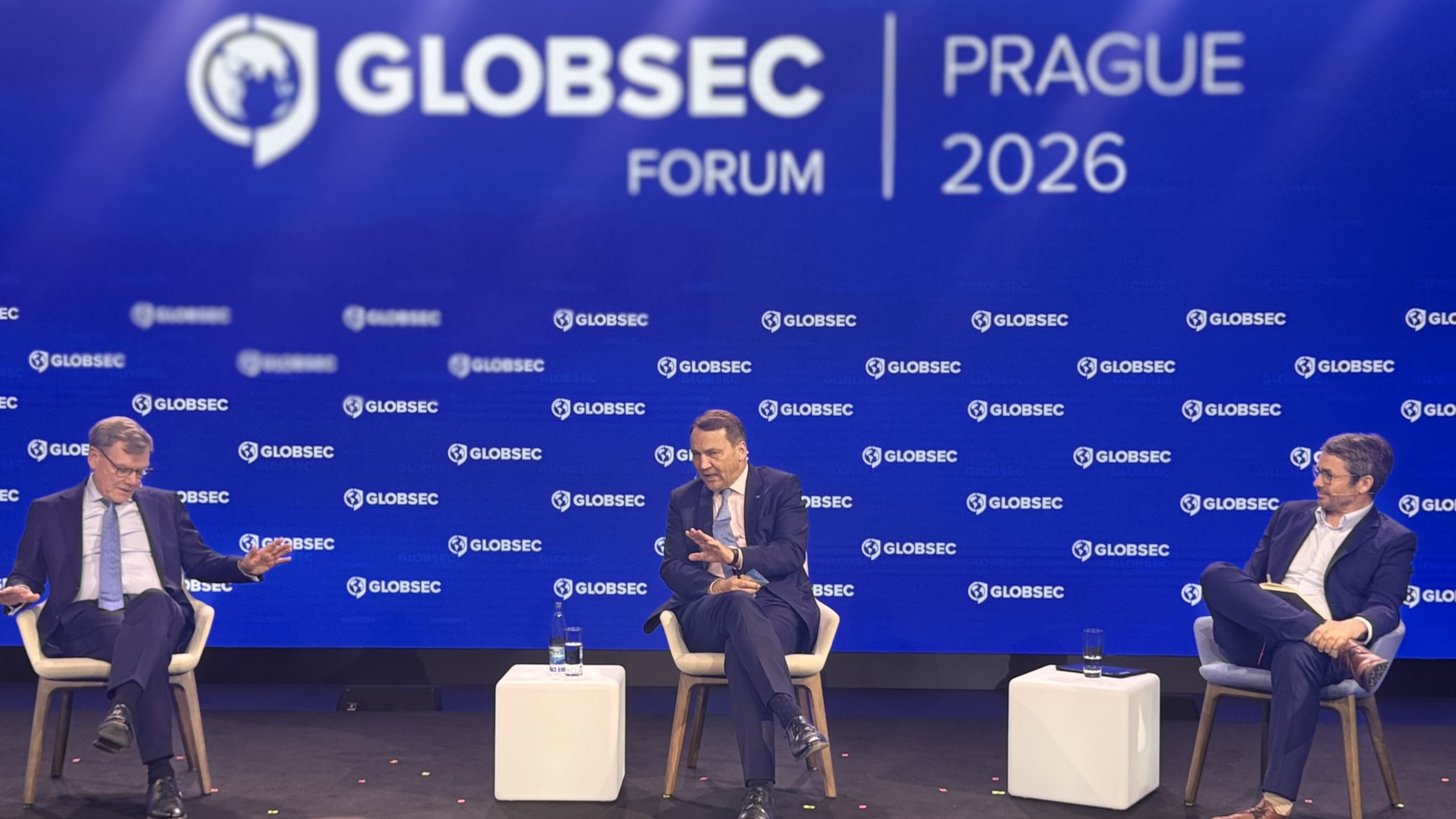
These concerns have echoed through recent European newspaper columns, think tank discussions, and security conferences. Yet at the GLOBSEC Forum 2026, held last month in Prague, the atmosphere felt noticeably different.
Indeed, at important points in its history, the organisation of this conference has tracked closely with decisions and dilemmas faced by Europe.
The conference began in 2005 as an initiative associated with the Slovak Atlantic Commission and a generation of young foreign policy thinkers shaped by Slovakia’s successful push for NATO and EU integration. In its early years, GLOBSEC reflected the priorities of post-Cold War Central Europe: anchoring the region firmly inside transatlantic institutions and ensuring that the strategic ambiguities of the 1990s did not return.
Over two decades, however, the conference evolved alongside the region itself. What began as a relatively modest Bratislava gathering gradually transformed into one of Europe’s major strategic forums, attracting heads of government, foreign ministers, military leaders, and policy thinkers from across Europe, North America, and increasingly the Indo-Pacific. In many respects, GLOBSEC’s growth mirrored Central Europe’s own evolution to the strategic centre of European security debates.
While GLOBSEC was born in Bratislava, the forum’s leaders decided to relocate to Prague in 2024 following the return of Robert Fico’s populist government in Slovakia. While the conference had in many ways outgrown the quaint charm of its original location, it also became increasingly difficult to imagine a gathering so closely associated with transatlanticism and support for Ukraine operating comfortably under a government openly flirting with Moscow.
Indeed, the symbolism of the speakers at this year’s conference was difficult to ignore: a sense of a geopolitical awakening in Europe is occurring in the midst of democratic progress in countries.
Across panels and private discussions alike, there was not only recognition that Europe was being pushed to assume far greater responsibility for its own security, industrial resilience, and geopolitical positioning, but also a growing sense that this was a challenge the continent should actively embrace. The conversation was less about preserving an old transatlantic order, and more about preparing for a world in which American reliability can no longer be taken for granted.
You could hear this changing tone most clearly in discussions involving German Foreign Minister Johann Wadephul and Poland’s Radosław Sikorski, both of whom reflected a Europe beginning to think of itself less as a geopolitical spectator and more as an actor capable of shaping events. Sikorski’s optimism on Ukraine — where Russia has year after year failed to achieve decisive strategic gains — extended even to a post-war future in which Europe could focus more strategically on the long-term challenge posed by growing Chinese power.
Crucially, Sikorski and others increasingly framed Ukraine not merely as a consumer of European security, but as a provider. Ukraine today possesses Europe’s largest and most battle-hardened military and has become a centre of innovation in drone warfare, battlefield adaptation, cyber resilience, and intelligence integration. Far from simply relying on Europe for protection, Ukraine is increasingly viewed as an indispensable contributor to Europe’s future security architecture and a state making its own case for integration into Europe’s political and security structures.
That renewed confidence was visible elsewhere too. Hungary’s Deputy Prime Minister and Foreign Minister Anita Orbán — serving in the reformist government of Péter Magyar, whose electoral victory swept Viktor Orbán (presumably no relation) and Fidesz from power in Budapest — remarked during an extensive account of her party’s electoral victory that “Hungarians want Hungary to be back in Europe.”
Meanwhile, Moldovan President Maia Sandu described her government’s efforts to resist Russian interference and subversion while keeping Moldova on a democratic and European path. Sandu’s own electoral victory, achieved despite sustained Russian pressure, together with political change in Hungary, contributed to a broader sense that democratic institutions in Europe may be proving more resilient than many feared–even if some of the continent’s most encouraging democratic stories are currently unfolding outside the European Union itself.
The prospect of eventual EU membership for Ukraine and Moldova is no longer treated as a distant abstraction. But enlargement under the EU’s current institutional rules may prove increasingly difficult to manage. Victor Orban’s repeated use of veto power in EU decisions, for example, over funding for Ukraine, has sharpened discussions about institutional reform, including the wider use of qualified majority voting in areas where unanimity has paralysed decision-making. While reform will likely be necessary for EU expansion, for now, however, the mood is more confident.
That confidence marked a noticeable shift from the atmosphere that dominated European security debates only a year ago.
Indeed, the evolving mindset evident at GLOBSEC may herald a slow reshaping of NATO itself. While the alliance’s collective defence provisions have only been formally invoked once, in response to the 9/11 attacks, NATO has for decades often been understood in practice as an American security guarantee for Europe.
At GLOBSEC, however, the “Europeanisation” of NATO — not separation from the United States, but a gradual rebalancing within the alliance — was a frequent topic of discussion. European governments are increasing defence spending, acknowledging the need for more serious coordination on military production, and speaking more openly about carrying greater responsibility for continental defence. In some respects, this would represent a return to the alliance’s original conceptual logic, where states were explicitly expected to provide for their own security in addition to the guarantees provided by the United States.
That shift was visible not only in what was discussed in Prague, but also in who was absent.
Besides figures such as former US Defense Secretary Mark Esper and two or three officials from previous American administrations, there were relatively few prominent American voices at the conference. A gathering that once would have revolved around assumptions of transatlantic leadership felt noticeably less Washington-centric.
Yet that absence was not unexpected. Trump administration officials have either largely avoided such forums or used them to troll an audience they disparage as part of an internationalist elite they oppose. If anything, however, the reduced American presence created more space for Europeans themselves to debate what a more independent Europe would actually require: militarily, institutionally, economically, and psychologically.
Nevertheless, mood is one thing, implementation is another. Europe’s vulnerabilities remain substantial. Much of the continent still depends heavily on American logistics, intelligence, and strategic lift capabilities. Europe’s defence industrial base continues to struggle with scale and coordination. And political fatigue over Ukraine could still emerge if the war drags on indefinitely. Europe is not suddenly becoming a unified superpower. American power still underwrites much of the continent’s security. And questions around growing nationalist sentiment in France and elections which placed opposing parties in the presidential palace and parliament in Poland as well as even the GLOBSEC Forum’s new home in the Czech Republic show that the EU still has a long way to go to convince local publics of its agenda.
But the Europe now tackling the Ukraine war feels notably different from the Europe that first faced it: less complacent, less post-historical, and more conscious that military, political, industrial, and institutional power still matters.
After decades of strategic drift, Europe may not fully have its mojo back yet.
But for the first time in a long time, it is beginning to behave like it wants to.
Dr Bryce Wakefield is the CEO of the Australian Institute of International Affairs. He has lived, worked and researched in the United States, Japan, Europe and New Zealand. He trained as a political scientist with particular expertise in International Relations and the international affairs of East Asia.
He attended the Forum as a guest of GLOBSEC.