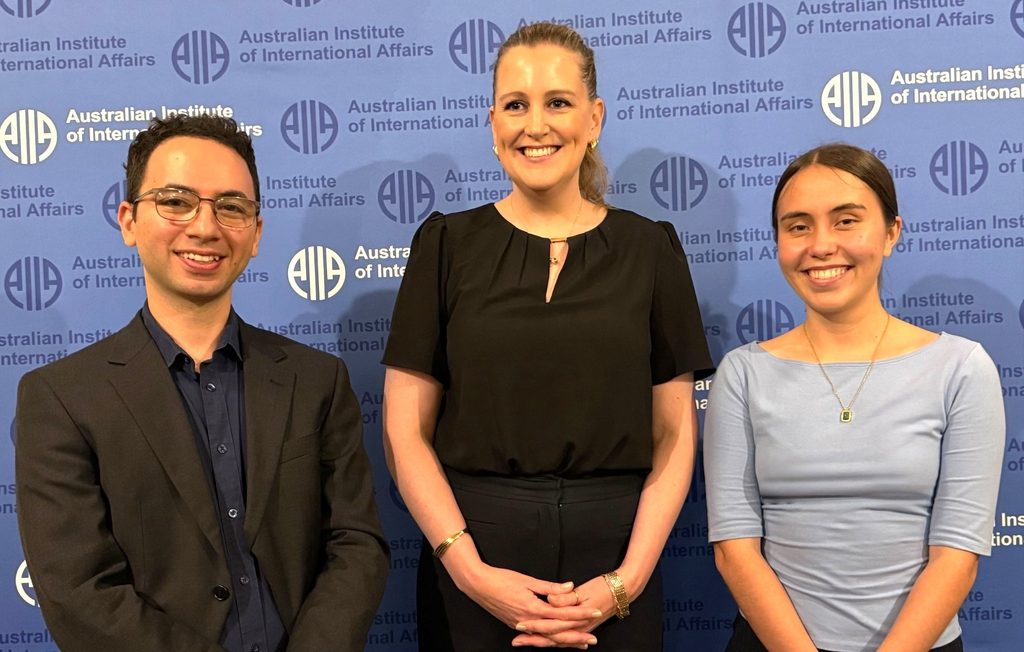
On 24 November 2026, Dr Madeline Gleeson, Deputy Director of the Kaldor Centre for International Refugee Law, spoke to AIIA NSW about the future of Australia’s commitment to the Refugee Convention. Dr Gleeson, who specialises in international human rights law, argued that Australia must reaffirm its commitment to the Refugee Convention and stand up for humanitarian law and the rules-based order.
Gleeson opened by describing the present as a moment of reckoning, in which support for refugee law is under threat. She attributed this in part to rising anti-immigration sentiment worldwide, evident in the rise of far-right parties in Europe and the restrictive policies of the Trump Administration.
Gleeson observed that even mainstream and centre-left parties are increasingly adopting anti-migration stances. The result is that policy debates are no longer about whether migrants should be admitted, but by how much their numbers should be reduced. This shift weakens refugee law by making the protection of refugees politically costly.
Gleeson then explained the history of the Refugee Convention. Written after World War II to address mass displacement across Europe, including many Jewish refugees, the Convention was expanded beyond its post-war origins in 1967. Australia played an integral role in its creation through the contributions of former Minister for External Affairs, H.V. Evatt. Australia was subsequently one of the Convention’s first parties, and its accession helped bring the treaty into force.
Turning to the state of refugee law in Australia today, Gleeson identified three principles of international refugee law that are currently under threat. The first is non-refoulement, which prohibits states from returning refugees to a country where they face a risk of persecution. The second is non-penalisation for irregular arrival, which recognises that refugees cannot always arrange their escape neatly. The third is the right to seek asylum itself. These principles are undermined when refugees are not given the opportunity to make claims for protection or are penalised for the manner of their arrival.
Gleeson concluded with recommendations for strengthening Australia’s approach to refugees. This includes ensuring refugees are given a proper voice, so that their claims receive a fair process and expanding measures such as complementary pathways, which offer displaced professionals the opportunity to migrate on the strength of their skills.
Audience questions considered the current state of international law, asking Gleeson about broader threats to refugee law given the increasing selectivity in which international law is applied. Gleeson was optimistic in response, noting that there is always more focus on international law’s failures than its many successes.
Questions also turned to why Australia’s policies currently fall short. Gleeson stressed the importance of addressing a refugee’s journey at every stage, including the causes of displacement, transit, and finally, arrival in Australia. Policies which address every stage, rather than the last, are more effective. She was also critical of policies focused on deterrence, suggesting that they are not effective and that there are fairer, more transparent and more efficient options available.
Report by Alexandra Kuo, AIIA NSW intern
Dr Madeline Gleeson (centre), AIIA NSW Vice President Chris Khatouki (left) and AIIA NSW intern Alexandria Kuo (right)