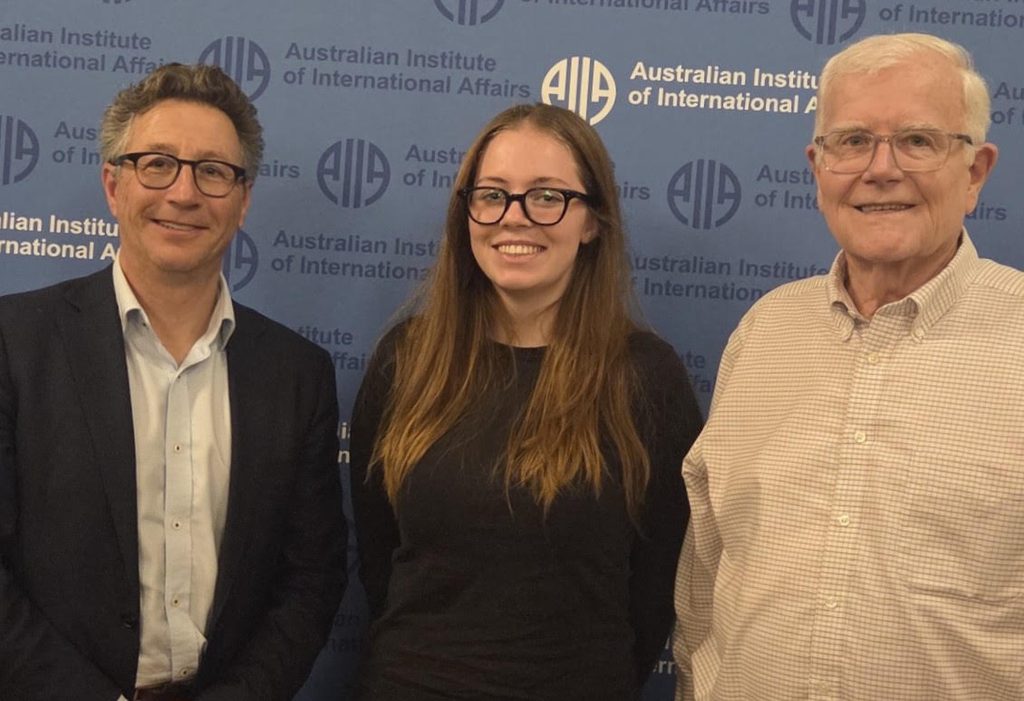
On Tuesday 10 November 2026, Professor Nick Bisley, Pro Vice-Chancellor for Research and Professor of International Relations at La Trobe University, addressed AIIA NSW on the role of globalisation and geopolitics in the making of modern Asia, drawing on his book, Asian Crucible: the role of globalisation and geopolitics in the making of modern Asia, published by Bristol University Press in March of this year.
Bisley’s central argument is that the globalisation which bound Asia together also generated the vulnerabilities now fuelling geopolitical contest. He characterised Asia as a shared space of economic interdependence, brought together through market globalisation and liberal capitalism during what he termed the market period. Spanning the 1990s to Covid-19, this period was defined by mutual vulnerability and the near absence of geopolitical competition. Today, Bisley observed, the political forces that allowed markets to self-regulate have been undermined by state intervention, and international institutions once thought capable of resolving global crises have proved unable to do so.
Between 1945 and 1979, Asia’s economic acceleration began with Japan, followed by Taiwan, South Korea and some Southeast Asian economies. China’s reforms from 1979 then drew it into regional supply chains, and its entry into the liberal order sustained rapid growth through the 1990s while requiring it to define its relationship with the US-led system. Yet, Bisley contended, the same forces that made China the world’s largest economy in purchasing-power parity terms also produced the conditions for their own reversal. Financial crises in the US and Europe raised questions about globalisation, and interdependence became a source of leverage, as China’s 2010 restriction of rare-earth exports to Japan during the Senkaku Islands dispute indicated.
The Covid-19 pandemic, however, marked the inflection point, eroding the political consensus around globalisation and the era of markets. It exposed manufacturing vulnerabilities and intensified US-China rivalry, as supply chains for pharmaceuticals and personal protective equipment became instruments of leverage and international cooperation was limited. China nonetheless remained central to the region. Bisley emphasised that Asia had become centred on China without becoming Sino-centric, its production networks integrated around the Chinese economy without the regional order deferring to Beijing. He acknowledged China’s greater geostrategic position and the alternative regional order it advances through the Asian Infrastructure Investment Bank, the Shanghai Cooperation Organisation and the Belt and Road Initiative.
Audience questions tested the durability of this China-centred order, probing the consequences of vast population decline and whether it poses a threat to security. Demographic decline threatens the foundations of China’s centrality, given that Asia’s rise rested on the labour and productive capacity that market integration mobilised. In China, decades of fertility control under the one child policy accelerated population ageing, contributed to a constrained labour force, and reinforced a significant gender imbalance. China’s weak institutional capacity to support its population through unevenly distributed social service programs compounds these challenges.
While China avoids framing its demographic pressures as a national crisis, the Chinese Communist Party’s (CCP) increasing emphasis on fertility-focused reforms suggests a growing recognition of their long-term economic and social implications.
Questions also turned to the emerging Sino-Russian relationship, which speaks to the geopolitical dimension of Bisley’s thesis. Sino-Russian alignment challenges the Western-led liberal international order and its associated security architecture, marking how far the region has moved from the near absence of geopolitical competition that defined the market period. Bisley framed this alignment as an observable pattern of policy coordination across strategic theatres. The relationship is not, however, free of friction. Points of tension include Chinese expansion in the Russian Far East, the entrenched Russian perception of China as the subordinate partner in the relationship, and even oil price negotiations between the two sides, suggesting that the alternative order China advances remains contested even among its closest partners.
Report by Mia Conway, AIIA NSW intern
Professor Nick Bisley (first from left) with AIIA NSW intern Mia Conway (second from left) and President Ian Lincoln (right)