In response to the 2025 US National Security Strategy, Japan needs to develop its own defence capabilities and expand access to US forces in order to make the US-Japan alliance the linchpin of the US sphere of influence in Asia.
Since the Second Trump administration released its National Security Strategy (NSS), analysts have observed notable shifts in tone and priorities. The document adopts more measured language regarding China, notably omitting the previous administration’s characterisation of Beijing as “the pacing threat.” Additionally, the strategy places greater emphasis on reasserting American influence within the Western Hemisphere.
However, while it does not describe China as “the pacing threat,” it demonstrates the US’s resolve to prioritize the Indo-Pacific region and geopolitical competition with China. The document notes that the Indo-Pacific will be at the center of geopolitical competition and that alliances in the region will serve as “the bedrock of security and prosperity.” It states the US will seek to maintain a regional balance of power and prevent “the emergence of dominant adversaries”—a clear reference to the Indo-Pacific, where China’s rapid military buildup is challenging existing power dynamics. The NSS aims to maintain this balance by sustaining US economic and military superiority while pressuring allies to enhance their defense capabilities.
Japan, which has worried about US isolationism and withdrawal from Asia since the beginning of the Trump administration, should now feel more at ease. It can be assured of sustained US presence, though it must continue developing its own defence capabilities—which it fully intends to do. Japan has already begun investing in emerging military technologies, including drones, unmanned vehicles, hypersonic missiles, and anti-drone systems. Japan may face pressure to spend at least 3.5 per cent of its GDP on defence, as the Trump administration has often demanded of its allies. The Japanese government understands it needs to spend considerably more to develop defence capabilities and must gain voter support to do so. Japanese voters grasp the severity of the security environment. However, the loss of seats for the ruling Liberal Democratic Party (LDP) in recent elections is considered linked to dissatisfaction over the misuse of taxpayers’ money, foreign assistance programs despite rising living costs, and immigration policies. The recent scandal involving the JICA hometown initiative, which was perceived as accepting immigrants, reflects voters’ dissatisfaction with the ruling party’s immigration policies. Therefore, the Japanese government will need to address concerns about political accountability and immigration policy, rather than defence policy, to secure public support.
Japan could offer more access to US forces in Japan, such as providing training facilities on Mageshima Island. In this way, Japan can insist on the strategic interest of the US forces in Japan due to its vital location within the First Island Chain.
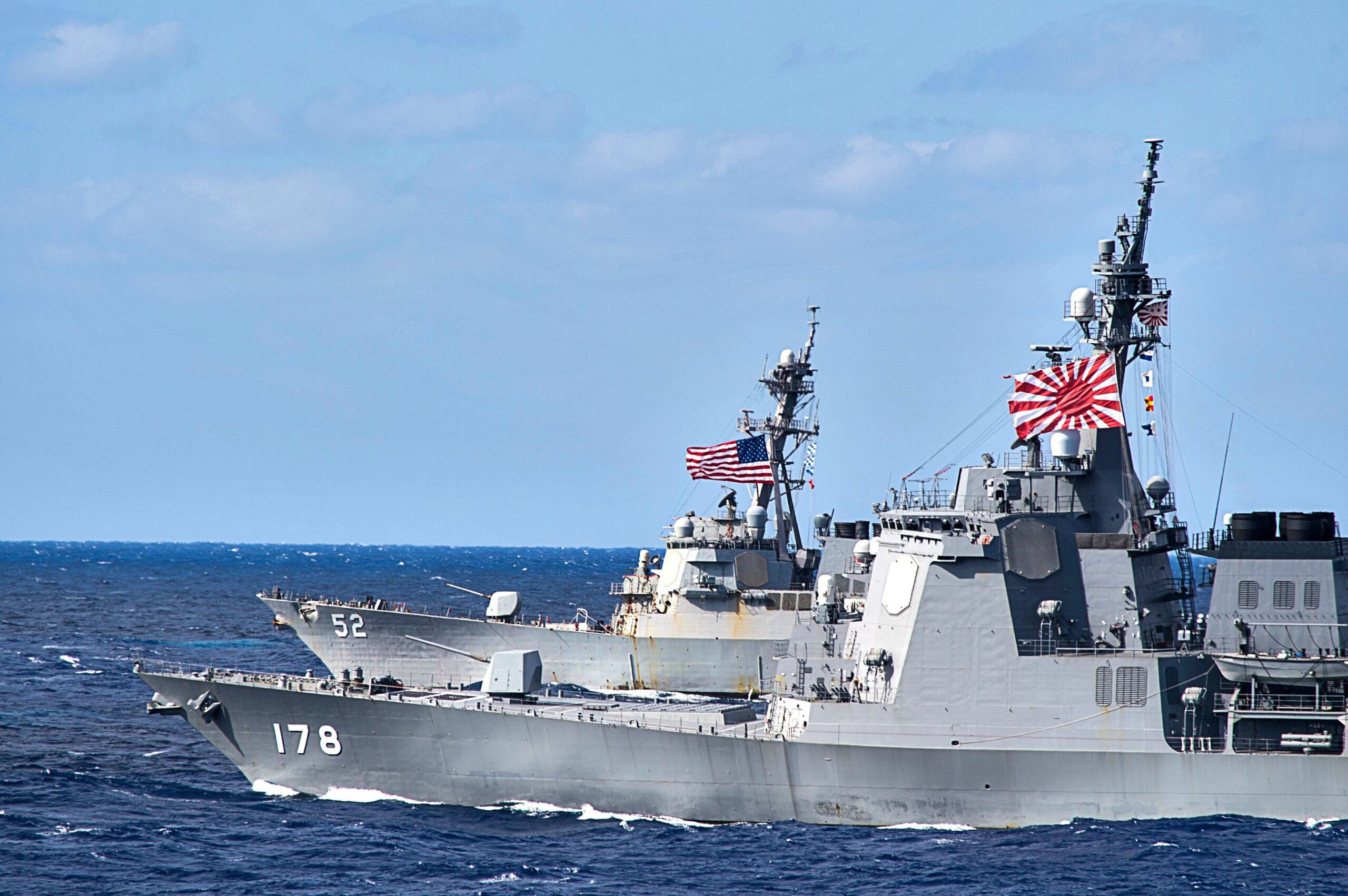
Indeed, this perception of vitality will be important as the US shows signs of prioritisation in its actions abroad. The perception will determine which country the US will need to maintain a presence in to prevent domination by China. It will be the demarcation line of the sphere of influence in the Indo-Pacific region. In recognition of this, Japan should seek to place itself firmly inside the US sphere of influence in the Indo-Pacific. The US could scale back the defence perimeter to Guam. For now, the US considers the US-Japan alliance vital. Military actions also show this. After Chinese and Russian bombers conducted joint patrols around Japan, the US and Japan conducted a joint patrol. Despite tensions between the US and Venezuela, the US deploys two aircraft carriers around Japan as of 22 December 2025; the only other region where the US deploys aircraft carriers is the Caribbean Sea. Although the White House denied it, reports suggested that a different version of the 2025 NSS proposed the idea of a “Core Five,” composed of the US, China, Russia, India, and Japan, to replace the G7.
The Chinese sphere of influence is beginning to take shape outside Japan, particularly in Southeast Asia. In most Southeast Asian countries, China has a stronger economic presence. China is involved in significant infrastructure projects, such as high-speed railways, in Laos, Vietnam, Thailand, Malaysia, and Indonesia. China is the largest trading and investment partner for most Southeast Asian countries. China has also expanded military influence through joint exercises, arms sales, and access to bases. China conducts joint military exercises with most Southeast Asian states, is negotiating the sale of J-10 fighter jets to Indonesia despite maritime disputes in the South China Sea, and has built and gained access to Ream Naval Base in Cambodia. Malaysia has expressed opposition to external interference in the South China Sea, echoing Beijing’s narrative. Although ASEAN meetings express the importance of the settlement of maritime disputes in accordance with the UNCLOS, regional states refrain from expressing concerns when Chinese vessels harass Filipino vessels in the South China Sea.
It is likely that the US also recognises the Chinese sphere of influence in Southeast Asia. President Trump did not attend ASEAN summit meetings during his first presidency, and the Biden administration did not actively respond to the expansion of Chinese influence either. The 2025 NSS does not mention Southeast Asia.
As the Chinese sphere of influence is forming in Southeast Asia, the US and Japan need to maintain at least the US sphere of influence around the Japanese archipelago. For this purpose, Japan needs to impress the US upon its strategic importance by increasing defence capabilities and considering how the geography and capability of Japan can be utilised for the defence of the US.
Japan needs to understand how the US defines vital interests worth defending in order to avoid being self-conceited about its strategic importance solely for its geography or defense capabilities. The Trump administration’s foreign policy priorities demonstrate that geographic proximity to adversaries alone does not determine where the US will commit resources; strategic value must be actively demonstrated and maintained. Japan must continuously reinforce its indispensability to US security interests through deeper military integration, expanded access to facilities, and robust defence spending. Only by remaining operationally vital can Japan ensure it stays firmly within the US sphere of influence as strategic priorities shift.
Daiki Tsuboi has a Master’s of Strategic Studies from the Australian National University and working experience in diplomacy.
This article is published under Creative Commons License and may be republished with attribution