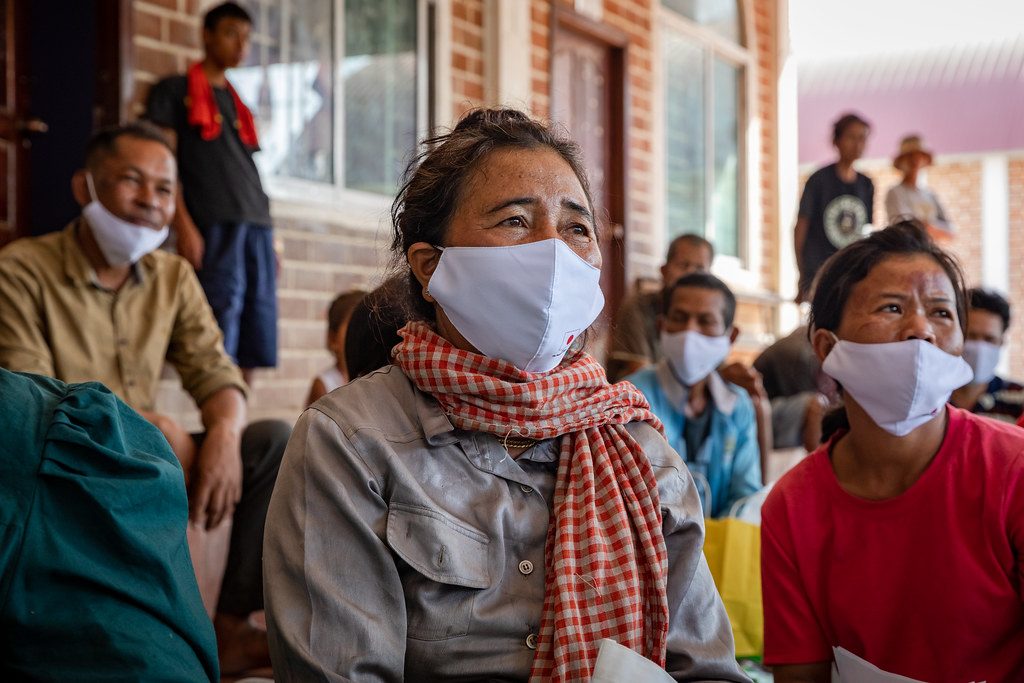
In early August 2025, a photograph circulated widely on Cambodian social media. It showed a woman sitting on her luggage at the Daung border crossing in Battambang province, staring at nothing in particular.
She had just returned from Thailand, where she had spent three years working construction. But she had not chosen to come home; the border conflict had decided that for her. By December 2025, she was one of at least 900,000 Cambodians who had made the same crossing. That number is not a migration statistic; it is the shape of an economic crisis that Cambodia’s government was not equipped to absorb and has yet to figure out how to address.
The Thailand-Cambodia border war generated extensive coverage of ceasefire negotiations, territorial disputes, and scam compounds. It generated almost no information on what happened to the workforce that had quietly been keeping Cambodia’s rural economy running. That story is far from being over. A UN assessment released in April 2026 warned of a looming crisis of landlessness and household debt that could undo years of development gains. The warning has gone largely unheard outside Cambodia.
The Remittance Economy That Held Things Together
Before the conflict, Cambodian migrant workers in Thailand were sending home close to US$3 billion a year. In surveyed households, 85.8 percent received remittances from Thailand, averaging $2,194 annually. That money was not discretionary. It was the primary means by which rural families serviced microfinance debt, paid school fees, and covered healthcare costs. When it stopped, those obligations did not stop with it.
The numbers since the conflict are stark. Total remittances fell 37 percent in 2025, from $2.95 billion to $1.86 billion. For returned households specifically, the average remittance income did not merely decline. It collapsed from $2,194 to approximately $110. The UN projects total remittance losses of $277 million in 2025 and a further $665 million in 2026. These are not projections about economic growth rates. They are projections about whether rural families can repay the debts they took on when they assumed the remittances would keep coming.
What Coming Home Actually Looked Like
The CENTRAL impact assessment, published in March 2026, put numbers to what returning workers found. Seventy-one percent reported being in debt, with an average household debt of USD 5500. Fifty-three percent said they planned to remigrate as soon as they could, because there was nothing viable at home. For 8 percent of respondents, the journey back itself generated new debt, through unofficial fees and bribes at border crossings. Only 30.5 percent received any assistance during or after the return; most of that was limited to short-term food aid and transport.
This wave dwarfs anything Cambodia has managed before. During COVID-19, roughly 260,000 migrants returned and institutions strained and largely failed even then. The current return is three and a half times larger, moving faster, and arriving in a labor market that was not waiting for them. The Ministry of Labor reported approximately 190,000 available jobs in Cambodia in mid-2025. Most were in manufacturing around Phnom Penh. Most returnees were living in border provinces with skills in Thai construction and large-scale agriculture. The mismatch between available manufacturing jobs and construction workers was not marginal, as this is structurally embedded in Cambodia’s labor market.
A Government Without Answers
However, Cambodia’s government has not been idle. Hun Manet travelled to the United States and Europe in early 2026 seeking new investment and trade diversification, explicitly framing the trip as an effort to reduce dependence on Thailand. There have been job-matching programs and announcements for vocational training. The IMF, downgrading Cambodia’s growth to 4.8 percent in 2025 and around 4 percent in 2026, acknowledged the country’s structural resilience while noting its sensitivity to exactly this kind of remigration shock.
But the institutional response has not matched the scale of the problem. The UN assessment was blunt about the gap: without targeted intervention, families losing remittances will have no option but distress sales of land to service creditors. Landlessness is not a temporary hardship; it is a generational one. When a rural Cambodian family sells land under duress, the loss rarely reverses. The children of that family absorb the consequences for decades.
Why This is a Security Story
The instinct is to read this as a humanitarian footnote to the border war. That reading misses what the numbers are pointing toward. Fifty-three percent of returned workers intend to remigrate. Most will go back to Thailand as the ceasefire allows, some will go elsewhere. A portion will look for any work available, including work in the informal grey economies that already dominate Cambodia’s border provinces. In the same provinces, the scam compounds operated, where border crossings are loosely governed, and where the conflict’s destabilizing effects have been most concentrated.
A state that cannot absorb its own returning workforce creates a different kind of fragility than one facing a border skirmish. Because the skirmish ends, but the debt crisis, the landlessness, and the absence of services do not. The policy community has spent months analysing the ceasefire terms and the territorial disputes. Almost no one has asked what happens to the 900,000 people who came home to a country that was not ready for them. That question’s answer will determine what Cambodia will look like in five years.
Showmik Sarker Prottoy is a student at the Department of International Relations, University of Dhaka. His work focuses on the transnational economic security and the political economy of conflict in South, Central and Southeast Asia.
This article is published under a Creative Commons License and may be republished with attribution.