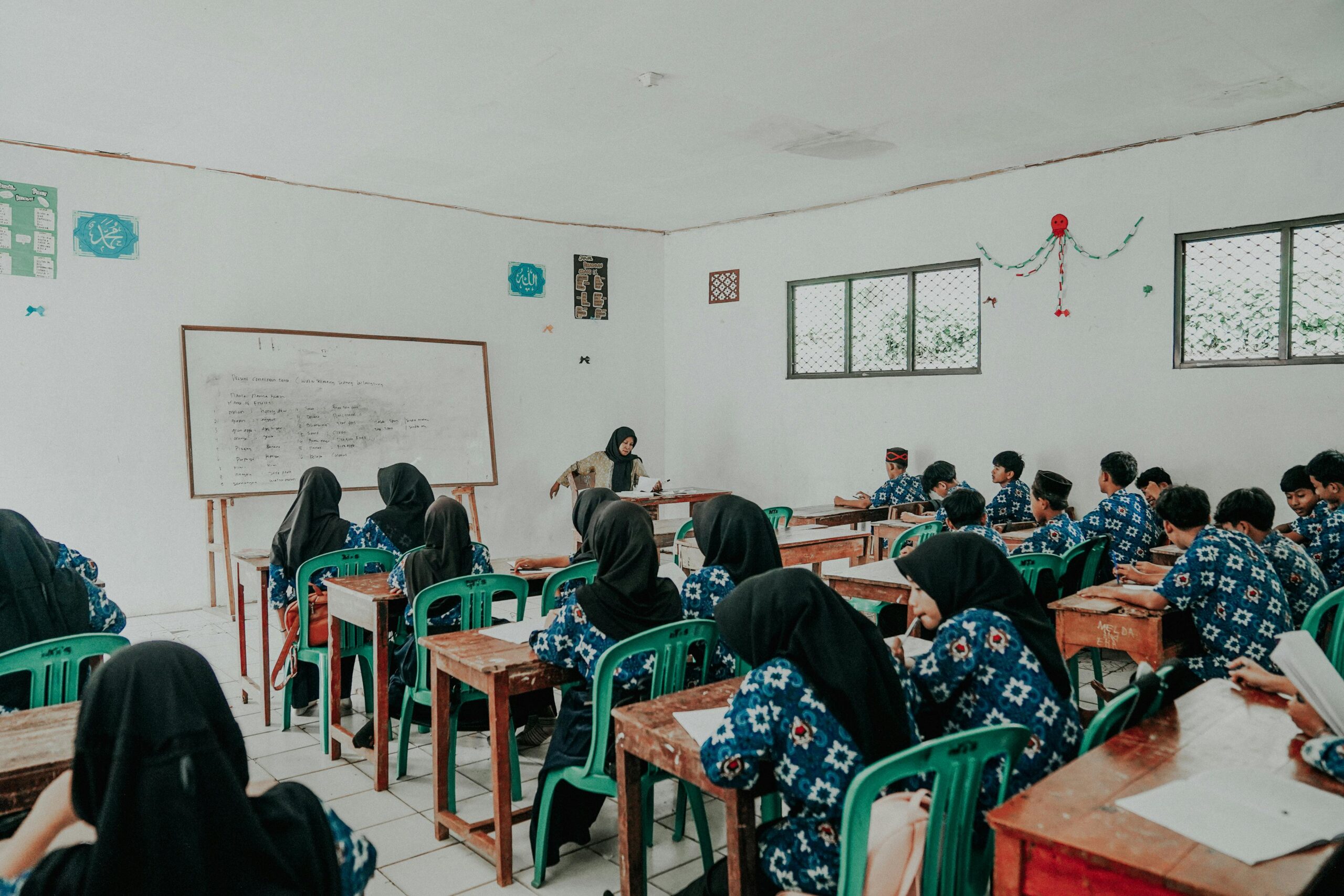
The students who will negotiate Australia’s future with Indonesia are currently in Year 7. What are we giving them? The case for teaching Indonesian in Australian schools has never been stronger. Enrolments have never been lower.
There is a word in Indonesian – selamat – that resists a single translation. On its own, it means congratulations. Paired with datang, it welcomes you, with the quiet implication of a safe arrival. Paired with belajar, it wishes you well in your studies—one word that does different work depending on what follows it.
This kind of layered richness exists in a language that most Australian students will never learn beyond the early years of secondary school. This is not simply a curriculum issue. It reflects how Australia engages – or fails to engage – with the country next door.
In November 2025, Asialink Education convened a national roundtable – educators, researchers, government representatives, language teachers – to grapple with a stubborn reality: Australia has struggled to sustain meaningful engagement with Indonesia through its school system, not from lack of interest, but from a systemic failure to create and sustain those opportunities. The January 2026 report from that gathering is a serious document, and its conclusions are not entirely novel. But its urgency is.
Indonesia is our nearest major neighbour and the world’s fourth most populous country. It is a G20 economy on a sustained growth trajectory, with a young population more digitally connected than many Australians might assume, and a government that has shown interest in deepening people-to-people ties with Australia. And yet, as the roundtable report documents, many Australians complete their entire education – school and university combined – without gaining even a basic conversational foothold in Bahasa Indonesia.
This is stranger than it sounds. Indonesian is, by any objective measure, one of the more learnable languages available to English speakers. No tones. No grammatical gender. No case endings. A phonetic spelling system that means you read what you see. The structure is practically an open door. It is, in the truest sense, a gift of a language – sitting at the end of our geographic street, spoken by a nation whose importance to Australia’s future is not seriously in dispute by anyone who has thought carefully about the region.
So why is enrolment declining? As the Asialink roundtable report notes, Indonesian language learning in Australia suffers from fragile pathways, with relatively few students continuing into senior secondary study. The pipeline often begins to thin in the middle years of schooling, where the subject becomes elective and students – and often their parents – quietly decide it isn’t worth the effort, choosing not to continue beyond Year 8 – a decision explored elsewhere in discussions of from sate to sour.
The roundtable identified the key points: teacher shortages, broken pathways, and structural disincentives in Years 11 and 12. All real. All worth fixing. But buried in the report’s recommendations is something quieter and more immediate – a lever capable of improving the experience of Indonesian in classrooms across the system. One of its clearest calls is to update and expand learning materials about Indonesia – to replace the ageing, culturally flat resources that still populate many Indonesian classrooms with something that reflects the country as it exists today: dynamic, digital, young, globally connected.
This is not a small thing. Teaching is relational. A student who watches a video filmed in a market in Java, hears the language in the mouths of people their own age, and sees Indonesia as a place of complexity and colour rather than a stock photograph of a temple – that student is in a different cognitive and emotional relationship with the language. They are not learning a subject. They are encountering a world. But the encounter must be structured. Pitched at the right level, introduced clearly, and scaffolded so that what students see and hear connects to what they can produce. Visual richness earns attention; structure is what makes it stick.
The research is unambiguous on this. Engagement precedes retention. Multiple exposures matter – repetition is how language becomes automatic, how a student stops translating in their head and starts speaking. But drilling without context or meaning cannot produce what keeps a student in the room past Year 8. And curiosity – genuine, culturally grounded, personally felt curiosity – is precisely what the middle years of schooling either build or destroy. Years 7 and 8 are not just a convenient administrative category. They are, as educators working in Indonesia have known for years, the window – or the continuity cliff. Catch a student there with the right teaching and materials, and you may have a future diplomat, a business leader, a researcher, or a person who can sit across a table from an Indonesian counterpart and be present in the conversation. Lose them there, and you lose them.
The Asialink roundtable calls for contemporary narratives reflecting modern Indonesia. It calls for audio-visual materials that carry authentic Indonesian voices. It calls for programs that can scale – that can reach schools across every region of Australia, not just the well-resourced ones. The report is direct: participants described the need for “new, dynamic audio-visual materials featuring authentic Indonesian teenage voices.” They argued that “the current low levels of engagement and declining language learning are not inevitable nor irreversible.” These are not radical recommendations. They are quiet ones. Practical ones. But practical recommendations still need to be acted upon.
That work is underway. A small number of Australian educators, working with Indonesian collaborators, have been producing exactly the kinds of cinematic, curriculum-aligned resources the roundtable is calling for – filmed on location in Indonesia, built for the Australian curriculum, designed not to replace teachers but to give them richer materials to work with. What has been missing is not the recognition of the problem. It is the sustained effort to address it.
Australia has a rare opportunity with a language and a neighbour. Indonesian is often treated as a niche subject. It is often framed as an exotic elective. It should be neither. It is the language of the country that matters most to our regional future – a language whose structure is practically an invitation to learn it, spoken by a people with whom we share geography, history, and an increasingly intertwined economic story. What would it look like to actually accept that invitation? To treat the teaching of Bahasa Indonesia not as an afterthought, but as one of the most strategically significant things we could be doing in our classrooms right now.
Andrew Catton is an Educational Content Specialist and a registered Indonesian, English, and Humanities teacher. He is the founder of Pondok Bahasa, an Australian education initiative producing cinematic, curriculum-aligned Indonesian language resources for schools. He has appeared before the House Standing Committee on Education’s Inquiry into Building Asia Capability and participated in the Asialink Education National Roundtable on Enhancing Australian Schools’ Engagement with Indonesia (2025).
This article is published under a Creative Commons License and may be republished with attribution.