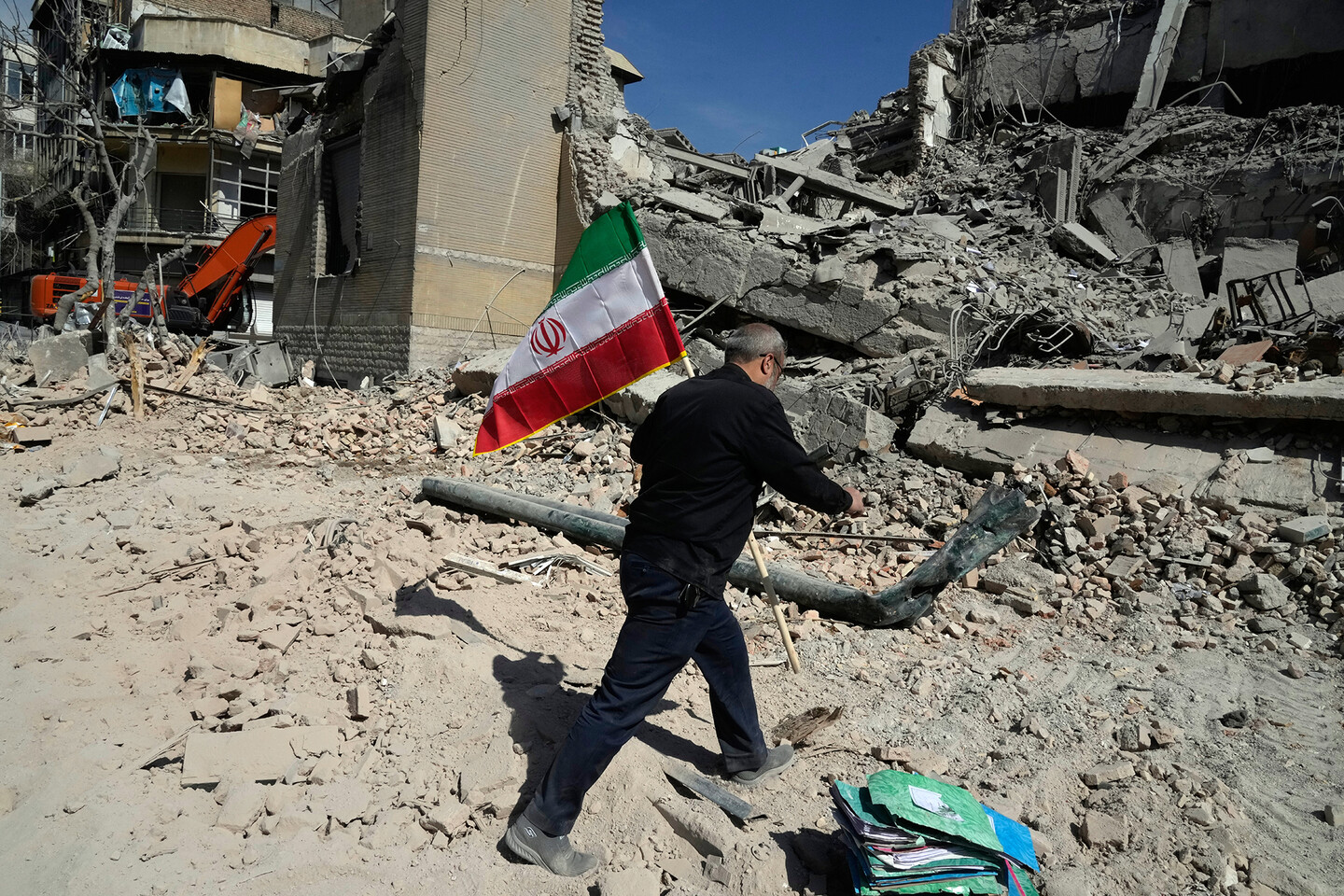
What the first month has revealed is a war producing outcomes directly contrary to its stated objectives. The strikes have appeared to have consolidated elite cohesion and handed the regime the external enemy it needed to silence dissent and justify wartime governance.
When the United States and Israel launched Operation Epic Fury on 28 February 2026, the expectation was that an overwhelming force would produce a rapid regime collapse. One month later, that expectation has not been met. Ali Khamenei is dead, and Iran has absorbed sustained strikes across the country. Yet the Islamic Republic remains intact. Iranian forces, including the Islamic Revolutionary Guard Corps (IRGC), continue to resist, and the conflict has spread well beyond Iranian territory. The central question has shifted from whether Iran can withstand punishment to whether its survival has given Tehran leverage over the terms on which this war will end.
Why Eliminating the Command Structure Has Not Ended the War
The US’s targeting list rested on the logic that killing the Iranian leadership at the right moment would fracture an authoritarian system from the top. The killing of Khamenei was meant to disorient the regime while military strikes dismantled its capacity to retaliate – producing the paralysis that would open the door to collapse. Neither has materialised. Iran’s institutions have been severely degraded – leadership losses, sustained strikes on infrastructure, and pressure on command networks – but the core structures of the state and military remain intact, evident in continued missile and drone operations, the rapid reconstitution of leadership, and the absence of large-scale defections within the security apparatus. That distinction is now the most important fact of the war.
Much of the early commentary went wrong on this point. It treated survival and victory as if they were the same category; they are not. Iran has not emerged militarily stronger from this war, and its strategic losses are severe. What it has done is endure. That endurance has been enough to prevent the US and Israel from converting battlefield dominance into political closure, and that failure is what has changed the bargaining dynamic. The killing of Iranian security chief Ali Larijani compounds this further; his successor will likely be closer to Mojtaba Khamenei, more ideologically rigid and less experienced in the architecture of negotiation, meaning Washington’s strategy is removing precisely the people most capable of managing an exit.
Survival as Leverage
The Strait of Hormuz has become the clearest expression of how Iran is fighting this war. Around 20 per cent of global oil passes through it, and Brent crude oil has risen more than 50 per cent since 28 February – a direct consequence of Iran’s campaign against civilian vessels and energy facilities that has sharply reduced traffic through the waterway. Tehran does not need to win a military exchange to inflict that kind of damage. It needs only to sustain enough disruption to make the economic cost of continuing the war harder for the US’s partners to justify than the cost of ending it. Survival has become leverage.
The geographic scope of Iran’s retaliation has made that leverage felt across the entire region. US bases in Kuwait, Qatar, Saudi Arabia, Bahrain, and Iraq were all struck, with Prince Sultan Air Base hit twice in one week, injuring 29 American soldiers and destroying an E-3 Sentry Airborne Warning and Control System (AWACS) aircraft. Diego Garcia was targeted with ballistic missiles from 4,000 kilometres away, exposing a missile range Iran had publicly denied possessing. The Houthis have since entered the conflict, raising the prospect of Bab al-Mandab becoming a second chokepoint alongside Hormuz. Iran’s security doctrine operates through distributed pressure; when it cannot match superior air power directly, it multiplies the fronts until the political cost of holding them all becomes unsustainable. What began as a counterproliferation campaign has become a contest over the regional order itself.
Iran’s Parliamentary National Security and Foreign Policy Commission has approved a plan to formalise control over the Strait of Hormuz by imposing mandatory transit fees, payable in rials, on passing vessels. These moves signal an intent to govern the strait as a sovereign asset, converting an international waterway into a chokepoint that Iran formally administers. An Iran that emerges from this war with institutionalised toll collection rights over 20 per cent of global oil flows would have converted wartime disruption into a permanent structural advantage that no previous Iranian government has formally claimed.
Satellite imagery showing fires at two pumping stations along the Habshan-Fujairah pipeline – which carries Abu Dhabi crude to Fujairah port, bypassing Hormuz entirely – points to a deliberate effort to close off the alternatives. Iran has not officially claimed responsibility, though analysts broadly assess the targeting was deliberate. Removing the one meaningful bypass route leaves Gulf oil exporters entirely dependent on Iranian decisions about access.
Strategic Overreach and Its Consequences
Seizing Kharg Island or establishing a military presence along the Hormuz coastline would not reopen the strait. Iran’s ability to threaten shipping rests on a dispersed network of naval mines, anti-ship missiles, and drone swarms that no single territorial seizure can dismantle. The escalation Trump is contemplating would trade air dominance for a ground engagement where geography, attrition, and the weight of a defending population favour the other side.
Having fired more than 850 Tomahawk cruise missiles in four weeks, the US is approaching the limits of what its precision weapons inventory can sustain in this theatre, while simultaneously holding deterrence commitments in the Western Pacific that China and Russia are watching closely. Escalating the war risks doing so with a depleted arsenal at the worst possible strategic moment. Trump’s repeated deadlines – 48 hours, then five days, then ten – are not diplomacy. They are what a position that has run out of options looks like from the outside. The country that launched this war, expecting a rapid collapse, is now extending deadlines and negotiating through Pakistan to find a way out.
On 31 March, Iran conditioned any talks on external guarantees as Pakistan’s Foreign Minister headed to Beijing to meet Chinese Foreign Minister Wang Yi. The two countries jointly released a five-point peace initiative calling for an immediate ceasefire, the start of peace talks, protection of civilian infrastructure, reopening of Hormuz, and respect for the UN Charter. An Arab diplomat confirmed that Tehran would look to Beijing as the guarantor of any peace deal with the United States. The country most critical to reopening Hormuz is also the country Washington is building AUKUS to deter. That tension has no clean resolution.
The Gulf states are already shaping the next phase of this war, whether they intend to or not. Bahrain, Saudi Arabia, Qatar, and the UAE have all absorbed Iranian strikes while simultaneously hosting the US forces conducting the campaign against Iran. Their position has become structurally untenable; remaining on the defensive keeps them exposed while providing the US with the basing it needs to continue, and entering the conflict more directly would transform it into a broader regional war none of them planned for. Time is not neutral – the longer the conflict continues without resolution, the more leverage shifts toward the actor most willing to keep inflicting pain, and Iran has demonstrated for a month that it is prepared to do exactly that.
What Australia Should Be Watching
For Australia, the significance of this war is not limited to petrol prices – though the energy shock is real, and households are already feeling it. The deeper exposure is strategic. AUKUS is premised on US strategic primacy in the Indo-Pacific, and that primacy rests partly on the precision weapons stockpile now being consumed in Iran. Australia backed a war it was never consulted about, against a country that poses no direct threat to Australian territory, and is now watching the deterrent architecture it depends on for its own security being quietly hollowed out in a theatre 5,000 kilometres away. Australian submariners were aboard USS Charlotte when it sank an Iranian frigate, and an E-7A Wedgetail has been deployed to the Gulf – Canberra is a participant in this war by any meaningful measure. The question it has not asked itself is what it is actually paying for.
The Question That Was Never Answered
What the first month has revealed is a war producing outcomes directly contrary to its stated objectives. The strikes have appeared to have consolidated elite cohesion and handed the regime the external enemy it needed to silence dissent and justify wartime governance. Khamenei’s fatwa-based nuclear restraint “has been thrown into question, leaving a successor under sustained attack with strong incentives to reassess that the absence of a deterrent is what made Iran vulnerable to begin with. A campaign designed to produce political transformation has risked political entrenchment – a harder regime, a more dangerous nuclear calculus, and a regional war that entered its second month without an agreed end state.
The question Trump has not answered is how this war ends. If the regime holds, if a negotiated deal falls short of the original objectives, and if the costs of continued military action keep climbing, what comes next? So far, the only answer has been to extend timelines.
Mohd Amirul Asraf Bin Othman is a PhD student in Political Science and International Relations at the Centre for Arab and Islamic Studies (CAIS), The Australian National University. His academic interests are diverse and encompass areas such as Middle East Security Studies, Regionalism, Terrorism, and Extremism, as well as the broader fields of Political Science and International Relations in the Middle East context. You can find him on social media here.
This article is published under a Creative Commons License and may be republished with attribution.