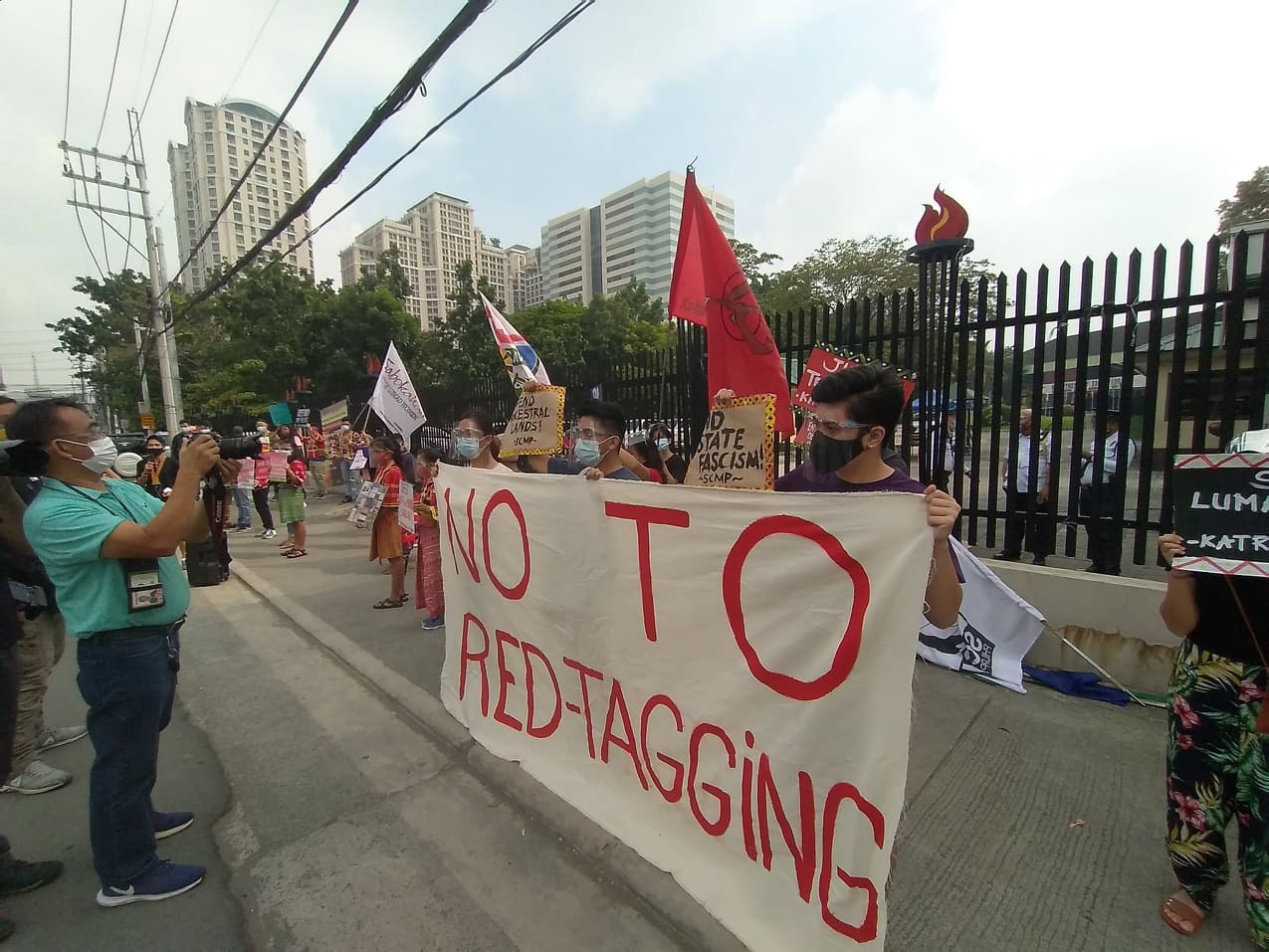
For years, Red-Tagging operated in a regulatory vacuum, shielded by the rhetoric of “national security”. A turning point arrived in May 2024, when the Supreme Court of the Philippines issued a landmark ruling defining Red-Tagging as a direct violation of the right to life, liberty, and security for the first time in Philippine jurisprudence.
The Philippines stands today at a historical crossroads that will define its role in Southeast Asia. The country aims to become a strategic economic hub and is preparing to assume the ASEAN chairmanship. (Association of Southeast Asian Nations) in 2026. However, its international credibility is heavily clouded by an archaic and violent practice: “Red-Tagging”. This government strategy consists of criminalising inconvenient figures – activists, journalists, unionists, and lawyers – by publicly labelling them as “communists”, “subversives” or “terrorists”.
From Marcos Sr. to the present
To understand the gravity of the situation, it is necessary to delve into the historical roots of this tactic. Red-Tagging is not a recent invention, but a dark legacy from the 1960s and 70s, perfected under the authoritarian regime of Ferdinand Marcos Sr. By declaring martial law in 1972, he paved the way for authoritarianism in the Philippines. The military was thus charged with preventing and suppressing any act of insurrection or rebellion. Initially, the tactic was born of the military objective of annihilating the threat posed by the New People’s Army (NPA), the armed wing of the Communist Party of the Philippines. However, over the decades, the line between armed combatants and peaceful government critics has been deliberately blurred.
Today, under the administration of Ferdinand “Bongbong” Romualdez Marcos Jr., this military tactic has evolved into a mechanism of systematic repression supported by state apparatuses such as the NTF-ELCAC (National Task Force to End Local Communist Armed Conflict). The imminent risk is that this authoritarian drift could permanently compromise Manila’s democratic reputation just on the eve of its debut as the leader of the Southeast Asian giant.
A ruling that fails to free Frenchie Mae Cumpio
For years, Red-Tagging operated in a regulatory vacuum, shielded by the rhetoric of “national security”. A turning point seemed to arrive in May 2024, when the Supreme Court of the Philippines issued a landmark ruling: for the first time in Philippine jurisprudence, judges defined Red-Tagging as a direct violation of the right to life, liberty, and security. In the landmark Deduro v. Vinoya ruling, the judge overturned a 2020 lower court ruling that had rejected the request for a writ of amparo (a legal remedy for human rights protection) filed by activist and former legislator Siegfred Deduro. As the Court states, “red-tagging” is a form of harassment and intimidation recognised by international organisations. People labelled “red” are often subjected to constant surveillance and harassment, sometimes even death.
Because of this definition, the victim doesn’t need to wait until they’re kidnapped or killed to seek protection; it’s sufficient to demonstrate a credible threat stemming from being red-tagged. Yet, the system exists in a brutal paradox, embodied by the face of Frenchie Mae Cumpio, in the country, known for her investigations into human rights violations in rural areas. Charged with illegal possession of firearms and, subsequently, terrorism financing – charges that many organisations (Amnesty International, the International Federation of Journalists and the National Union of Journalists of the Philippines) believe were fabricated – her story has become the symbol of the ineffectiveness of reforms.
Her January 2026 verdict, carrying a sentence of 12 to 18 years in prison, has dashed the hopes of those who saw the Supreme Court’s ruling as the beginning of a new era. As highlighted by the Committee to Protect Journalists, Cumpio’s trial is not just a legal matter, but a decisive test for Philippine democracy. If the State continues to imprison those who write the truth, the promises of internal stability and respect for democratic values made to ASEAN partners lose every shred of credibility.
Leadership or control? Manila’s test at the helm of ASEAN
ASEAN is a political-economic bloc that unites ten nations in the name of stability and the free market. However, the Philippine chairmanship scheduled for 2026 raises profound ethical and political questions that cannot be ignored. Can a country act as a guarantor of regional security and cooperation if, internally, it turns its own citizens into targets? According to statements made in recent years by APHR (ASEAN Parliamentarians for Human Rights), human rights violations undermine the country’s democratic effectiveness. Former Philippine Senator Leila de Lima, released in 2023 after seven years of unjust detention, has denounced the continued use of draconian laws to restrict freedom of speech, as well as the ongoing recourse to imprisonment, intimidation, and violence.
Manila presents itself on the global stage with the inclusive slogan “Navigating Our Future, Together”, seeking to position itself as a promoter of peace, security and unity, as well as a protector of vulnerable groups. Yet, the actions of its internal security apparatus tell a diametrically opposite story – one of pervasive surveillance, repression of dissidents, and social control. According to an RSF (Reporters Without Borders) report from January 2026, the Philippines, ranked 116th out of 180 countries in the RSF Press Freedom Index 2025, is now among the most dangerous countries for journalists. Amnesty International, in its World Report 2024/2025, documents how the 2020 Anti-Terrorism Act (ATA) authorises the surveillance of communications and social media to persecute activists. Furthermore, Human Rights Watch, in its World Report 2026, highlighted the government’s creation of a list of ‘internal targets’.
True regional leadership is not measured by the ability to impose silence through power, but by the will to protect democratic space. For ASEAN to truly progress, Manila must recognise that lasting stability is built on respect for dissent and the definitive end of a system that equates social criticism with terrorism.
The Role of the International Community and Investors
Another fundamental aspect concerns the economy. The Marcos Jr. government is actively seeking to attract foreign capital by courting non-traditional investors, with a strong interest in the EU and in strengthening ties with long-standing partners such as Japan, the US, and South Korea. He presents the Philippines as a stable and secure democracy compared to other, more overtly authoritarian regional neighbours, such as Myanmar – currently under military junta control following the 2021 coup – or Cambodia, often cited as an example of consolidated authoritarianism where opposition is virtually non-existent. However, the instability caused by the persecution of activists and unionists creates a climate of uncertainty. Adherence to the Rule of Law is a key parameter for global investors; if laws are used as weapons against citizens, market confidence wavers.
The United Nations, through its special rapporteurs, has repeatedly urged the Philippine government to dissolve the NTF-ELCAC, the primary body responsible for the spread of Red-Tagging. The European Union is also watching with growing concern through human rights clauses in trade agreements (such as the GSP+ system). The ASEAN chairmanship will place Manila under the global spotlight: every arbitrary arrest and every “red tag” will be amplified by the media, risking the country’s isolation rather than its elevation.
The last call for Philippine democracy
The Marcos Jr. administration is currently facing a coordinated ultimatum from a powerful alliance of domestic actors (the Supreme Court of the Philippines) and international actors (the UN, Human Rights Organisations, ASEAN). This pressure forces a critical choice: will the Supreme Court’s 2024 landmark ruling remain a “victory on paper” or finally evolve into a functional shield for Philippine civil society?
Recently, UN experts such as Irene Khan (Special Rapporteur on freedom of expression) and Ian Fry (former Special Rapporteur on human rights and climate change) – both of whom have extensively monitored and documented cases of red-tagging in the Philippines – along with organisations such as Amnesty International, have emphasised that, despite the Court’s breakthrough, the pervasive culture of repression has not yet been dismantled. The path toward the ASEAN chairmanship requires an act of courage: to stop viewing dissent as a threat and to recognise it as the vital heartbeat of a healthy nation. The future of the Philippines in ASEAN will depend on Manila’s ability to move from words to deeds, transforming a landmark ruling into real protection.
Tommaso Franco is a geopolitical analyst from Rome and a member of the IISS and Chatham House. A regular contributor to Limes, The European Sting, and Notiziegeopolitiche.net, he holds an MA in International Relations (European Studies) from Luiss University. Specialising in Asian friction points and human rights, Tommaso combines strategic intelligence with a deep commitment to underreported social realities.
This article is published under a Creative Commons License and may be republished with attribution.