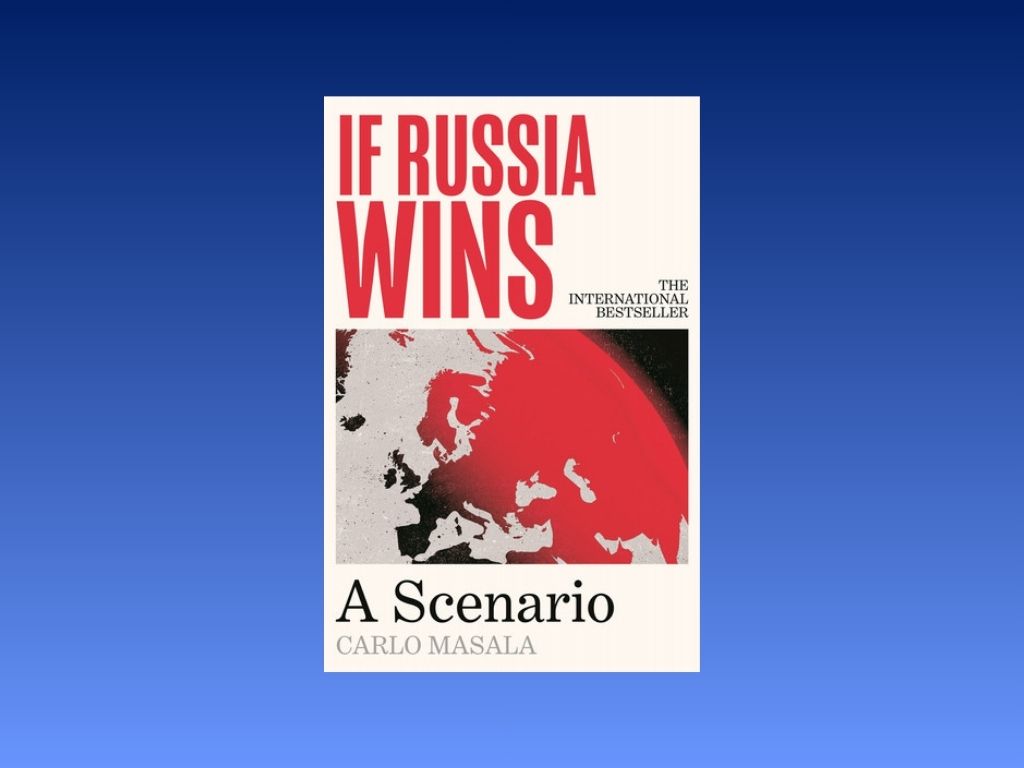
This compact work by Bundeswehr University München professor Carlo Masala is in its sixth printing in German. An English translation, or other translations, might become available. Written mainly for a non-academic public, it is part hypothetical scenario, part reportage, part political thriller, with some specialist International Relations theory in the background. Above all, it is a critique of Western complacency and irresolution toward the Putin regime in Russia.
The scenario portends realisation if preventive measures are not implemented. It begins in March 2028, when Russian forces cross the Narva River to occupy the Estonian city of the same name, along with an island in the Baltic Sea. After describing these operations in a brief initial chapter, the text proceeds as the retrospective story of a gathering storm for the West, especially Western Europe, plagued by bureaucratic inertia, indecision, disunity, apprehension, and myopia—unable to see or act to prevent the actual Russian attack on Ukraine in 2022, nor what might follow.
In scenario mode, the book imparts that in 2025 Ukraine was militarily defeated and forced to accept a “peace” agreement, signed in Geneva, and concede about 20 per cent of its territory. Western actors accept the outcome, some more readily than others. After his victory, Putin surprisingly retires voluntarily and is replaced by a 47-year-old economist who continues largely the same policy and political direction as his predecessor.
Concurrently, the book conveys that in the current real world, the West possesses far greater resources than Russia, which is under severe pressure to subdue, let alone defeat and occupy, its smaller and less-equipped neighbour, Ukraine. However, the West cannot sufficiently assert itself to end the war favourably and compel Russia to desist from provocations against NATO states, especially around the Baltic region. Domestic political and psychological problems hinder some European countries from comprehending what is happening and acting accordingly, causing vacillation or underpreparedness. Aware of their susceptibility to populism and hybrid warfare, the Kremlin persistently tests NATO to see how far it can go before provoking a vigorous response. Russia’s alliance with the People’s Republic of China assists in diversionary and other purposes.
Three (and now four) years after the Ukraine invasion, Russia uses multiple tactics to support its war effort: drones, balloons, planes, and submarines enter European airspace and waters, while migrants from Africa and the Middle East are pushed across land borders from Belarus and Russia. The concern of small Baltic states—Estonia, Latvia, and Lithuania—is reflected in their apparent hypervigilance. Despite restrictions, however, there is still two-way traffic over the bridge separating Narva (and thereby NATO territory) from Ivangorod on the Russian side of the river. Narva’s population is almost 90 per cent native Russian speakers. That does not mean that a majority exhibits primary loyalty to the Moscow regime, or would if what the book conjectures were to occur. Yet the prospect cannot be excluded. In any event, Mother Russia is 100 metres away. These are among the many issues the book notes or hints at.
Although it makes no claims to being intensive academic research, the book, perhaps unintentionally, points to divisions within the broadly conceived “Realist” school (classical, neo- or structural, neoclassical, defensive, offensive, etc.) to which Masala belongs. Despite the commonalities of this approach, individual adherents do not, in practice, interpret world affairs uniformly nor advance the same policy prescriptions. Some say the West is responsible for the crisis with Russia (Mearsheimer), some that the West should not interfere, while others insist that the West must assist Ukraine. The subtext of Wenn Russland Gewinnt goes beyond appeals for prudence or contentions that material power capability is the sole significant factor in world politics. This slim volume expresses disquiet that what has happened can happen. It transmits a normative message— fiat iustitia et pereat mundus—a plea for a more militant liberal democracy that demonstrates resolve and accepts domestic political risks when confronted with authoritarianism.
This is a review of Carlo Masala’s If Russia Wins (Atlantic, 2025), ISBN 9781805465744
Dr Steve Wood is an Associate Professor in Politics and International Relations at Macquarie University, Sydney. He is the author of four books and articles in Cooperation and Conflict, Review of International Studies, Energy Policy, International Relations, and Cambridge Review of International Affairs. In 2022 he was the recipient of an Alexander von Humboldt research grant.
This article is published under Creative Commons License and may be republished with attribution.