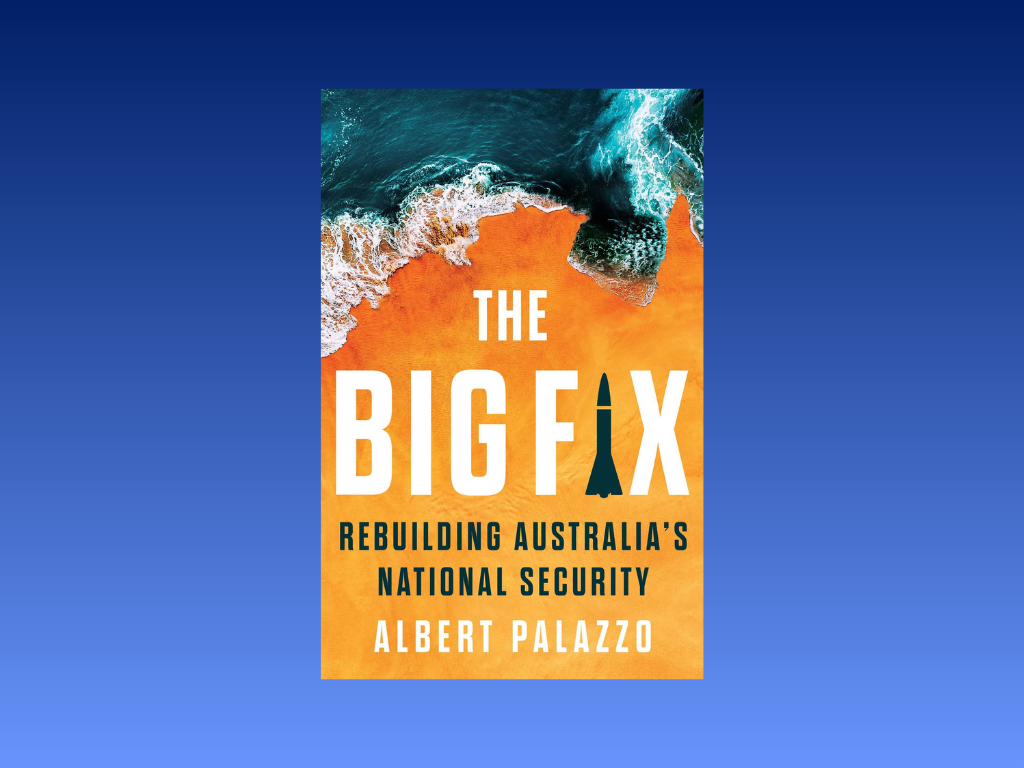
The Big Fix continues in line with Palazzo’s trend of presenting well-considered analysis regarding his adopted country’s security vulnerabilities, both current and pending. Refreshingly, he unfailingly moves beyond the task of casting stones to provide recommendations. Palazzo does so in the context of an increasingly less reliable American ally, an experience with which Australia is intimately familiar, given its past as a junior member of the British Empire during the world wars.
Dr Albert Palazzo, late of Brooklyn, New York, now an Australian citizen and voice within the latter country’s defense community (or “defence” if we want to maintain a Down Under ambiance), is a prolific writer. He is unfailingly one to, at a minimum, stir readers’ brain cells. He can also incite something akin to frothing-at-the-mouth rage in those who feel their windmills are under assault. But while Don Quixote’s windmills were mistakenly taken for giants, Palazzo’s are giants in reality, ones whose policies are of vital—even survival—importance to their country and broader regional and worldwide actors. Whether his quest to motivate revision of Australia’s political and security strategic thinking succeeds or proves futile remains to be seen. Regardless, this is an important book for what it says as well as for what it implies.
Earlier works of Palazzo’s books include Planning Not to Lose (a largely theoretical study of victory and political warfare; 2021), Climate Change and National Security (with particular focus on accompanying sea level rise and related disasters; 2022), and Resetting the Australian Army (a look at the country’s defense/defence strategy and army force structure; 2023).
In The Big Fix the author summarizes his objective as “to outline and promote a different and better path for the attainment of Australia’s national defence and security, one in which a policy of dependency on a foreign state is not the central feature.” (5) His “different and better path” is the Strategic Defensive, capitalized given Palazzo believes the term is an appropriate moniker for the country’s formal security policy in addition to its meaning in security literature. In considering the way ahead, Palazzo returns to the earlier discussions in his books on force structure while looking beyond military considerations alone, a later approach he finds remarkably short-sighted for overlooking the threats posed by climate change.
By putting other defense challenges on par with those of the military, Palazzo joins an increasing but still underrepresented group, one that recognizes the inadequacy of circumscribing national security primarily in the context of military capability. He continues along these lines, stating that while he has chosen to focus on climate change as his non-military exemplar, he is aware that “there are many other potential threats deserving consideration by Australia’s security policy practitioners.” These include
the growing income gap between the masses of the poor and the wealthy elites; the possibility of another pandemic, including a weaponized one; the global weakening of democracy and resurgence of authoritarianism; and the potential for cyber and artificial intelligence to destabilise essential systems. (38-39)
No country views security exclusively in terms of military threats, of course. Those who are led similarly can monitor and, when necessary, take action when economic, informational, criminal, or other forms of aggression imperil. Palazzo’s pointedly calling out vulnerabilities to health challenges is notably pertinent both in light of recent COVID-19 experiences and the inexplicable Trump administration policies that increase world exposure to future infections and—arguably—invite deliberate malfeasance in introducing them. Yet too few leaders are preparing for the true scope of looming challenges. Fewer still have effective government structures and national strategies to address them.
In Australia’s case, Palazzo posits, policymakers view existing and future threats through the prisms of the country’s past and present reliance on the United Kingdom and the United States. It is a reliance that repeatedly demands the sacrifice of the nation’s men and women in the interest of maintaining that support. With London’s failure to meet its obligations after the fall of Singapore and sinking of the capital ships Prince of Wales and Repulse, Canberra looked to a partnership with the United States. It was not an immediate transition. Nor was the country ever entirely dependent on either for security. While it partnered with one or the other of the two powers in Malaya, Korea, Vietnam, and elsewhere, Australia has also asserted itself as a regional security power, as actions in late 20th-century East Timor and early 21st-century Solomon Islands exemplify.
Palazzo evaluates Australia’s security challenges today in light of the past. Citing the country’s 2023 Defence Strategic Review, he concurs, at least in part, “the defence of Australia’s national interest lies in the protection of our economic connection with the world and the maintenance of the global rules-based order.” (21) The same document overtly recognizes an increasingly regionally-assertive China as chief threat to the world’s rules-based order. It is at this point the author pointedly takes on the difficulties posed by Australia’s choosing to rely on continued American commitment, recognizing “to Australia’s leaders it must seem supremely ironic that under the Trump presidency the greatest threat to the global rules-based order could now turn out to be the United States.” (21) He also pulls no punches in arguing for a broader recognition of the threats Canberra should incorporate in his proposed Strategic Defensive policy. Palazzo takes particular aim at defense budgeting that grossly favors the Royal Australian Navy at the expense of ground, air, and cyber capabilities, the result of commitments to acquiring nuclear-powered submarines and Hunter-class frigates, and an accompanying assurance that national shipyards will maintain viability. This approach, he states, leaves the country with only seven surface warships in the period 2026 to “about 2033.” (104) That current government policymakers limit themselves to an approach only concerning risks “originat[ing] from another state or sub-state actor to the exclusion of other kinds” he finds “can be politely described as immature [and] unimaginative because it is unable to appreciate national security threats [not falling] within narrow and predetermined boundaries.” (54)
Palazzo describes his Strategic Defensive both in terms of what it is not and what it should be:
The Strategic Defensive means neither neutrality, utopian disarmament, nor retreat into isolationism. Australia would continue to maintain…a well-resourced and powerful military. [The Australia-New Zealand-United States] alliance could also remain in effect, although it would no longer serve as the foundation of Australian defence as is presently the case…. Designing, equipping, and training the [Australian Defence Force] for interoperability with a great power partner would no longer be the force’s guiding ambition, as it is now…. Australia would look to itself for its security and, in doing so, become a fully sovereign and independent nation. (7-8)… The weakness in relying on an imperial leader—a foreign state, let us not forget—to define one’s grand strategy is the risk that the senior partner may settle upon a poor or inappropriate one, or even go without. (96)
Palazzo is right to question the continued reliance on a partner that, of late, demonstrates it is anything but reliable. Australia, however, cannot afford to cast aside its relationship with the United States altogether. Difficult as dealing with the current administration is, this, too, shall pass. No single nation can secure the welfare of the Pacific region on its own. Australia is and will remain a necessary partner in this obligation in the service of world peace, countries’ sovereignty, and citizens’ self-determination. He is wise to emphasize that such security—national, regional, and planet-wide—is more than a function of armed forces’ might. He is accurate in stating that climate change is one of the additional threats to those securities. Palazzo’s book is both a reasoned argument for reconsideration of Australia’s security policy and a stick-in-the-eye for those who are self-trapped in a too-limited understanding of what policy should include. This reviewer would argue that Australia, like the United States and much of the world, where populations retain some hold on democracy, is already at war with countries that recognize the broader reality when it comes to what constitutes security. Whether through complacency, ignorance, or—ostrich-like—an unwillingness to confront reality, these nations’ leaders do not comprehend they are being assailed economically, diplomatically, informationally, and—perhaps, but perhaps not—militarily by others seeking to redefine current regional and broader orders.
This is a review of Albert Palazzo’s The Big Fix: Rebuilding Australia’s National Security (Melbourne University Press, 2025), ISBN 9780522881363
Dr Russell W. Glenn spent sixteen years in the think tank community and several more on the faculty of the Australian National University’s Strategic and Defence Studies Centre after 22 years US Army service. He has since retired in Williamsburg, Virginia where he continues to conduct research and write. Recent books include Gods’ War (an American Civil War novel) and Brutal Catalyst: What Ukraine’s Cities Tell Us About Recovery From War.
This article is published under a Creative Commons License and may be republished with attribution.