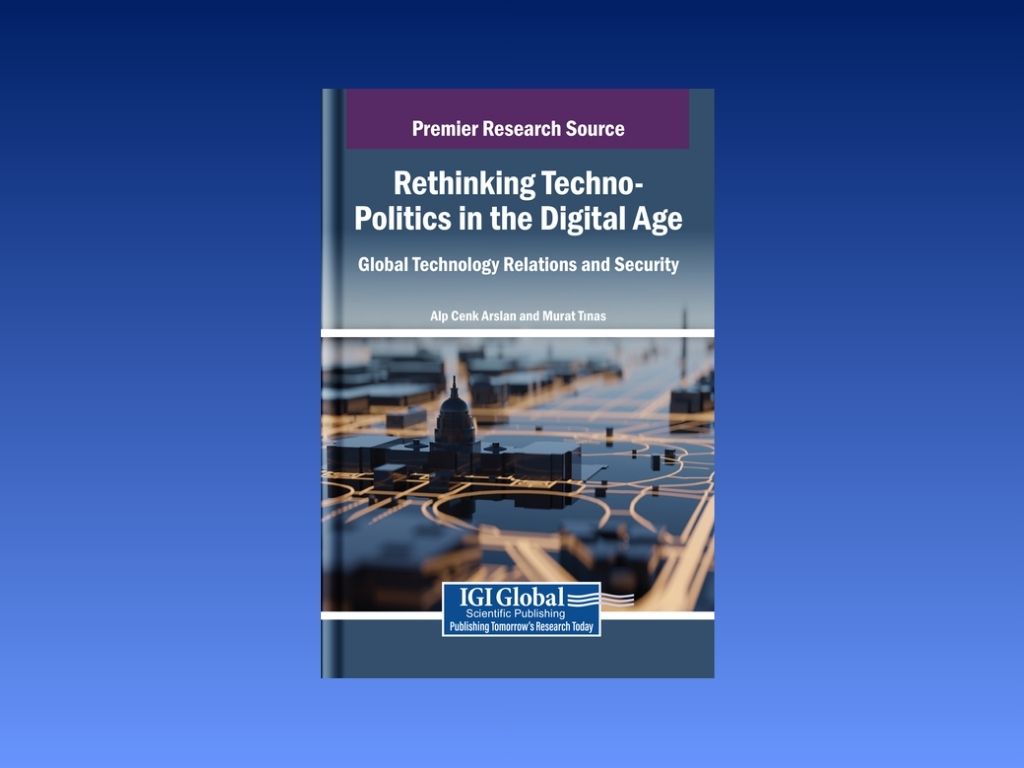
‘Rethinking Techno-Politics in the Digital Age: Global Technology Relations and Security’ offers an interdisciplinary framework that delves into the symbiotic relationship between technology, political authority, security, and global power dynamics.
The book, comprising ten chapters, brings together a diverse range of current academic discussions, spanning artificial intelligence (AI) policies, algorithmic radicalisation, cyberattacks, and data protection law. In addition, it also addresses the political and social impacts of digital infrastructures and digital media, as well as new-generation surveillance tools such as digital government applications and facial recognition technologies. While discussing hybrid regulatory models within the context of global governance, the authors make the normative and ideological dimensions of the digital realm visible through the concepts of internet aesthetics and techno-politics. The work serves as a comprehensive reference source and examines the reciprocal interaction between technology and politics through a multi-layered analysis.
The book appoaches today’s digital transformation not merely as a technical advancement but as a techno-political process that reconstructs the ontological foundation of politics. Its main argument is that technology has ceased to be merely a tool (techne) serving political ends and has transformed into a creative force (poiesis) that constructs new political realities. It examines critical themes such as AI, smart cities, digital sovereignty, and cybersecurity across a broad theoretical spectrum, drawing on thinkers ranging from Carl Schmitt and Langdon Winner to Sheila Jasanoff and Bruno Latour.
The first part focuses on the philosophical foundations of techno-politics. The opening chapter by Arslan philosophically presents the transition from the instrumental nature of technology (techne) to its constitutive nature (poiesis). The author argues that digital infrastructures are restructuring sovereignty and blurring public-private boundaries, producing new political orders. The section addresses the rise of big technology companies as semi-sovereign actors, whose market values exceed national GDPs and whose user bases rival global populations.
The second chapter, authored by Jonathan Stein and Matthew Murphy, examines how social values are quietly displaced in AI policies. The authors use examples to show that the deep integration of technology companies with the state prioritises operational values such as efficiency and security over societal values like justice, accountability, and sustainability. Warren Alan Bowles, in contrast, proposes a therapeutic approach to the global AI race, discussing how technology can be restructured within the framework of human-centred values and fundamental rights. At the end of the chapter, Ufuk Ayhan compares and analyses the techno-political dimensions of smart cities, using China and the UK as examples, and questions the ideological neutrality of digital infrastructures.
The second section of the book delves into the effects of techno-politics on identity formation and governance through empirical and theoretical case studies. Atdhe Lila’s fifth chapter analyses different AI governance models in the EU, US, and China, proposing a hybrid regulatory model that balances global interoperability with national sovereignty. Begçecanlı’s sixth chapter, entitled ‘Digital States: The New Frontier in the Techno-Political Power Struggle’, argues that in this era where data has become as valuable as oil, real authority has shifted from states to platform ecosystems. In the seventh chapter, Kılıç evaluates Europe’s pursuit of technological sovereignty through the lens of Kondratieff’s long-wave theory and Schumpeter’s concept of creative destruction. The author describes the EU’s regulatory initiatives, such as the Digital Markets Act and the AI Act, as a strategic resistance to American techno-political influence and the construction of a new paradigm. In the next section, Zeki Can Saroğlu investigates perception management within a psychological framework, focusing on implicit learning processes in digital media. He demonstrates how algorithmic filters and micro-targeting reinforce ideological homogeneity. Zeynep Melike Saroğlu, on the other hand, analyses the depoliticising effect of aesthetic movements in internet curation (cottagecore, balletcore, etc.) on youth identity, drawing attention to the rise of passive identity performance in digital panopticons.
The major contribution of this work to the literature is its holistic approach, which rejects the view of technology as a technical field separate from politics. The book expands on Castells’ ‘network society’ and Zuboff’s ‘surveillance capitalism’ theories, arguing that technology is not merely a tool of surveillance but also a constitutive element of political ontology. The blending of concepts such as ‘techno-diplomacy’ and ‘digital sovereignty’, drawing on both Western-centric perspectives and insights from the Global South, enhances the book’s global inclusivity.
The book’s methodological rigour lies in its ability to combine philosophical abstractions with current political events (the Russia-Ukraine war, the US-China chip wars, and applications of the General Data Protection Regulation). In a world where code becomes law and data defines sovereignty, authors are successfully filling the algorithmic governance gap left by traditional political science. However, while the book occasionally paints a pessimistic picture when discussing the limits of individual and collective agency in the face of technology’s immense transformative power, it balances this dark outlook with the normative futures roadmap presented in the concluding section. The concluding chapter provides a strategic framework for a human-centred, ethical, and participatory digital governance model.
In sum, this book is a significant contribution in the field of technology and security studies. It is a valuable resource for both academic researchers and policymakers seeking to understand how power operates in the digitalising world. The main contribution is its redefinition of the political conditions of the twenty-first century by elevating the technology-politics relationship from an instrumental level to an ontological one. This work offers a notable synthesis that combines theoretical depth with practical strategy for anyone seeking to navigate the complex techno-political landscape of the digital age.
This is a review of Rethinking Techno-Politics in the Digital Age: Global Technology Relations and Security. Edited by Alp Cenk Arslan and Murat Tınas. Hershey, PA: IGI Global. 2026. ISBN 9798337324593.
Seda Çolakoğlu is a PhD researcher in the Department of International Security at the Institute of Security Sciences, Turkish National Police Academy. Her research focuses on critical perspectives related to security, (counter) terrorism, and political violence, as well as various aspects of gender within the contexts of international security and (counter) terrorism.
This article is published under a Creative Commons License and may be republished with attribution.