‘Crucible’ according to the Oxford English Dictionary refers figuratively to any severe test or trial. This surely is what contemporary Asia is undergoing. In a masterly analysis Nick Bisley demonstrates the essence of what this situation entails: how it came about, how it has developed in more recent times, what might emerge in the future, and what might be done in favour of more benign outcomes.
After the introductory chapter, chapters 2-4 discuss the long-term historical perspective; chapters 5-9 cover more recent history with reference to likely future developments; chapter 10 has recommendations for minimising conflict and securing the region’s future.
The strength of the book is the way the author builds the analysis around the themes of geopolitics and geoeconomics, and how those themes intersect. There is a lot of detail but presented in a disciplined way to highlight the two themes. Modern Asia, meaning primarily Northeast and SoutheastAsia, South Asia and Central Asia, emerged from the experience of imperialism to become a major focus in the Cold War (centred in this context on the rivalry between the United States (US) and China), while also benefiting from economic modernisation and especially the shift to globalisation.
The extent of growth within the more integrated regional economy is developing within a wider system of globalisation. China was the major beneficiary, but not the only one, if we think of the ‘Asian tigers’ and other countries such as Indonesia, Vietnam, Thailand, and Malaysia, not to mention Japan. These developments (geoeconomics) in turn had an impact on geopolitics. Most notably, China became much more powerful, with consequences for a number of conflicts discussed in the book, such as Taiwan, the South China Sea, and Sino-Indian border disputes. More broadly, the question is whether other powers, especially the US and its allies, will accept the shift in geopolitics arising from what has occurred in geoeconomics.
A key point in chapter 10 about ‘Securing Asia’s Future’ is that there needs to be ‘a genuine strategic balance’. Bisley says he is not arguing for accommodation or acquiescence but rather a better understanding of what drives the powers involved. While it is too simple to focus just on the US and China (as the book amply demonstrates), ‘balance’ implies a shift away from US primacy, with an acceptance of China being in a stronger position geopolitically than was previously the case.
The book shows well how globalisation has led to improved economic circumstances for a huge segment of humanity. While suggesting various ways in which the worst-case scenarios in geopolitics can be avoided or minimised, the author also advocates a strengthening of links among countries that favour a more open economic model. In this respect he argues for a stronger relationship between the CPTPP (Comprehensive and Progressive Agreement for Trans-Pacific Partnership) countries and the European Union.
The point about Trump having ‘shown a distaste for foreign wars’ (p. 165) needs modification in the light of the US/Israeli attack on Iran. Trump was not a latter day isolationist after all, but what are the implications for the US role in East Asia, especially Taiwan? The US role in the Middle East (West Asia?) needs to be factored into any consideration of the US role in Asia. Recent developments have huge implications for US-China relations, but it is too early to tell whether there will be a long term shift in the US role in East Asia because of the Middle East war.
The various maps in the book help to clarify different conflicts and situations discussed in the text. Inscribing ‘Qing dynasty’ on a map of China in 1927 was confusing. Thailand is missing from the list of ‘swing states’ in Table 6.1 on the strategic alignment of Asia’s states.
A helpful section of the book is the literature survey in the section on Sources and Further Reading, organised according to the chapters in the book. The References at the end of the book also provide a very strong list for readers wanting to explore further.
I thoroughly recommend this book for its incisive analysis of the intersection of geoeconomics and geopolitics in Asiaall while giving due attention to the historical contextand emphasising more recent developments and possible futures. We live in momentous times. This book contributes to a better understanding of those times as they relate to Asia broadly defined. But then, to quote a well-known Russian revolutionary, ‘what is to be done’? While the book mostly focuses on what governments might do, this is also a question that applies to each of us as part of the region and as global citizens.
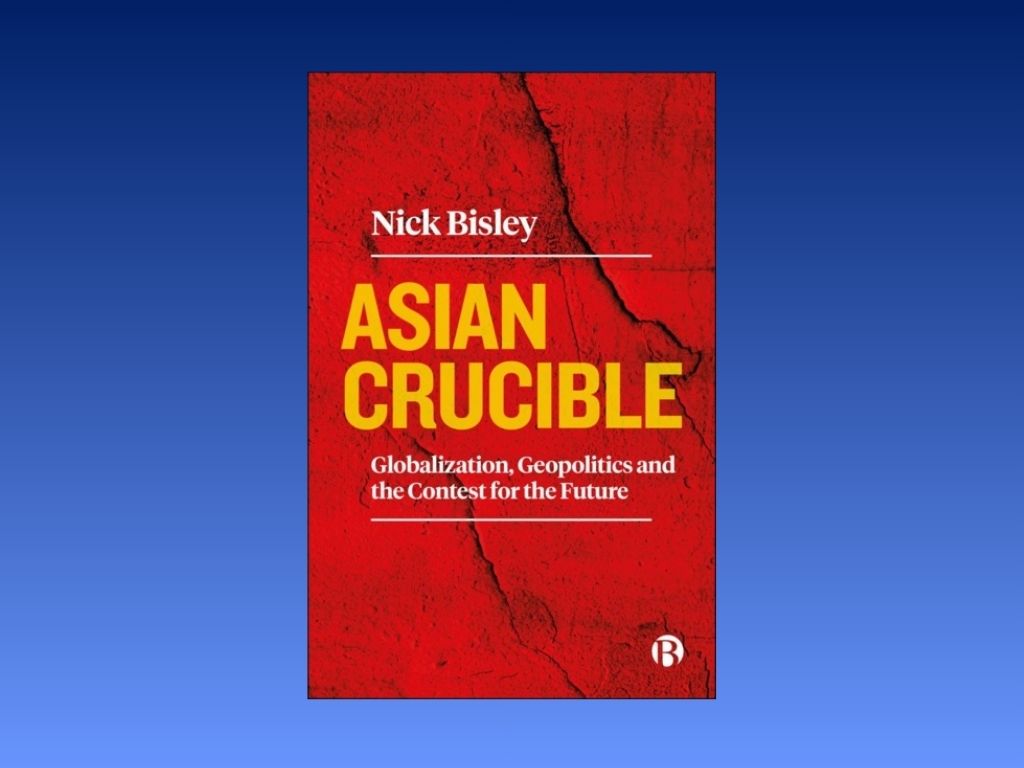
This is a review of Asian Crucible: Globalization, Geopolitics and the Contest for the Future by Nick Bisley. Bristol University Press, 2026. ISBN 9781529233179 (paperback), 9781529233186 (ePub), 9781529233193 (ePdf).
Derek McDougall is a Professorial Fellow at the School of Social and Political Sciences at the University of Melbourne.
This article is published under Creative Commons License and may be republished with attribution.