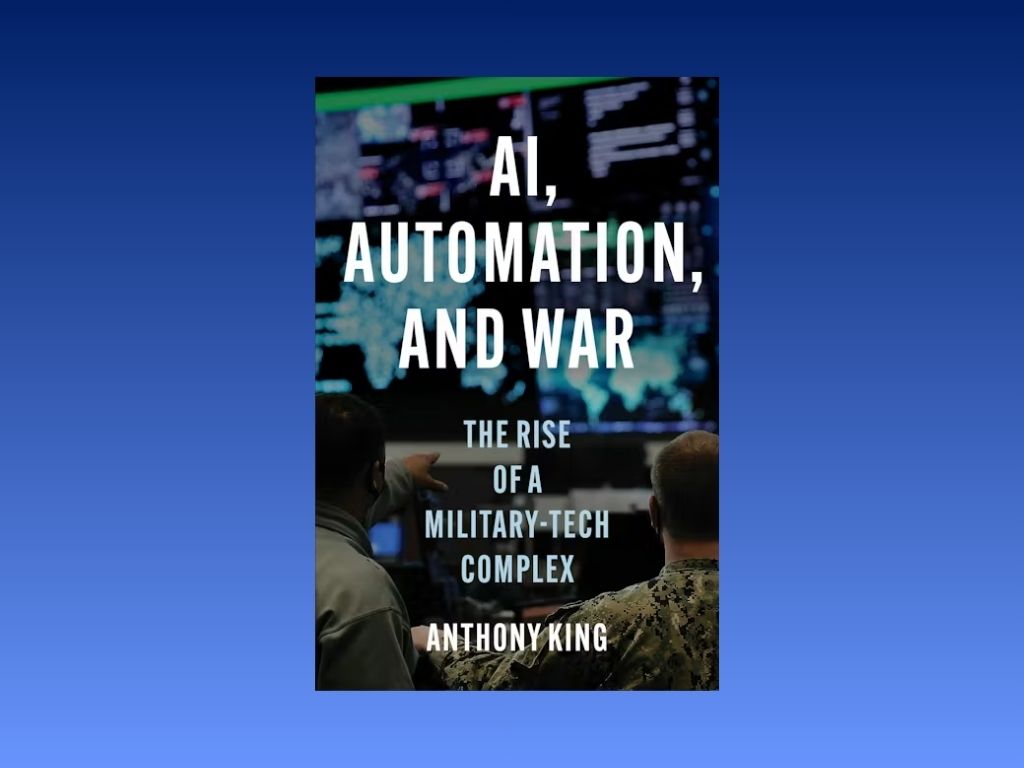
AI, Automation, and War: The Rise of a Military Tech Complex is a book by Anthony King that offers a detailed and critical account of artificial intelligence (AI) in modern military contexts. The author uses case studies, doctrinal examination, and historical analysis to deliver this study.
He also challenges prevailing beliefs regarding autonomous warfare. The operational and technological data provide substantial empirical support for the paper’s core argument that AI is primarily utilised to augment human judgement rather than replace it. This vision is utilised repeatedly throughout the novel. This study, situated at the crossroads of military studies, science and technology studies, and security policy, provides an important counterweight to the inflated claims about “killer robots” and fully autonomous fighting systems that are circulating in popular and academic circles. The opening chapter effectively sets the stakes for the argument by characterising artificial intelligence as a technology with great revolutionary potential but also facing considerable obstacles.
Alarmism, Determinism, and AI
The author uses the views of futurists and sceptics such as James Lovelock, Ray Kurzweil, Geoffrey Hinton and Henry Kissinger to present artificial intelligence (AI) as a contemporary-day Prometheus. AI may be very efficient, but it could potentially destabilise the world. I think the debate about AlphaGo as a metaphor for the potential and limits of computer innovation is very interesting. You can’t always escape alarmism, but the chapter begins with high-profile examples and remarks from specialised sources. It doesn’t adequately contextualise the forecasts of military and technological elites in historical and practical limits, but it does lean on warnings from such experts.
The chapter’s challenge to technological determinism, and especially its invocation of David Hume to challenge extrapolations from current trends, makes a strong conceptual underpinning for the book’s larger argument: that artificial intelligence complements, not replaces, human decision-making.
Chapter 2 contains an in-depth, historically accurate review of the technical history of artificial intelligence, providing more information on this topic. The author maps the evolution of innovations such as ImageNet against a backdrop of rising processing power, greater data availability, and algorithmic improvements. The author chronicles the progression of these advances, from the symbolic artificial intelligence of Simon and Dreyfus to the machine learning and deep neural networks of today. This chapter aims to illustrate the potential and limits of artificial intelligence using real-world examples from firms like Amazon, Netflix, and Google.
This chapter has an appropriate level of technical difficulty. A major achievement in artificial intelligence is to represent it as probabilistic rather than deterministic, enabling it to perform repetitive tasks and find patterns. It doesn’t have the capacity to analyse causally, assess contextual circumstances and make ethical judgements. The critique of large language models, and in particular generative systems such as ChatGPT, reiterates the book’s central thesis: that artificial intelligence is here to stay as a decision-support tool. It also points to the continuing gulf between technical proficiency and independent agency.
The third chapter addresses the problem from a doctrinal perspective by analysing the attitudes of key nations, such as the United States of America, Russia, and China, towards artificial intelligence and their respective military projects. The talks on integrating artificial intelligence into multidomain operations and the detailed exposition of the United States’ Third Offset Strategy are particularly informative. The author draws effectively on government policy documents, practitioner testimony (e.g., Frank Kendall, Jack Shanahan) and operational examples to illustrate that the value of artificial intelligence is not in autonomous execution but in intelligence fusion, information processing, and faster decision cycles. Evaluations of partner strategies, such as NATO and British strategy, are continuously preoccupied with “data dominance” over autonomous lethality, dispelling the idea of an artificial intelligence arms race, contrary to popular perception. The methodological rigour of the chapter is significant in that it counters alarmist narratives in public and academic contexts through a combination of empirical observation and doctrinal analysis.
Digitally Mapping the Military
Chapters four and five take a closer look at the sociotechnical and organisational aspects of the employment of artificial intelligence in the military. The book examines the formation of a military-tech complex, the political and strategic repositioning of tech entrepreneurs and the historical development of Silicon Valley, and contends that AI is part of a larger ecosystem of corporate expertise, venture capital and state policy. The debate on Project Maven, the Defence Innovation Unit and the JAIC highlights the increased reliance of the armed services on private-sector experience and talent to operationalise AI. It achieves this by highlighting the interaction between technological capabilities, organisational culture and human labour. The emphasis on Special Operations Forces as intermediates for testing and deployment in Chapter 5 shows that the adoption of AI is a difficult subject, including both technological and organisational/cultural elements. In these parts, the author’s critical perspective is brought forward, in which the success of AI is ascribed not to autonomous algorithms but to human networks, trust and iterative co-development.
Chapter Six considers the practical applications of AI, how it might improve cyber operations, targeting, and planning, while maintaining human control. The author illustrates the real-world advantages of AI through in-depth case studies, including MCOSM, BRAWLER, the UK’s Microworld, Elbit’s Torch, and Ukraine’s Delta and Lattice systems, which improve situational awareness, speed up simulations, and fuse streams of data. An essential similarity between AI-enabled planning and earlier mapping achievements is that AI is a dynamic decision support tool, like a digital map, rather than an autonomous commander. Large language models, such as Hermes, are being investigated in the emerging field of AI-assisted planning. This indicates that these systems can generate hypotheses and synthesise intelligence, but they still require human interpretation and oversight. This chapter illustrates the book’s basic argument: AI augments human capabilities without assuming leadership, strategic, or judgmental duties.
In chapters seven to nine, we empirically analyse human-AI cooperation in targeted and operational situations. In this piece, the author looks at initiatives such as Project Maven, the Israeli AI systems Gospel and Lavender, and Task Force Dragon in Ukraine, and makes the case that AI remains under human control as it becomes more accurate, faster, and more scalable. Human-machine teaming is full of interesting aspects, and one of them is how it challenges the idea that AI is an equal partner, while also underscoring the necessity of leadership, civilian knowledge, and organisational frameworks for effective operations. These chapters are based on a civil usage of AI-enabled targeting principles that may be employed outside of combat but would still depend on human judgment, namely the British Army’s COVID-19 testing in Liverpool. The examination of algorithmic warfare, cyber operations, and diaspora involvement in chapter eight provides more evidence that AI complements rather than replaces human strategy. The last chapter situates AI-enabled fighting within a broader strategic context and addresses the theoretical and practical issues of automated war and operational deployments.
Key Takeaways
The practical ramifications of artificial intelligence are clearly explored through problems such as current conflicts, including the war between Russia and Ukraine, the absorption of the private sector (e.g., Starlink), and hybrid military-tech teams. I believe this chapter must recognise that there are boundaries to what artificial intelligence can do. Artificial intelligence may accelerate data processing and enable attacks to be launched with more accuracy, but it cannot ensure that a plan will be effective. In addition, information management, sensor saturation, and the attrition inherent in contemporary warfare may still limit the operational tempo. The author also discusses legal and ethical issues, pointing to the precarious situation of civilian information technology workers, a crucial but often ignored dimension of technology assessments.
This book not only provides a thorough, critical, and empirically based review of artificial intelligence (AI) in modern conflict, but also combines academic rigour, historical context, practical case studies, and technical rigour. Its fundamental relevance is that it utterly disproves the notion of autonomous fighting and presents persuasive evidence that artificial intelligence can enhance human decision-making, operational efficiency, and organisational agility.
The reading of this material is not always easy, and the quantity of information that is offered in certain chapters, especially those that deal with military systems and technical specifications, may be excessive. On the other hand, it is always interesting because it connects the discussion of policy, actual actions, and theoretical analysis. The paper calls for more detailed research into the ethical and legal aspects of civilian involvement in military operations, as well as studies comparing the adoption of artificial intelligence in various countries and the socio- organisational aspects of AI adoption.
This book is an essential, relevant and thorough addition to the topic of military AI, analysing its strengths, shortcomings and organisational impacts. It dispels apocalyptic scenarios and offers factual detail while placing AI within a wider social, political, and institutional framework. This book will provide key insights and vital information to academics, policymakers and practitioners interested in the nexus of technology, strategy and defence, and assist them in assessing current and future advancements in AI-enabled military processes. It is a must-read for anyone seeking to understand the impact of AI on modern combat, balancing optimism, scepticism, and empirical studies well.
This is a review of Anthony King’s AI, Automation, and War: The Rise of a Military-Tech Complex. Princeton University Press, 2025. ISBN: 9780691265148
Nimra Javed is a Research Officer at the Center for International Strategic Studies AJK, working on Emerging Technologies. She holds an MPhil Degree in Strategic Studies from National Defence University, Islamabad.
This article is published under a Creative Commons License and may be republished with attribution.