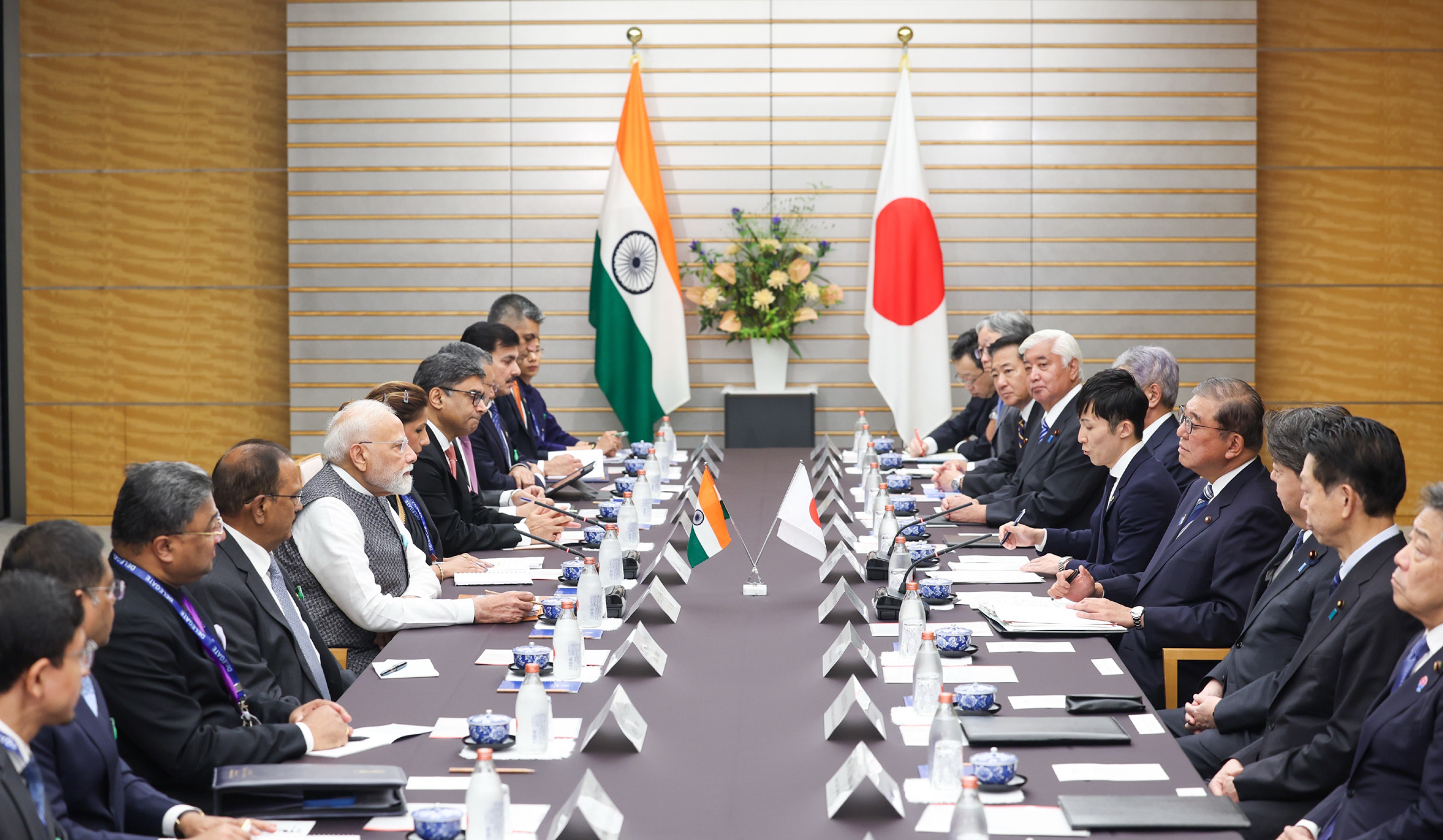
Japan’s new leadership is increasingly focused on deepening tieswith India as a counterweight to China. The “Free and Open Indo-Pacific” vision and talk of a quasi-alliance frame this partnership in strategic terms.
On the Indian side, the Act East Policy (AEP), launched in 2014 as the successor to the Look East Policy (LEP), aimed to deepen India’s engagement with Southeast Asia through trade, infrastructure, and people-to-people links. The best way to understand how this partnership is unfolding on the ground is to look at recent developments in the northeastern state of Assam, a region once treated as a remote frontier but now emerging as the hinge that can swing South Asia toward Southeast Asia.
The transformation was on full display at the “Advantage Assam 2.0” Investment and Infrastructure Summit in Guwahati on 25-26 February 2025. Attended by representatives of sixty-two foreign missions, the meeting showcased Assam’s claim to be “the gateway to Northeast India and Southeast Asia.” Speaking at a session titled “Act East, Act Fast and Act First,” Japanese Ambassador ONO Keiichi highlighted Tokyo’s expanding footprint: more than ₹22,000 crore committed to roads, water systems, electricity, health care, biodiversity and, most symbolically, the flagship North-East Road Network Connectivity Improvement Project. That project is stitching together transport corridors that lead from Assam through Meghalaya toward Bangladesh and, beyond, to Myanmar and Thailand, weaving India’s domestic markets into the economic fabric of Southeast Asia.
Infrastructure, however, is only half the story. The other half is human capital. Japan’s population is aging rapidly, with the average age nearly 48, while Assam’s median age hovers around 22. Recognising the demographic complementarity, Chief Minister Himanta Biswa Sarma launched the Chief Minister’s Foreign Language Initiative for Global Human Talent (CM-FLIGHT) in July 2025. The programme will train 3,000 Assamese youths in Japanese to the JLPT N2 level, qualifying them for Japan’s Specified Skilled Worker visas. Each participant will receive a government subsidy of ₹1.5 lakh toward tuition, with the remainder payable through bank loans easily serviced by entry-level salaries in Japan, which can reach ₹2.5 lakh per month. Partnerships with Japanese firms like ASEAN ONE Co. Ltd. and Meiko Career Partners, forged during the Advantage Assam summit, ensure that training aligns with industry needs, making this a sustainable model for skill-based migration. For Assam, it is a pragmatic answer to unemployment and under-employment, for Japan, it is a lifeline for sectors ranging from aged-care nursing to information technology and for the wider region, it is an experiment in circular migration that ties communities together more tightly than any free-trade agreement.
This human capital initiative is just one facet of a broader strategic ecosystem being cultivated through high-level diplomacy and investment. Sarma’s January 2025 visit to Tokyo, followed by Japan’s Speaker of the House, Nukaga Fukushiro’s three-day stay in Assam, signalled that the partnership is becoming embedded in elite networks and bureaucratic routines. The Chief Minister used his Tokyo meetings to pitch a dedicated business park for Japanese firms outside Guwahati and to request the establishment of testing centres for technical intern programmes. In contrast, Japanese leaders expressed interest in sectors ranging from renewable energy to semiconductors to tourism. Back home, External Affairs Minister S. Jaishankar publicly acknowledged Japan’s unique role in the Northeast through the India-Japan Act East Forum, noting that mobility initiatives and capacity-building projects now receive priority treatment in bilateral discussions.
The strategic logic behind these moves is straightforward. Assam sits at the neck of the geographic corridor linking India not only to its own Northeast but also to the markets of Myanmar, Laos, Thailand, and Vietnam. Upgrading highways, bridges, and inland waterways, therefore, has regional implications well beyond state boundaries. Economically vibrant land routes between South and Southeast Asia help de-risk supply chains that currently depend heavily on contested maritime chokepoints. Japanese support for road projects in the Northeast and for deep-seaports like Matarbari in Bangladesh thus dovetails with Tokyo’s broader effort to secure alternative logistics pathways across the Indo-Pacific. At the same time, sending skilled Assamese to work in Japan does more than fill labour shortages; it seeds a network of remittances, cultural fluency, and professional contacts that will endure long after individual visas expire. For countries across Southeast Asia, which are themselves grappling with aging populations and digital transitions, the Assam–Japan model offers a template for how sub-national regions can mobilise international partnerships to leapfrog development stages.
Moreover, Japanese assistance in sectors such as bamboo value chains, forest management, and renewable energy underscores a preference for sustainable growth, dovetails with global climate goals, and reinforces a rules-based order built on transparency and mutually beneficial investment.
For New Delhi, the implications are equally far-reaching. By demonstrating that the AEP delivers visible gains, motorable roads, industrial parks, and overseas jobs, the government strengthens domestic support for outward-looking policies. It encourages other Northeastern states to pursue similar international partnerships. For Southeast Asian capitals, the message is that India’s engagement is increasingly multisectoral and grounded in projects they can measure in container volumes and tourist arrivals, not just communiqués. For the wider Indo-Pacific, the Assam-Japan nexus adds density to a regional architecture that balances major-power competition with developmental pragmatism.
Pratyush Paras Sarma is a PhD researcher at the School of Politics and International Relations. Research School of Social Science, Australian National University, Canberra. His research focuses on the strategic dimensions of election campaigns in the Indian context, with a specific focus on political parties’ behaviour during campaigns. Beyond his doctoral work, Pratyush examines international security and the intersection of global power dynamics and sport, expanding his academic engagement with themes of power, strategy, and global governance.
This article is published under a Creative Commons License and may be republished with attribution.