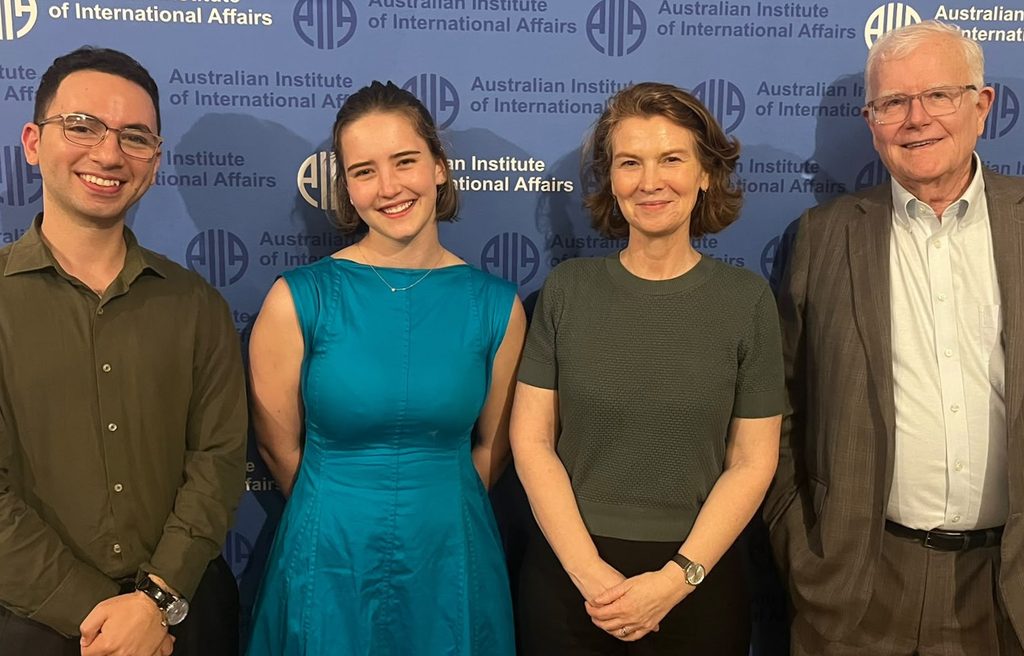
On Tuesday 3 November, AIIA New South Wales welcomed Elizabeth Thurbon, Professor of International Political Economy in the School of Social Sciences at UNSW Sydney and co-founder and Director of the university’s Green Energy Statecraft Project, to address us on how Australia might view the green energy transition as an opportunity to become a “renewables” superpower. This transition is transforming economies and relationships across the Indo-Pacific. For Australia, it can be a national security multiplier – strengthening economic, energy, environmental, social and geostrategic security. But these gains are not automatic.
Drawing on the work of the Green Energy Statecraft Project, Professor Thurbon examined how Australia can use its resources to build clean industries and reduce strategic dependencies. She suggested that cooperation on clean energy and industry can strengthen Australia’s security and reinforce its role as a trusted trade and development partner in the region.
Professor Thurbon explained that the energy transition is a techno-economic paradigm shift for governments and economies. To speed the shift, state actors must be both willing and able to invest in green energy creation and in fossil fuel destruction, two outcomes which affect different demographics. In the West, the focus has largely been to start with the latter. But the pattern of the North-East-Asian region has been quite different, starting with billions of dollars of investment in the mid-2000s on ambitious energy generation projects, with pressure on the fossils phase-out only now coming increasingly to the forefront.
The other major divergence, Thurbon argued, has been in ways of thinking about the purpose of the energy transition. In Australia, the focus has been on environmental necessity, which has had limited bipartisan appeal. In North East-Asia, pursuing the energy transition quickly has been viewed as a “national security multiplier” – an opportunity to boost environmental security, but also energy security, economic security, social security, and geostrategic security.
This, the Statecraft Project concludes, has prompted a more positive attitude to the energy transition. Thurbon advocated for Australia to view investment in renewables as the cure to our “cascade of converging challenges”. By pursuing green energy transition “at pace”, she argued, Australia can boost its energy security and, by developing new industries, its economic security. It could allow us to grow new export markets, for example, in green ammonia and polysilicon, strengthening our relationships with partners in the Pacific and reducing our dependence on unpredictable global energy prices. Exporting green iron and green steel would offer new, profitable exports. But the government needs to deliver ambitious, strategic policy. Such statecraft can unite voters across the political divide.
Professor Thurbon’s presentation invited lots of engagement from the audience. A key question which emerged was why we should be relying on governments, rather than the market, to drive change. Professor Thurbon explained that consultation with industry has revealed that preliminary capital investment costs create a need for demand-side policy; no country has ever taxed its way to a techno-industrial revolution. The Green Energy Project proposes a policy whereby the government contracts to purchase the “green premium” on the first volumes of products like sustainable aviation fuel. The commodity then sells on the market at conventional prices, while the government banks “Clean Commodity Credits” to be traded later. Firm contracts also offer the benefit of being irreversible at the next election, building investor trust.
An additional question picked up from the discussion was whether the Project’s research has actually affected real world policy. Lily Manning, one of our Councillors, offered her perspective, shaped by working in government. She agreed with Professor Thurbon that the Project’s focus on demand has impacted the government’s approach to regional engagement.
Report by Rebecca Wallwork, AIIA NSW intern
Professor Thurbon (second from right) with AIIA NSW intern Rebecca Wallwork (second from left), Vice-President Christopher Khatouki (left) and President Ian Lincoln (right)