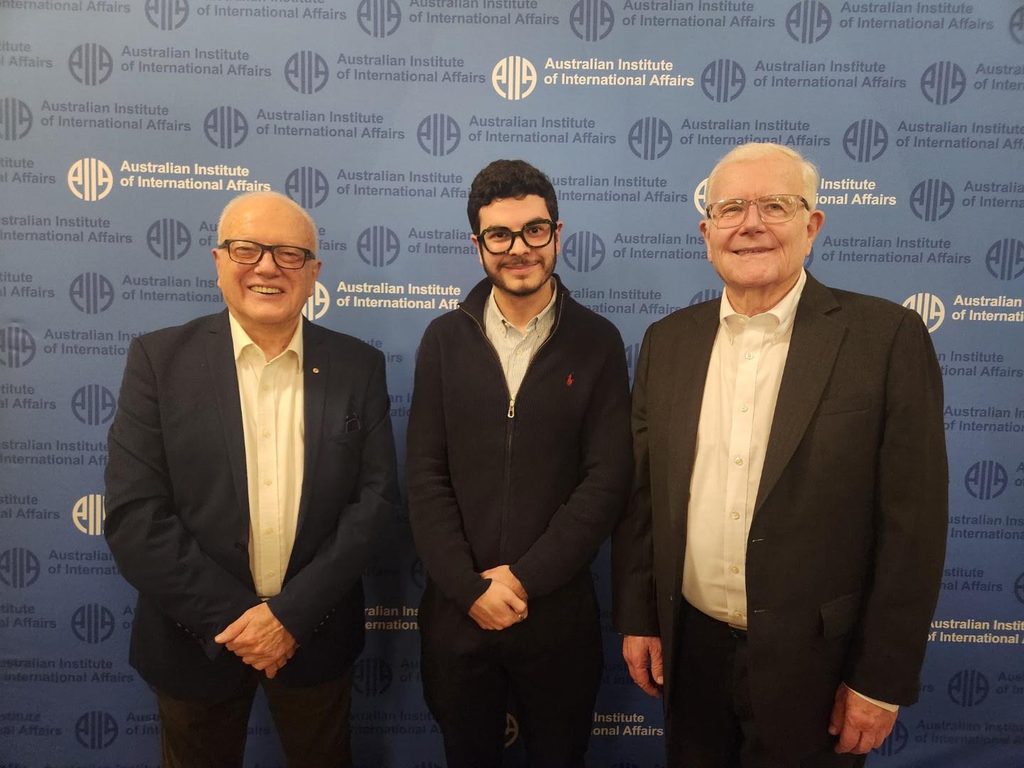
On 25 August, the NSW Branch of the Institute had the pleasure of welcoming our national president, Mr Gary Quinlan AO FAIIA, who delivered a most insightful presentation on middle powers and international influence. Mr Quinlan drew on his extensive professional experience as a senior diplomat and ministerial adviser to interrogate both the status quo and the need for change within a world order which is increasingly characterised by competition between hegemonic powers.
Mr Quinlan emphasised that Australia’s role in international diplomacy should not be underestimated. We have been one of the most influential middle powers both globally and regionally, beginning with our founding role at the 1945 San Francisco Conference, where Dr Herbert Evatt (then External Affairs Minister) pushed to expand the General Assembly’s influence and broaden the UN’s remit beyond security into economic and social affairs. Dr Evatt also sought to place limitations upon the veto power of permanent members, although the great powers held firm on this point.
Turning to the present, Mr Quinlan noted that the global rules-based order had depended on the primacy of the United States to hold it together. Although the power of the US and China is way ahead of everyone else, the increasing multipolarity between countries and the transactional and mercantilist approach of the Trump administration had damaged the old order fundamentally. He described a “polycrisis” of nuclear, ecological, technological and geopolitical and strategic risk, and the collapse of much of the global multilateral system meant to help manage this. He argued that too much of the UN-related global architecture, especially the financial institutions, still assumes American hegemony in a world that has become multipolar.
The Security Council desperately needs reform. Middle powers, he suggested, must build much closer cooperative resilience and reckon honestly with resentment felt towards Western-designed and selectively enforced rules. For Australia, this could mean leaning more into regional pluralism and deepening economic complexity: we needed to strengthen Australia’s own resilience with better supply lines, stronger manufacturing and research capacities, and an increased defence industry.
Although the US/China fault line is the most decisive for the future, middle powers can use regionalism as an instrument to try to ensure that the regional order is not shaped by the great powers alone. Mr Quinlan noted that ASEAN presents a unique opportunity as its member states have developed their own mechanisms to respond to regional challenges. Ultimately, for middle powers including Australia, there are opportunities to manipulate or reshape the regional order without exclusive reliance on American (or Chinese) power. The CPTPP was considered to be a successful model of this approach.
The audience question and answer session opened with discussion on whether middle powers should de-risk from the United States in the manner of Canada. In response, Mr Quinlan characterised PM Mark Carney’s Davos address as a necessary wake-up call to middle and smaller countries to mobilise quickly through increased collaboration to survive in a world where much of the old order was over, and where geopolitical and economic coercion had become the new normal. The US would remain the most consequential country but the Iran war had shown the limits of US power. It would remain the security partner of choice for many, but greater self-reliance, defence spending, and economic diversification were essential for the future.
Asked about the UN’s effectiveness, he argued for pragmatism: middle powers should identify which of its structures and programmes are genuinely worth preserving and pool resources to sustain them. We would have to accept that the UN system would be smaller and less funded in the future but its core functions were still vital; in particular, the role of the Specialised Agencies – which underpin the standards and rules by which the world operates every day through aviation, shipping, telecommunications, food security, global health, humanitarian assistance and so much else – must be preserved.
The final question hinged on Hugh White’s new book, published that day, Hard New World: Australia’s Post-American Future, in which White contends that it is no longer feasible to claim that America is the guardian of global order, that it may already have “lost Asia” and might itself need to recalibrate its role and step back in the face of growing Chinese power. Ultimately Mr Quinlan’s broader message was not that Australia should abandon its alliances, but that it must develop greater resilience at home and in its international partnerships (especially in the security domain), a broader-based economy, and diplomatic independence to operate more effectively in a contested and fragmented world – one in which the fundamental assumptions about our security and prosperity can no longer be relied on.
Report by Jack Bettar, AIIA NSW intern
From left to right: AIIA president Gary Quinlan, AIIA NSW intern Jack Bettar and AIIA NSW president Ian Lincoln