India-China relations are entering a new phase in which economic cooperation and diplomatic engagement are increasingly conditioned on stability along the disputed border. As New Delhi reassesses the strategy of compartmentalising economic ties from territorial tensions, the question is no longer whether India and China can engage despite their border dispute, but whether genuine normalisation is possible without first rebuilding strategic trust along the Line of Actual Control.
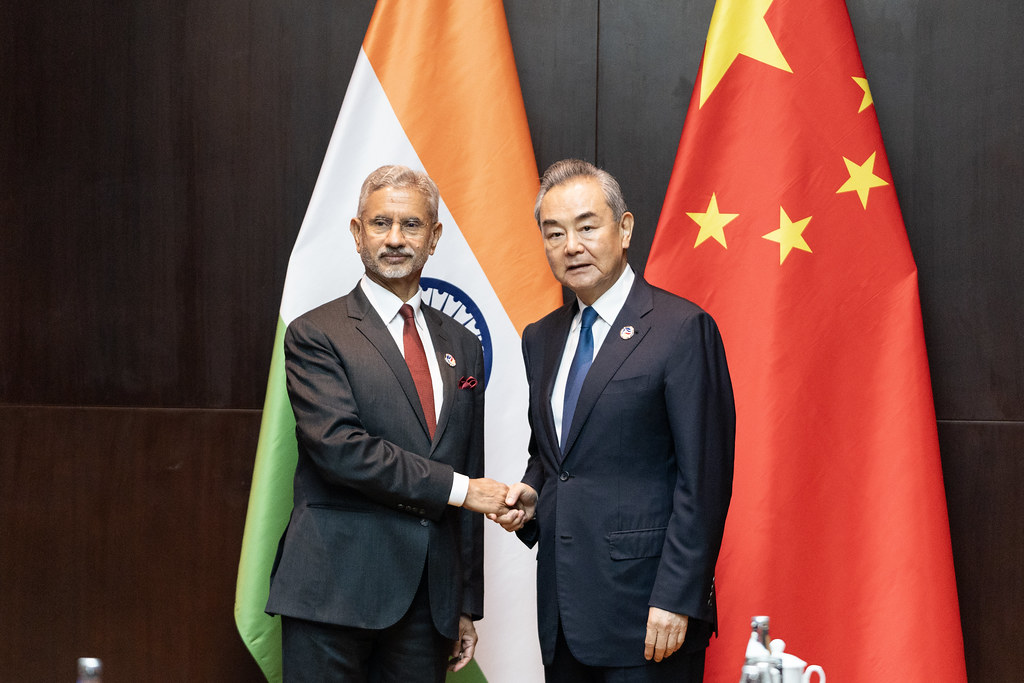
The meeting between Indian External Affairs Minister S. Jaishankar and Chinese Foreign Minister Wang Yi on the sidelines of the ASEAN Foreign Ministers’ Meeting in July 2026 may have appeared to be another routine diplomatic engagement. Yet Jaishankar’s remarks once again underscored a principle that has steadily become central to India’s China policy; peace and tranquility along the Line of Actual Control (LAC) is a prerequisite for the normalisation of bilateral relations. Rather than treating the border dispute as one issue among many, India increasingly views stability along the frontier as the foundation on which the entire relationship must rest.
This shift marks a significant departure from the framework that governed India-China relations for nearly three decades after the end of the Cold War. During the 1990s and 2000s, New Delhi largely pursued a strategy of compartmentalisation. While the boundary dispute remained unresolved, both countries continue to develop cooperation in other areas. Trade expanded rapidly, political dialogue intensified, and confidence-building agreements sought to prevent military escalation along the border.
Compartmentalisation in Practice
Since resolving one of the world’s most complex territorial disputes requires years of diplomacy, dialogue and compromise, both countries could deepen economic interdependence while simultaneously negotiating the boundary question separately. Agreements signed in 1993, 1996, 2005, and 2013 established protocols for maintaining peace along the Line of Actual Control and created institutional mechanisms for military communication and crisis management. These arrangements reflected a shared belief between India and China suggesting that strategic competition could be managed without preventing cooperation elsewhere.
Yet beneath this growing economic engagement, strategic distrust never truly disappeared. As China expanded its military capabilities, deepened strategic partnership with Pakistan, increased its presence in the Indian Ocean, and developed infrastructure under the Belt and Road Initiative, new security concerns were generated for New Delhi. India, meanwhile, gradually strengthened strategic cooperation with the United States, Japan, and Australia through the Quadrilateral Security Dialogue (Quad), while simultaneously attempting to preserve stable bilateral engagement with Beijing.
The turning point came in June 2020 with the violent clash in the Galwan Valle, the first deadly confrontation between Indian and Chinese soldiers in over four decades. More importantly, Galwan shattered the central assumption underlying India’s previous China policy, that economic cooperation could remain insulated from security competition.
Strategic & Border Stability
Manufacturing initiatives such as Make in India, the Production-Linked Incentive (PLI) scheme and efforts to position India as an alternative destination for global supply chains all depend upon perceptions of long-term strategic stability. For India, this changing environment reinforces the importance of border stability. Investors increasingly incorporate geopolitical risk into decisions regarding capital allocation, production networks, and technology partnerships. Persistent military tensions along the Himalayan frontier therefore impose costs that extend well beyond defence planning.
Moreover, India’s emphasis on border stability reflects an appreciation of what international relations scholars describe as “issue linkage”. Rather than negotiating individual disputes independently, governments increasingly connect progress in one area to cooperation in others. During the earlier period of India-China engagement, New Delhi largely rejected such linkage by allowing economic cooperation to continue despite unresolved territorial disagreements. Today, India appears to have reversed this logic.
By consistently emphasising the border as the basis for broader normalisation, India communicates that confidence building cannot rely solely on diplomatic assurances or economic incentives. Instead, strategic trust must be demonstrated through cooperative behaviour on the ground. This further suggests that military restraint becomes a prerequisite for political confidence. At the same time, India’s position should not be interpreted as a rejection of diplomacy. On the contrary, the continued meetings between Jaishankar and Wang Yi demonstrate that both governments recognise the necessity of maintaining communication between two nuclear-armed neighbours with overlapping regional interests. However, the purpose and function of dialogue has evolved. Prior to 2020, diplomacy sought to expand cooperation despite unresolved disputes. Today, diplomacy increasingly focuses on managing strategic competition while seeking conditions under which broader cooperation might eventually resume. This distinction reflects a shift from engagement-first to security-first diplomacy.
Becoming a Key Global Partner
India seeks to emerge as a leading manufacturing economy, an important Indo-Pacific security partner, and a central participant in efforts to diversify global supply chains . Achieving these objectives requires not only domestic economic reforms but also a stable external environment. Border instability with China complicates these ambitions by increasing geopolitical uncertainty and raising questions about long-term regional stability.
Concepts such as de-risking, and resilient supply chains illustrate the declining separation between commercial policy and strategic competition. Furthermore, India’s evolving position mirrors a wider transformation in global politics. Across Europe, East Asia, and the Indo-Pacific, governments increasingly evaluate economic relationships through the lens of national security. India’s China policy should therefore be understood not as an isolated bilateral adjustment but as part of this broader international trend.
The July 2026 meeting between Jaishankar and Wang Yi thus carries significance beyond the immediate diplomatic exchanges. It illustrates how India’s strategic thinking has evolved since Galwan. The central question is no longer whether India and China can maintain dialogue despite unresolved boundary disputes. Rather, it is whether meaningful normalisation of bilateral relations is possible without first rebuilding strategic trust along the frontier.
During the post-Cold War period, economic cooperation was expected to generate the trust necessary for eventual political settlement. Today, New Delhi appears to believe only sustained peace along the border can generate the confidence required for broader economic and diplomatic engagement. Whether Beijing ultimately accepts this framework will shape not only the future of India-China relations but also the evolving balance of power across the Indo-Pacific. Until strategic trust is restored along the Line of Actual Control, normalisation is likely to remain limited, cautious, and conditional.
Ashish Khanna is a master’s student in Eurasian Studies at the Centre for Central EurasianStudies,University of Mumbai. His research interests include International Relations theory, Chinese foreign policy, the foreign policy of small states, Eurasian geopolitics, strategic autonomy.
This article is published under a Creative Commons License and may be republished with attribution.