The Pacific’s security challenges run deeper than the cables that connect it to the world. As great-power competition intensifies and US attention wavers, Australia and Japan are increasingly being called upon to help shape a more resilient regional order.
At Asia’s foremost defence forum, the Shangri-La Dialogue, Australian Defence Minister Richard Marles told delegates that undersea cables, or as he referred to them, the “arteries of modern civilisation,” are under attack. “We have been slow — collectively slow — to recognise them as the strategic targets they have become,” Marles remarked.
His anxieties are warranted. Subsea cables are estimated to carry over 99% of international internet traffic, and Australia, a country whose connectivity relies on just fifteen cables, is acutely exposed. Whether accidental or targeted, significant damage to this infrastructure risks communication blackouts.
Equally vulnerable and singled out by Marles in his address at Shangri-La, are the Pacific island countries. Indeed, many of the island states rely on a single cable for digital connection. However, this regional priority spans far beyond simply ensuring reliable connectivity, it is also asks regional actors to think more critically about their approaches to diplomacy and security.
Australia’s Undersea Diplomacy
Reinforcing undersea architecture is emerging as a significant tenet of Australian foreign policy. In December 2025, Australia funded a $120 million project enabling the development of three subsea cables in Papua New Guinea.
This decision signalled more than Australia’s increased commitment to seabed security around the Pacific islands. It also reflects a deliberate shift in Australia’s approach to the Pacific – away from the traditional donor-partner dynamic and toward genuine integration with the surrounding region.
The approach appears to be landing well. Fiji, Papua New Guinea, Vanuatu, Nauru, and Tuvalu have all signed bespoke bilateral agreements with Canberra since 2023, each tailored to the individual nation’s priorities.
The Pacific islands have long demonstrated a shrewd capacity to engage multiple partners on their own terms. They have secured development finance as well as diplomatic and security support from a range of suitors – but have done so without surrendering their own strategic autonomy.
However, the calculus is shifting on pace with growing security concerns across the Indo-Pacific.
Pacific islands can no longer rely on the benign certainty of major powers in an intensifying security environment – an environment in which Chinese engagement arrives with hidden baggage, and American assistance is increasingly temperamental. Trade with China is arguably ‘weaponised’ against the Pacific’s small Island states. For countries like Palau, this may prove more frustrating with the lack of interest from its American partner.
Partners who offer consistency, without conditionality or political baggage, are becoming increasingly vital to the Pacific islands. This is exactly what middle powers like Australia and Japan can provide.
Earlier this month, the US Government Accountability Office released a report finding that Washington had failed to meet its legal obligations to staff missions in the Freely Associated States of Micronesia, the Marshall Islands, and Palau. The lapse is emblematic of a broader trend within President Trump’s administration: the gradual sidelining of the ‘Pacific’ half of the Indo-Pacific.
Australia and Japan must assume that role.
Australia-Japan Leadership
Japan’s Prime Minister Sanae Takaichi underscored as much during her visit to Canberra in May. In talks with Australian Prime Minister Anthony Albanese, Takaichi explicitly named the Pacific island countries alongside China and Southeast Asia as a focus of strategic discussion. That the islands featured so directly in her remark is significant politically.
These nations are frequently overshadowed by more headline-grabbing security flashpoints, namely the Taiwan Strait and the South China Sea. Clearly Japan and Australia understand the region’s strategic weight are willing to take steps to expand security cooperation that have already begun.
Australia delivered a new top-class patrol boat to the Marshall Islands earlier this year, and Japan remains one of the Pacific islands’ largest aid donors. Through its Official Security Assistance (OSA) framework, Tokyo has provided heavy engineering equipment to Papua New Guinea and unmanned aerial vehicles to partners such as Tonga.
Tokyo’s defence budget now exceeds nine trillion yen (AUD $78 billion) for the first time in its history and Australia has committed to increasing annual defence expenditure from AUD $44.6 billion in 2026 to $56.2 billion by 2030.
For both capitals, defence spending increases reflect a strategic realisation of the hard costs of upholding the rules-based order on which stability in the Indo-Pacific security depends.
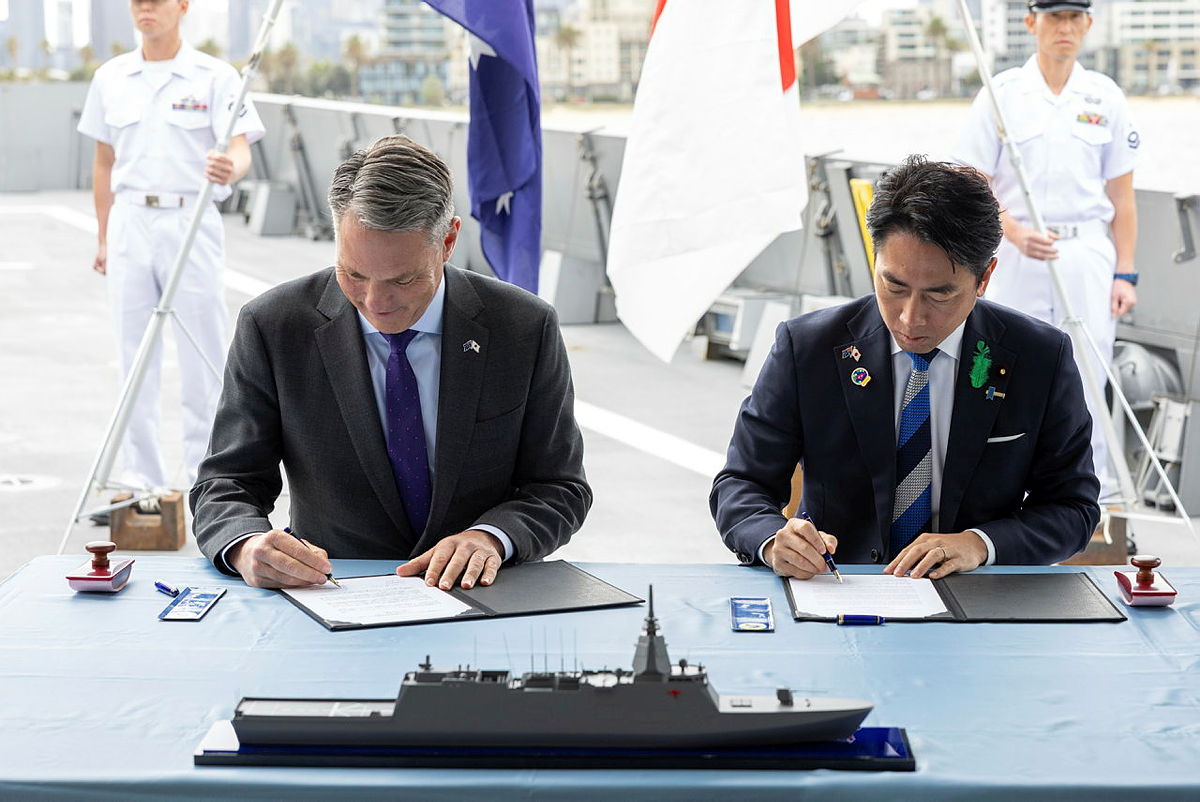
In April, Takaichi made headlines when she lifted Japan’s longstanding restrictions on lethal weapons exports. Australia has already ceased this opportunity with the procurement of the Mogami class frigate from Japan’s defence industry.
Japan’s expanding engagement is anchored in the Free and Open Indo-Pacific (FOIP) vision. Pioneered by Japan’s former Prime Minister Shinzō Abe, FOIP contends that Indo-Pacific to be governed by the rule of law and freedom of navigation across the maritime, littoral, and terrestrial domains.
A New Pacific International Order
Marking the tenth anniversary of FOIP this year, Prime Minister Takaichi emphasised that Japan will play a more proactive role than ever before in supporting an international order based on FOIP’s principles of “freedom,” “openness,” and “diversity.”
Critically, for Pacific Island states who value their own strategic autonomy, these principles go beyond taking sides to preserving the right not to. If Palau’s example reveals anything, it is that choosing to remain neutral in a polarised world will become increasingly difficult without the alignment of likeminded regional partners.
A central question remains, however. What precisely can a likeminded partnership from Australia-Japan deliver in the Pacific islands?
An annual trilateral exercise between Japan, Australia, and the US in the Torres Strait, which separates Australia from the island of New Guinea, modelled on the multinational Balikatan drill, would certainly sharpen interoperability and demonstrate an unambiguous signal of collective resolve.
Crucially, US participation would also show that Washington has not abandoned the region in its entirety. Involving Pacific Island regiments in these exercises would only reiterate Australia and Japan’s multilateralist credentials.
A diplomatic strategy should run in parallel.
The triennial Pacific Islands Leaders Meeting (PALM) summits bring together Japan and eighteen Pacific Island Forum (PIF) member states to coordinate on shared interests. Increasing the cadence to a bi-annual summit aligned with the Japan Pacific Island Defence Dialogue (JPIDD), and including like-minded partners like Australia, would deepen those relationships and create more regular opportunities for regional alignment.
What Minister Marles said is invariably true. Swiftness in securing the region is critical but the architecture for diplomacy is already there. Canberra and Tokyo must find common ground to bring in the Pacific who are the custodians of the maritime domain. Undersea diplomacy might be that terrain.
Hansley Gumbaketi is a current graduate student at the Department of Pacific Affairs at ANU. His research interests span infrastructure governance arrangements and its security implications focusing on the Pacific.
This article is published under a Creative Commons license and may be republished with attribution.