As regional cohesion falters under the weight of US-China great power competition, territorial disputes in the South China Sea and the erosion of international law and multilateralism in the region, key middle power countries – Australia and Indonesia have a timely opportunity to bring the Association of Southeast Asian Nations (ASEAN) and the Pacific Islands Forum (PIF) closer together.
Recently, Australian Prime Minister Anthony Albanese said in his speech, “We can work together to shape the future, not wait for the future to shape us.” Indonesia, as the largest country in ASEAN and Australia, the largest country in PIF, can play a pivotal role in forging ASEAN-PIF cooperation and multilateralism.
This aligns with Indonesia’s recent vision for closer cooperation between PIF and ASEAN. In fact, when Indonesia last served as chair of ASEAN in 2023, it was advocating for a deeper ASEAN-PIF relationship. Indonesia initiated the 2023 ASEAN-PIF MoU on maritime cooperation, sustainable development goals, people-to-people exchanges, disaster relief and humanitarian assistance. The 2025 ASEAN foreign ministers’ meeting mandated the ASEAN Secretariat to advance a plan between PIF and ASEAN. The plan is presently being developed by the ASEAN Secretariat.
Moreover, in 2019, Indonesia launched its Pacific Elevation Vision – a foreign policy approach aimed at strengthening diplomatic, economic, and cultural ties with Pacific Island countries. For instance, the vision focuses on areas of collaboration such as climate change, education, development cooperation, and maritime issues. Indonesia shares an 820-plus-kilometre land border with Papua New Guinea (PNG), the largest Pacific Island country. For decades, Indonesia has fought a low-level insurgency in West Papua. Nevertheless, the PNG government unequivocally recognises Indonesia’s sovereignty over West Papua, and Indonesia-PNG relations have deepened in recent years. In 2023, the two neighbours ratified an agreement governing their border, and in 2024, Jakarta and Port Moresby ratified and expanded their existing defence cooperation agreement. PNG has observer status in ASEAN and is seeking accession to the grouping. Indonesia supports PNG’s long-proposed bid to join the bloc.
Therefore, Indonesia’s increasing engagement with PIF is essential for regional stability and economic partnership. At the 2023 Australia-Indonesia foreign and defence ministers’ meeting, Canberra welcomed Indonesia’s growing engagement in the Pacific through Indonesia’s Pacific Elevation Vision and the inaugural Indonesia-Pacific Forum for development in 2022.
ASEAN and PIF: Cornerstones of the Region
Since 1967, ASEAN has been the cornerstone of Indonesian foreign policy and a key pillar in Jakarta’s search for a peaceful, stable, and prosperous Southeast Asia. Australian foreign policy also sees ASEAN at the centre of a peaceful, stable and prosperous region, where sovereignty is respected, and all countries benefit from strategic balance. In 1974, Australia became the grouping’s first dialogue partner. Since its humble beginnings over 50 years ago, the ASEAN-Australia partnership has grown stronger. In 2010, the ASEAN-Australia-New Zealand Free Trade Agreement came into effect. And, in 2021, the ASEAN-Australia relationship was elevated to a Strategic Comprehensive Partnership.
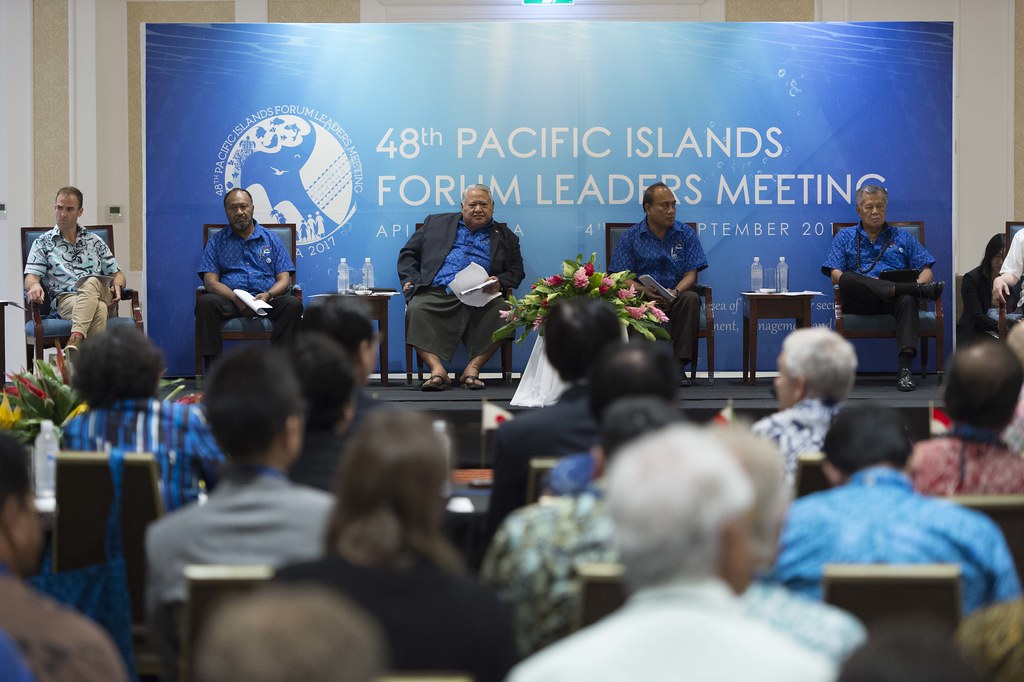
In terms of Australia’s engagement with the Pacific (its immediate region), it was a founding member of PIF in 1971. Today, the Albanese government’s climate diplomacy efforts in the Pacific are an integral part of Australian foreign policy. Pacific Island nations are among the most vulnerable countries to climate change, and Pacific communities are on the front lines of the climate crisis. In 2022, the government formally reinstated an Australian Ambassador for climate change. The Ambassador plays a leading and pivotal role in global climate advocacy, including engaging with Australia’s Pacific neighbours. The Department of Foreign Affairs and Trade has subsequently been at the forefront of leading Australia’s international response through multilateral organisations. This renewed commitment was welcomed by Pacific Island leaders at the 2022 PIF Leaders Forum.
Australia’s climate diplomacy efforts in the Pacific have been given a further boost in its recent official development assistance (ODA) budget, pledging a record $AUD 2.157 billion to the Pacific. Entrenching a high-level ASEAN-PIF partnership will boost PIF’s collective voice in the Indo-Pacific and give it a substantial voice on key issues that affect the Pacific. This strongly aligns with Australian Foreign Minister Penny Wong’s priority of amplifying the collective Pacific voice on the regional and international stage. Additionally, it will give Australia’s leadership further legitimacy and weight in the Indo-Pacific.
A Relationship with Great Potential
ASEAN and PIF can cooperate in a wide array of areas, including disaster relief, blue economy, climate change, energy transition, humanitarian assistance, cybersecurity, technology and connectivity, peacekeeping, maritime cooperation, transnational crime, economic and infrastructure development, health security, food security, law enforcement, addressing illegal fishing, sea cable connectivity and resilience.
Australia and Indonesia should advocate for a 3-point ASEAN-PIF cooperation plan. Firstly, the PIF Secretariat should become an official dialogue partner of ASEAN. ASEAN’s other dialogue partners include Australia, New Zealand, Japan, the EU, China and the US. Dialogue partners are central players in ASEAN-led mechanisms, including the East Asia Summit (EAS), the ASEAN Regional Forum (ARF), and the ASEAN Defence Ministers’ Meeting Plus (ADMM-Plus). For instance, Dialogue partners played a pivotal role in negotiating the Regional Comprehensive Economic Partnership (RCEP), which is the world’s largest trading bloc. ASEAN’s institutional mechanisms subsequently allow dialogue partners to engage on economic, political, and security issues with Southeast Asian counterparts and major powers such as China, the US, Japan, and India.
Secondly, the ASEAN Secretariat should become an associate member of PIF. Present PIF associate members include the United Nations Secretariat and the Asian Development Bank. Associate membership in PIF would enable the ASEAN Secretariat to participate in regional affairs in the Pacific, providing a formal “seat at the table” to influence policy without the full rights or responsibilities of full member states. They can contribute to regional discussions, policy development, and governance by sharing challenges related to climate change, transnational crime, disaster relief, and maritime security.
Finally, annual meetings between ASEAN and the PIF Secretariat should be institutionalised. This will help the respective Secretariat’s to build personal trust and relationships and empower them to advance economic cooperation, high-level negotiations and address key regional issues.
A strong ASEAN-PIF partnership will reinforce the growing importance of middle- and small-power regional multilateralism. This will enhance regional stability, uphold a rules-based regional order, offer a needed counterweight to great power rivalry and unilateralism, and forge cooperation on pressing regional security and trade issues.
Ridvan Kilic holds a master’s degree in international relations from La Trobe University. His research interests include Australian and Indonesian foreign policy, the Australia-Indonesia bilateral relationship, and ASEAN regionalism. Ridvan’s work has been published in the Lowy Institute Interpreter, The ASPI Strategist, Australian Outlook, The Diplomat, Papua New Guinea Post Courier, Indonesia at Melbourne, the East Asia Forum, South Asian Voices, 9DashLine and the ISEAS Yusof Ishak Institute Library.
This article is published under a Creative Commons License and may be republished with attribution.