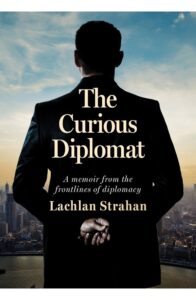
On Tuesday 3 March 2026 Dr Lachlan Strahan, former Australian diplomat and High Commissioner to the Solomon Islands, addressed AIIA NSW at Glover Cottages in a wide-ranging conversation with Ben Doherty, an award-winning foreign correspondent whose work has appeared across The Guardian, The Age, and the ABC, among others. The occasion centred on Dr Strahan’s recently published memoir The Curious Diplomat, which charts his thirty-year career across postings in Germany, South Korea, India, the Solomon Islands and representing Australia at the United Nations in Geneva, as well as working on policy formulation in Canberra.
Doherty opened proceedings with a quote about the importance of diplomacy from Guests of the Ayatollah, a book on the 1979 Iranian hostage crisis. Strahan drew a parallel with the current situation in the Middle East, arguing that the Trump administration had not genuinely attempted diplomacy before escalating tensions with Iran, and emphasising that diplomacy should always be the first resort. He pointed to the dismantling of the Obama-era nuclear framework agreement with Iran, imperfect as it was, as a cautionary example of what happens when diplomacy, with its demands for compromise and the judgment to know when enough has been achieved, is abandoned. A similar lesson was illustrated with Australia’s still-unresolved feasibility study for a free trade agreement with India, first launched in 2008.
On the culture of diplomacy itself, Strahan acknowledged that this work spans a remarkable spectrum, from productive, collegial partnerships to what he did not hesitate to describe as the occasional “knife fight,” recalling a human rights dialogue with Iran that descended into near-shouting and repeated threats to walk out. He commented on the rarity of Australian diplomatic memoirs, which he attributed to an ingrained institutional culture of non-disclosure, ongoing security obligations, and the ever-present risk of defamation. His own motivation in publishing his memoir combined a lifelong compulsion to write with a desire to process the personal toll of a demanding career.
Strahan described the question of reconciling personal disagreement with government policy as a central tension inherent in public service. During the Howard government’s handling of climate policy, he found his discomfort sufficient that he stepped back from the negotiating delegation. It was clear, however, that a coherent foreign service cannot function if individual diplomats pursue their own agendas. In unsparing comments on ministerial character, Strahan was especially critical of those who lacked the courage to press difficult issues, recalling one unnamed minister who, sitting across from senior Chinese officials, systematically skipped every hard issue in the brief.
The conversation turned to Australia’s relationship with India, where Strahan urged a move beyond the hackneyed invocation of the “three Cs”: cricket, curry and Commonwealth. He expressed concern about the Modi government’s trajectory, arguing that its erosion of India’s secular pluralism was undermining one of the historic foundations of the bilateral relationship, and drawing a parallel with the United States under Trump, asking whether populist-nationalist changes of this kind, once made, can ever be truly reversed.
On the Solomon Islands – the posting he described as the most challenging of his career – Strahan offered a frank account of the 2022 security agreement between Honiara and Beijing, which became the unexpected centrepiece of an Australian federal election campaign. He was critical of both sides of politics for turning the Solomons into a political football, characterising the outcome as the worst foreign policy blunder in the Pacific since World War II. He was equally clear, however, that China’s tactics in the Pacific, particularly coopting political elites and forming links to corrupt business networks, warranted genuine concern. His counsel was against both reflexive alarm and wilful obliviousness: Australia must accept that Pacific nations see China through their own eyes and engage accordingly, rather than berate them for their contacts with China.
In discussion with the audience, Strahan reflected on the personal costs of a diplomatic career, including disruption to partners’ professional lives, the uprooting of children and the psychological weight of managing difficult conduct within a mission. On why he left DFAT, he said that the Solomon Islands posting had taken chunks out of him, and when his department continued pressing him on to further Pacific work despite his requests for a change, an offer from his publisher to write a book had made it easy to decide on a return to his life as a historian.
An audience member took up his comment that few Australian diplomats had written about their professional lives, pointing to numerous diplomatic memoirs dating back as far as the 1950s.
On conflict management in diplomacy, Strahan was clear that no single approach works universally. He recalled being deliberately blunt with a Canadian delegation that was digging in its heels, a tactic he judged would work with them but would never use with the French or Americans. In the Solomon Islands, cultural nuance demanded an entirely different register, just as a calm, measured response was the only viable option when faced with a minister’s temper. Each country, each culture and each situation, he argued, demands its own tactics.
On the rules-based international order, Strahan noted, that while the United States has always selectively ignored its obligations, the system functions best when Washington is positively engaged and comes under acute pressure when it is not. His broader prescription for Australian foreign policy was more strategic boldness: a greater willingness to stand alone on specific issues, and less reflexive alignment with the great and powerful friend.
Report by Federico Canas Velasco, AIIA NSW intern
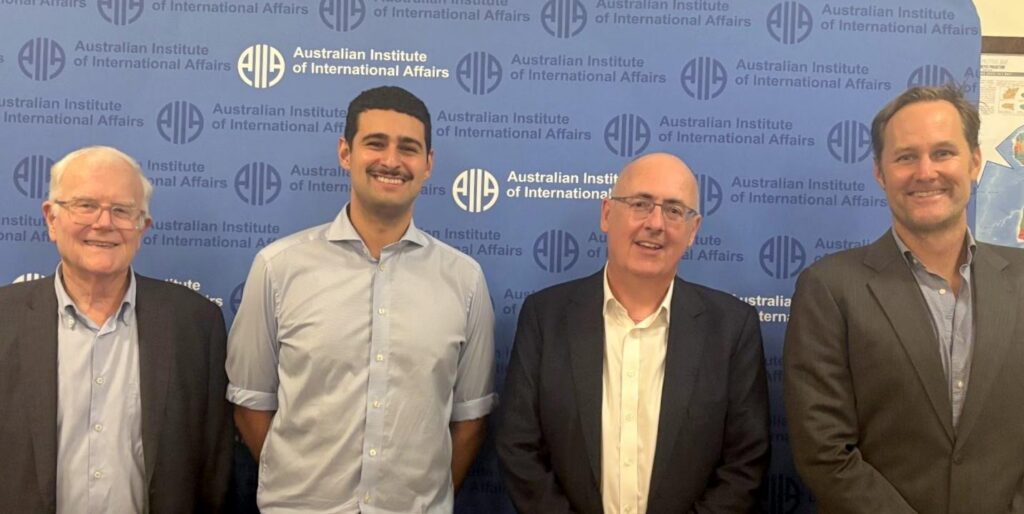
Ben Doherty (right), Dr Lachlan Strahan (second from right), AIIA NSW intern Federic Canas Velasco (second from left) and AIIA president Ian Lincoln (left)