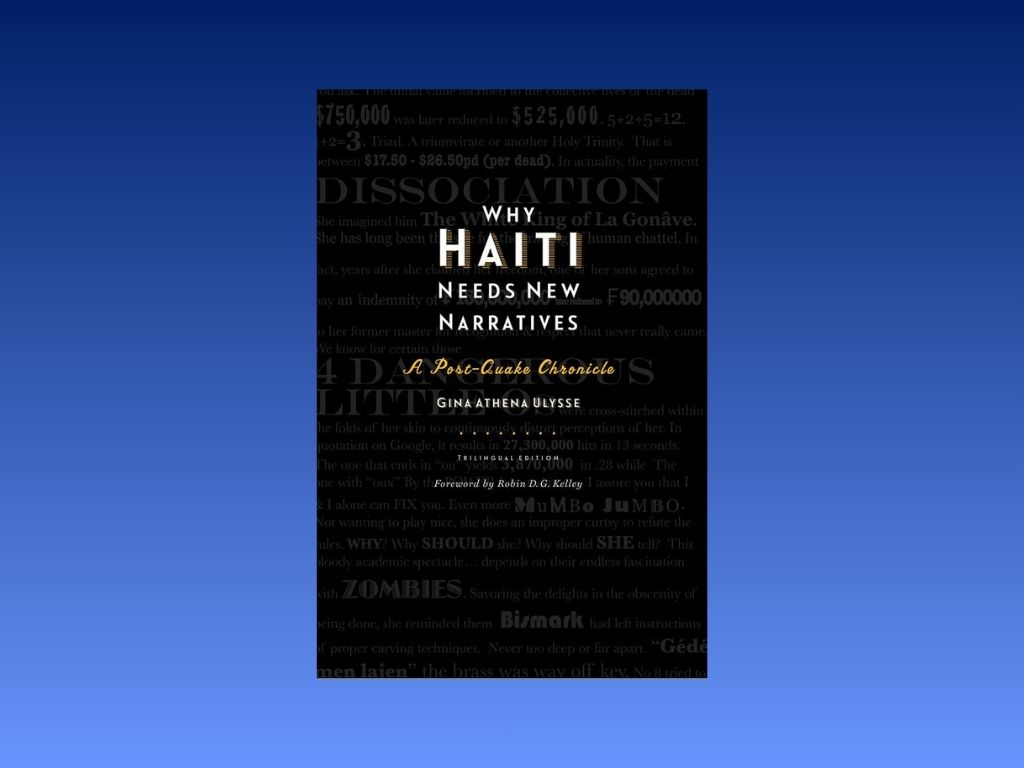
Gina Athena Ulysse’s Why Haiti Needs New Narratives: A Post-Quake Chronicle fundamentally interrogates which stories are told of Haiti, and who tells them. Not only is it extremely engaging and thought-provoking, but Ulysse writes in English, Haitian Creole, and French to enhance universal accessibility and bridge educational knowledge hierarchies.
She has carefully curated thirty chronological non-academic articles, op-eds, and blog posts written and/or published between 2010 and 2012 into the book. In this way, the book is simultaneously thoroughly scholarly and widely accessible. By distributing her works unevenly across all three sections of the volume, Ulysse challenges the traditional rigidity of academic structure while simultaneously reflecting her evolving perspective on the multiplicity of Haiti’s post-earthquake realities.
She elaborately weaves together interrelated essays on international aid, development, race, gender, colonisation, media representation, performance, politics, and Vodou. Doing this creates a nuanced and holistic account of how several themes intersect to construct narratives about Haiti. Repeated foreign interventions, debt repayments, diplomatic isolation, and global discourse reducing Haiti to a hallmark of dysfunction have all contributed to its historical incarceration, diminishing both Haiti’s material development and the ways in which it is perceived. Ulysse’s repetition across pieces arguably articulates her most pressing insights. Among the most compelling is how Ulysse challenges the historical incarceration of Haiti through her personal diasporic identity and via wider media narratives that reduce Haitians to stereotypes, empowering readers to reflect on the very notion of “disaster”, and how disasters permeate beyond the physical.
Ulysse’s Unique Perspective
Ulysse’s positionality as both an “insider” and “outsider” in her anthropological work provides a uniquely insightful angle. Born in Haiti and raised in the United States from age eleven, Ulysse discusses her navigation of the nuances of lived experience and diasporic identity, an experience many marginalised individuals may resonate with. These reflections, often given little space in academia, highlight the fluidity of identity, as Ulysse passionately advocates making space for herself in spheres not designed for her. It is a testament to the contradictions of diasporic identity and the lifelong journey traversing privilege, (un)comfort, and socially internalised borders. Ulysse epitomises these themes by dispersing her evocative poetry and performance art throughout the book, refreshingly dismantling traditional academic boundaries through a variety of storytelling approaches. Meanwhile, the recurring theme of embodied trauma illustrates the spectrum of ways in which suffering can be portrayed while also collapsing distinctions between public and private spheres.
By exploring the intimately subjective journey of continual (un)learning, hurting, and healing, her creative storytelling additions contribute a restorative refinement to the book. Eloquently, Ulysse’s exploration of the entanglement of pasts, presents, and futures unifies her personal experience with popular portrayals of Haitians.
The Complexities of Haiti
Using her unique positionality, Ulysse problematises the media’s post-earthquake reinforcement of singular narratives that exclude Haitian voices and perpetuate historical stereotypes. In her earliest pieces, her sense of urgency alongside the initial shock of the earthquake is palpable. Readers feel the tangible shift when Ulysse’s hope for post-quake transformation falters as she realises the extent to which old narratives have not only persisted but intensified.
Ulysse argues that Haiti’s history as the first independent Black state necessitated its suppression because it threatened Black slave uprisings in slave-dependent nations. Ulysse illustrates how this legacy persists in contemporary media representations which dehumanise Haitians by reducing them to mere subjects of “Blackness” or “poverty” while ignoring influences of colonisation and oppression, as well as human agency and autonomy. She repeatedly invokes the media’s portrayal of Haitians as disembodied spirits that require an intermediary as a key driver that sustains the narrative of a fragmented Haiti that needs saving. Ulysse instead artfully disentangles the hegemonic reiteration of a world order in which Haiti is objectively portrayed as the poorest nation in the Western hemisphere.
Ulysse invites us to suspend our belief that disasters are solely physical, revealing the multidimensional nature of the structural intersections between identity, history, and power. She demonstrates that international aid reinforced Haiti’s global subordination instead of offering a human-centred transformation of systemic inequalities. The unprecedented influx of unregulated post-earthquake aid enabled missionaries to use religious conversion as a condition of assistance, repressing traditional Haitian Vodou and deprioritising temple reconstruction. Here, Ulysse further queries superficial allyship and invites more carefully cultivated understandings of solidarity.
Structural neglect further exacerbated already startling figures of mass graves and gender-based violence. As damaging socio-historical narratives remained unchallenged and consistently reproduced in the post-quake period, Ulysse expresses her withering hope for Haiti to “build back better”. Instead, Ulysse asserts that it is time for new narratives and the present enactment of a liberated Haiti.
Final Reflections
Although Ulysse does not explicitly include all possible narratives of Haiti, she intentionally creates space for a wide spectrum of voices to emerge. Because Ulysse’s reflections are deeply personal and cannot possibly be all-encompassing, this is not by any means a disadvantage.
Arguably, the entire book is proof that both popular and personal understandings are constructed through an assortment of fragmented realities and narratives. Ulysse aligns with notions of Queer and Black futures which alter the very possibilities of existence and representation by advocating for a self-defined, pluriversal Haiti that contends deterministic discourse. In this way, though the book may not explicitly offer ‘new narratives’, the powerful renunciation of old narratives makes space for empowering new ones to emerge.
Ultimately, Ulysse calls for readers to interrogate hegemonic bias and make space for more liberating narratives, both specific to Haiti and, more broadly, dominant epistemologies, disaster, identity, and care.
This is a review of Why Haiti Needs New Narratives: A Post-quake Chronicle. By Gina Athena Ulysse. Middletown, CT: Wesleyan University Press, 2015. ISBN 08195-7546-1.
Amber Wright is studying MSc Global Development, Poverty and Inequality at the University of Manchester, UK. She is an aspiring PhD candidate and aims to continue researching global development, peacebuilding, and poverty and inequality through frameworks of feminism, abolition, care, border politics, and more. She places particular attention on social justice for racialised and marginalised communities globally.
This article is published under Creative Commons License and may be republished with attribution.