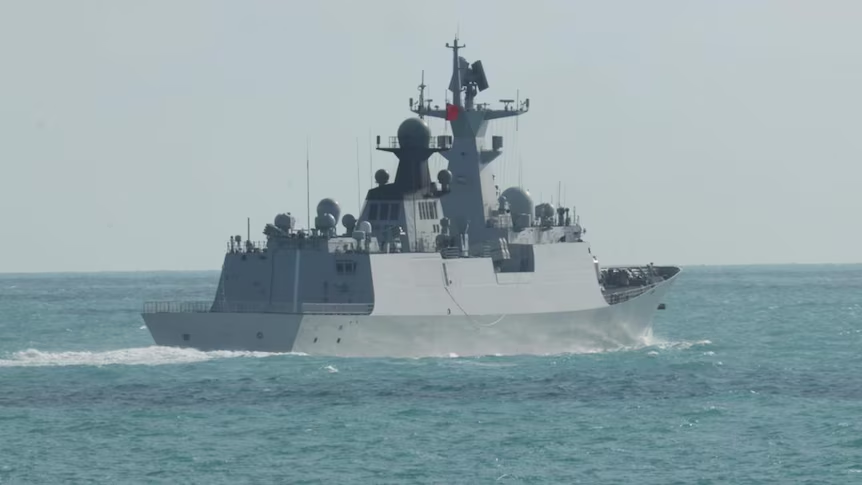
In late February, the Peoples Liberation Army-Navy (‘PLA-N’) entered Australia’s exclusive economic zone (‘EEZ’) and conducted live-firing drills off Sydney. According to strategic commentators, the motives were obvious. It demonstrated China’s increasingly blue-water capable navy. It was a test of our civil and military responses. And, it showed China’s capability to execute wartime scenarios against Australia. While true, these responses overlook one crucial aspect to the visit. That is, the effect of the Chinese expedition on influencing Australian public opinion.
The reaction to the Chinese ships within Australian society was hysterical. Described as stoking ‘an anxious nation’s worst fears’, one could be forgiven for thinking the long-standing fear of the yellow peril had come to bear. The move caused a fervent mixture of shock, panic and outrage. Australia’s commentariat derided the transit as ‘military brinkmanship’, ‘gunboat diplomacy’ and there were even suggestions of ‘sending [Australian] ships out’ to confront the PLA-N. The reaction was so widespread that the government was forced to take a stance, urging the public to remain ‘calm’ and suggested they ‘take a deep breath’, while opposition politicians criticised the government for being ‘weak’ on a ‘totemic issue’.
This hysteria was not an unpleasant by-product of the mission, but a calculated move designed to exploit Australia’s sense of security.
Australia has historically enjoyed a ‘relatively benign’ strategic environment, buttressed by extended American military deterrence. Not since World War II, more than 80 years ago, has a possible or actual adversary operated off Australia’s coast. Japanese submarines and warships lurking in the Pacific and Indian Oceans were the last near competitor to undertake that course. For that reason, Australians are unaccustomed to adversaries operating near their borders. This lack of confrontation has led to what maritime security expert Douglas Guilfoyle suggests is an Australian attitude of a ‘peaceable sphere’, defined by a ‘view that [conflict] occurs over there’ and as a result it ‘suddenly seems rather startling when the world comes to [Australia]’.
This gap in Australian public memory, and Australia’s ‘peaceable sphere’ was a deliberate and important target of the manoeuvre.
The Chinese expedition sought to rile the angst and fear associated with a military exercise and provide Australians with a tangible experience of having an adversary close to their shores. The naval flotilla aimed to shatter the Australian perception of a ‘peaceable sphere’ and force a reflection within the public on Australia’s decision to conduct freedom of navigation operations (FONOPs) in the South China Sea and Taiwan Strait. In doing so, Beijing hopes to use the weight of an anxious public to increase the pressure on the Australian government to withdraw from those exercises.
It’s no coincidence that China’s warships entered Australia’s EEZ, at precisely the same distances that Australia operates when it regularly conducts FONOPs in the South China Sea and Taiwan Strait. These moves are deeply unpopular in China, with Beijing condemning them as ‘provocation’ or a ‘threat to China’s territorial integrity’. Prior to the Chinese expedition of late February, however, these words were meaningless to the Australian public. Australians had no experience of an adversary proximate to their coastline to gauge or conceptualise China’s ill-feeling.
Since the naval expedition of late February, Australians now have that experience.
The Chinese expedition provides a previously lacking context to the Australian public and brings perspective to Chinese protests of ‘provocation’ over these exercises. Given the fallout within the public and Australian commentary of ‘gunboat diplomacy’, one might consider whether a resonant experience has been achieved by Beijing. Suddenly, ‘provocation’ doesn’t seem so outlandish.
The angst and uncertainty that results from the move also forces Australians to grapple with a series of questions that were once academic. Why are we conducting FONOPs? Do we need to conduct them? And if we found it so unpleasant, is this how the Chinese feel, given Australia has conducted at least four FONOPs in 2025?
The emphasis on public opinion becomes clear when viewed amongst the uniformity of narratives put forward by Chinese state-owned media organisations. The Global Times reported that ‘Australia should reflect on itself for its activities rather than feel nervous about Chinese vessels’. Another article cited a Chinese military expert who commented ‘if the legitimate PLA far seas drills hit the nerves of some countries, they should reflect: some countries have been frequently conducting military activities near China, including transits through the Taiwan Straits and into Chinese territorial waters’.
Similarly, Zhou Bo, a retired People’s Liberation Army Senior Colonel appeared on Australia’s public broadcaster the ABC and asked ‘Why would [Australian] ships sail so close to Chinese shore? What is the purpose of you sailing through the Taiwan Strait? There is not much business for you to go through there… ask yourself [why you are there], do some self-searching’.
The Chinese narrative demonstrates the visit was chiefly aimed at catalysing a reflection within Australian society regarding FONOPs. In this reflection, and in the unpleasantness associated with the visit, calls from within Australian society for a withdrawal from FONOPs grow louder, something China has repeatedly called for and is a long-term foreign policy goal of Beijing.
Such a strategy fits within China’s Three Warfares’ (三战)doctrine, a guiding PLA strategy that involves the targeting of public opinion, psychological warfare and legal warfare to protect and promote the interests of the Chinese Community Party. As former CIA analyst Peter Mattis observed, the strategy involves ‘influencing potentially threatening actors at their source to shape their thinking and actions’.
In visiting Australia, China attempts to influence Australia ‘at the source’, shaping its thinking and actions in the South China Sea and Taiwan Strait. The naval flotilla was an attempt to provide the Australian public with an identifiable experience of FONOPs, bring into relief the Chinese experience and to reduce support for them by raising the fear and uncertainty associated with conflict. It leads Australia to an uncomfortable position the next time it considers returning to contested waters. Does Australia continue with FONOPs? And, if Australia found the Chinese visit so unpleasant, should it withdraw from them entirely? Such a goal would fit squarely within China’s strategy of ‘win without fighting’.
Oliver Sinclair is a lawyer and is studying a Masters of International Relations at the Australian National University.
This article is published under a Creative Commons License and may be republished with attribution.