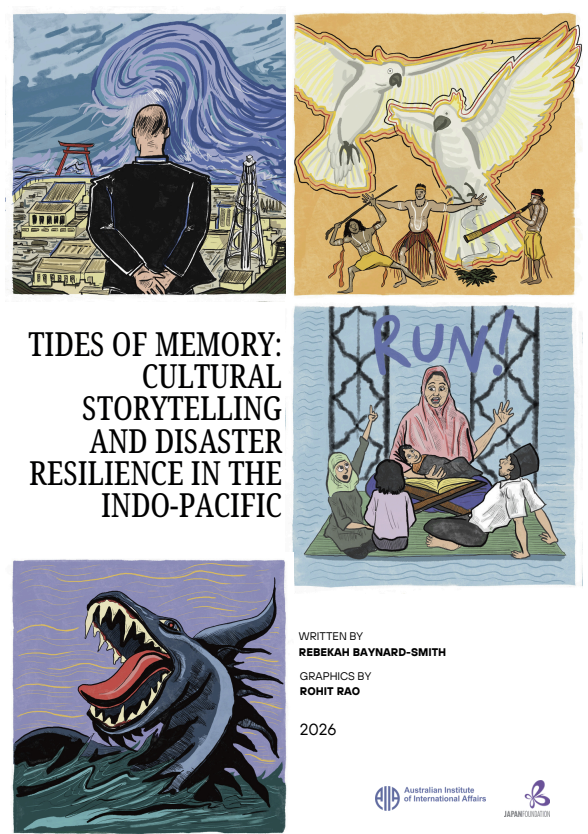
Tides of Memory: Cultural Storytelling and Disaster Resilience in the Indo-Pacific

Authored by Rebekah Baynard-Smith, Illustrated by Rohit Rao

12 Mar 2026
Product Details

In an age of relentless news cycles and information overload, it’s easy to forget the disasters we’ve faced and the lessons they carry. Storytelling and memorialisation are powerful tools to actively remember collective experiences and their lessons and ultimately build resilient communities.

In this report, author Rebekah Baynard-Smith draws on case studies from across the Indo-Pacific to explore how societies use storytelling, art, music, memorials, museums, traditional ecological knowledge, and technologies to keep disaster memories alive and transmit hard-won lessons to future generations.

The case studies show how storytelling and memorialisation play dual roles of individual and community healing, as well as disaster risk reduction. By grounding preparedness in lived experience and collective memory, communities can build resilience in ways that leverage unique cultural practices and traditions and take advantage of modern technologies.

Practices from these case studies should be understood, further explored and, wherever possible, embedded in disaster risk reduction and emergency management.

The report is free to download and a must-read for policy makers, emergency managers, community organisations, and anyone working at the intersection of culture, memory and resilience.
Share

Description

In an age of relentless news cycles and information overload, it’s easy to forget the disasters we’ve faced and the lessons they carry. Storytelling and memorialisation are powerful tools to actively remember collective experiences and their lessons and ultimately build resilient communities.

In this report, author Rebekah Baynard-Smith draws on case studies from across the Indo-Pacific to explore how societies use storytelling, art, music, memorials, museums, traditional ecological knowledge, and technologies to keep disaster memories alive and transmit hard-won lessons to future generations.

The case studies show how storytelling and memorialisation play dual roles of individual and community healing, as well as disaster risk reduction. By grounding preparedness in lived experience and collective memory, communities can build resilience in ways that leverage unique cultural practices and traditions and take advantage of modern technologies.

Practices from these case studies should be understood, further explored and, wherever possible, embedded in disaster risk reduction and emergency management.

The report is free to download and a must-read for policy makers, emergency managers, community organisations, and anyone working at the intersection of culture, memory and resilience.