On 18 November 2025 Jon Richardson, Visiting Fellow at the ANU Centre for European Studies and a former senior diplomat, addressed the Australian Institute of International Affairs NSW about the Russia-Ukraine War and Europe’s evolving perspectives on the conflict.
Richardson opened by outlining competing narratives. Drawing on a quote from Ursula von der Leyen, President of the European Commission, he argued that Europe sees its support for Ukraine as a defence of core values at a time when major powers – especially the United States under the second Trump administration – appear increasingly ambivalent about European security. Russia, by contrast, frames the conflict as a metaphysical battle against “woke” values, portraying Europe as the source of the war. For Richardson, this values-based antagonism underpins much of the conflict’s political and strategic dynamics.
Richardson highlighted the war’s grim realities. Russia has seized roughly 20% of Ukrainian territory but suffered close to a million casualties. Ukraine’s losses are also severe, with an estimated 80,000-100,000 military deaths and heavy civilian tolls. These numbers are estimates: both sides avoid reporting accurate casualty data. After early Russian gains, the conflict has settled into attrition. Drone warfare now dominates the battlefield, from surveillance to precision strikes and supply delivery. Russia holds a modest technological edge but faces labour shortages and growing difficulty avoiding conscription. On sanctions, Richardson noted that, while they have significantly affected the Russian economy, it is “creaking rather than crumbling”. Ukraine has struck up to 20% of Russia’s oil refining capacity, creating fuel strain inside Russia.
Richardson also highlighted the escalation of Russia’s hybrid and grey zone warfare across Europe. Cyber attacks and physical sabotage targeting energy and transport infrastructure have quadrupled since 2023, often focusing on assets supporting Ukraine. These operations frequently involve proxies and crypto-currency financing and aim to weaken European unity. Inside Europe, Russian narratives about “woke liberalism” continue to influence segments of the far right.
Europe has now overtaken the United States as Ukraine’s largest donor. It increasingly views Ukraine as a frontline buffer and an opportunity to gain practical experience with drone systems and NATO weapons. Long-term, Ukraine may require up to €400 billion to sustain the conflict through to 2030. The EU’s use of loans leveraged on frozen Russian assets, combined with ongoing sanctions (which have driven down Russian oil revenues by 20-25%) remains central, though enforcement challenges persist.
Diplomatic and battlefield stagnation has made Putin’s remaining aims difficult to read. European states have shown growing unity. They recognise that they must assume greater responsibility for their own defence. But domestic budget pressures and doubts over US reliability remain key vulnerabilities, and Russia’s actions continue to threaten Europe’s post-Cold War security order.
Questions from the audience addressed Putin’s true intentions in the conflict. One audience member suggested that, if Russia achieved certain military aims (such as control of the Donbas region and ensuring a denial of NATO membership for Ukraine) it would end the conflict. Richardson responded by pointing to Putin’s maximalist and imperialist ambitions in Ukraine, saying that Russia will seek to keep annexed provinces and integrate these areas constitutionally into the Russian Federation. Yet he also noted Putin’s pragmatism, with Russian public opinion as the war grinds on likely to shape his calculations. While dismissing the likelihood of Russia invading wider Europe, he warned that further incursions into the Baltic region and efforts to stir pro-Russian sentiment among Russian-speaking minorities were plausible.
Asked about what a ceasefire between the two states might look like, Richardson expressed his view that an end to the conflict may come from Trump strong-arming Ukrainian president Zelensky into ending the conflict. He considered that Putin will not end the conflict until he is “running up a brick wall”. He considered it unlikely that Ukraine will regain the territory that Russia has taken.
With this in mind, Richardson reflected on the future of Ukrainians in the annexed regions. He noted that these areas are home to around 12 million people and that widespread looting, repression of Ukrainian language and culture, and systemic erosion of local identity are already evident. While a temporary settlement might halt the violence, he questioned the long-term consequences of sustained Russian control.
Final questions considered the strength of the Europe response. An audience member suggested that the EU has been overly cautious, particularly regarding Baltic defence and Russia’s shadow fleet. Richardson acknowledged these criticisms. He pointed to Europe’s steps to restrict Russia’s international trade, expand Europe’s defence industry capacity and increase military support for Ukraine, but acknowledged that Europe remains wary of escalation such as imposing NATO-enforced no-fly zones. He concluded that helping Ukraine defend itself remains the most viable path to peace.
Report by Mae White, AIIA NSW intern
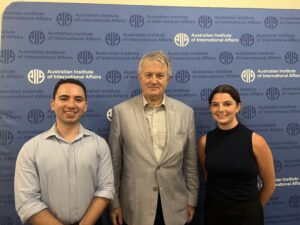
Jon Richardson centre, Chris Khatouki left and Mae White right