On Tuesday 17 March 2026, James Curran, Professor of Modern History at the University of Sydney and foreign affairs columnist for the Australian Financial Review, addressed the NSW Branch of the Australian Institute of International Affairs on the current state of Australia’s foreign policy and the challenges facing middle powers in an increasingly unstable global order.
Professor Curran has written extensively on the history of the Australia-US relationship and its psychological stronghold over Australian strategic thinking. In his address he reflected on whether Australia can develop genuine strategic autonomy as a middle power, or whether its ambivalence will harden into dependency by default. He offered a fresh perspective on the challenges and opportunities facing Australia’s foreign policy, emphasising the importance of ambition and strategic foresight in shaping our international role.
Opening with the description of Australia as a “proverbial shag on a rock,” Curran examined the nation’s hesitant approach to foreign policy. He highlighted the ‘irresistibility’ of the alliance with the United States for Australian policymakers and the increasingly lockstep alignment with Washington. He posed a central question: has Australia lost agency and autonomy – the foundations of a foreign policy grounded in our own national interests? While acknowledging the importance of the alliance with the US, he argued that, as a middle power, Australia should more actively assert itself in our region and cultivate stronger relationships with our neighbours. Given growing fears among Pacific and Southeast Asian countries in response to the rise of China, Curran emphasised that a confident and proactive Australia in the region would encourage broader strategic collaboration with our neighbours – a strategic collaboration which would benefit nations grappling with their footing in an unhinging rules-based order: ‘the level of volatility in the world hasn’t been seen since the Vietnam War’.
Drawing on his expertise in modern history, Professor Curran pointed to the disruptive influence of culture-war politics on serious foreign policy debate, citing the role of former federal opposition leader Mark Latham. He underscored how such rhetoric can distort and diminish the quality of national security discussions. He acknowledged the leadership of former Prime Minister Julia Gillard and former Prime Minister and Ambassador to the United States Kevin Rudd, both of whom had provided distinct and substantive contributions to Australia’s foreign policy discourse, helping to shape a more engaged and strategically coherent approach to our regional politics. In a global environment that continues to evolve and reorder itself, he emphasised the importance of looking not only forward but also to the past for insight. As the adage goes, “history does not repeat itself, but it rhymes” – a reminder that historical awareness remains essential when navigating contemporary foreign policy challenges.
While Curran was critical of current Australian foreign policy, he did not leave the audience in total despair. The ‘silver lining’ for our nation is the latent strategic potential we have yet to fully realise. He remarked that ‘multiculturalism is the new orthodoxy’, bringing diverse voices and ambitious perspectives into the foreign policy space and creating a network of identities that a confident, outward-looking Australia would be wise to draw upon more deliberately in the pursuit of becoming a reliable, strategic partner. By capitalising on the success of multiculturalism, Australia can gain an intimate understanding of the regions we seek to engage with – an under-utilised asset in our foreign policy.
When asked by an audience member about the growing anxiety around the relationship between the United States and China, Curran said he couldn’t see a situation where we could have much say about joining a hypothetical war, reiterating his point that anyone not at the table is most certainly on the menu when it comes to making autonomous choices about our national interest.
He agreed with an audience member on the important role of Asia in shaping a new world order. Australians could learn from our previous missteps in foreign policy and form new alliances. We must move beyond merely ‘dipping our toes in the water’ and instead plunge into the deep end if we are to pursue our interests effectively in a rapidly changing world.
Report by Clodia Stanislaus, AIIA NSW intern
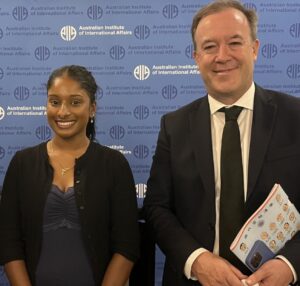
Speaker James Curran on the right and Clodia Stanislaud, AIIA NSW intern, on the left