On October 28th, Professor James Laurenceson, director of the Australia-China Relations Institute at the University of Technology Sydney, addressed AIIA NSW at Glover Cottages to assess the China-Australia Free Trade Agreement (CHAFTA) a decade after its signature, and to discuss the trajectory of the two powers’ relationship into the future.
He opened the address by describing the hopes and concerns Australians had for CHAFTA in the lead-up to its implementation. Proponents of the agreement, such as former Prime Minister Tony Abbott, hoped that the deal would increase trade with China, enhancing our national prosperity. Opponents of CHAFTA had worried that exposing workers to labour competition from Chinese nationals would leave many Australians out of work. With the benefit of hindsight, Professor Laurenceson said the detractors had proved wrong and the proponents correct. Trade between China and Australia had increased: Australia’s share of China’s import base had grown from 4.5% ten years ago to 5.7% currently. The growth in Australia’s exports to and imports from China had significantly outpaced Australia’s trade growth with the rest of the world.
In Professor Laurenceson’s view, Australia and China are closer economic partners today than in 2015. That closeness does not threaten Australian jobs through migration, as some feared it would; both numerically and as a percentage of the workforce, the number of temporary resident skilled visas offered to Chinese nationals has in fact decreased since CHAFTA was signed. CHAFTA has been an economic success but, regardless of the positive economic outcomes, its critics do not welcome China comprising a higher portion of Australia’s trade: there are fears of coercion that might lead to Australia being pressured by our largest trading partner to fall in line with its foreign policy.
The last ten years, argued Professor Laurenceson, demonstrated that this problem was not as significant as some may have feared. Australian governments persistently raised points of difference with China despite the importance of the economic relationship. Legislation criminalising foreign interference, a ban on a Chinese telecommunications company from tendering for the NBN, and the establishment of the AUKUS security arrangement were all steps that openly differed from Chinese positions, and yet our policy makers had felt secure in implementing them. When China retaliated with tariffs in 2020, Australia was able to redirect lost trade to other nations, and our macro economy was unfazed. Australia, Professor Laurenceson commented, is stronger than some may give us credit for.
After assessing the past role of CHAFTA, Professor Laurenceson turned to the future of Australia-China relations. He recognised that, while Australia is benefiting from trade with China, our foreign policy differences make this relationship inherently uncertain. But he saw those differences as unlikely to be as significant or as challenging as some might expect. Where tensions existed, trade continued and disagreements could be smoothed over. Chinese and Australian foreign ministers insisted that policy divergences would be managed carefully, and that mutually beneficial trade would not fall victim to political disagreements. Australia would not replicate US trade restrictions on China, instead favouring a strong, persistent long-term relationship with the newer superpower.
In discussion with audience members, Professor Laurenceson said that this major bilateral trade agreement did not affect Australia’s engagement in the multilateral trading order. CHAFTA created trade security; it had been able to reduce friction except in specific markets such as wine and education. Some goals might have been missed through reliance on multilateral agreements due to certain large stakeholder conflicts having slowed negotiations through the WTO. Both China and Australia still engaged strongly with multilateralism; both countries respected rulings made by the WTO and engaged in regional FTAs like RCEP.
Asked about the risk of conflict involving China possibly affecting Australia’s trade with the nation, Professor Laurenceson underscored the improbability of China violently disrupting trade. China, as much as anyone, was reliant on international markets for its wealth and continuing development.
On the potential flashpoint of Taiwan, Professor Laurenceson argued that China did not want war, and if it did, the involvement of the US and Australia in that war was not certain . While risks may exist, Professor Laurenceson observed that it would be an error to forge Australia’s entire economic strategy around them.
Report by Lachlan Doyle, AIIA NSW intern
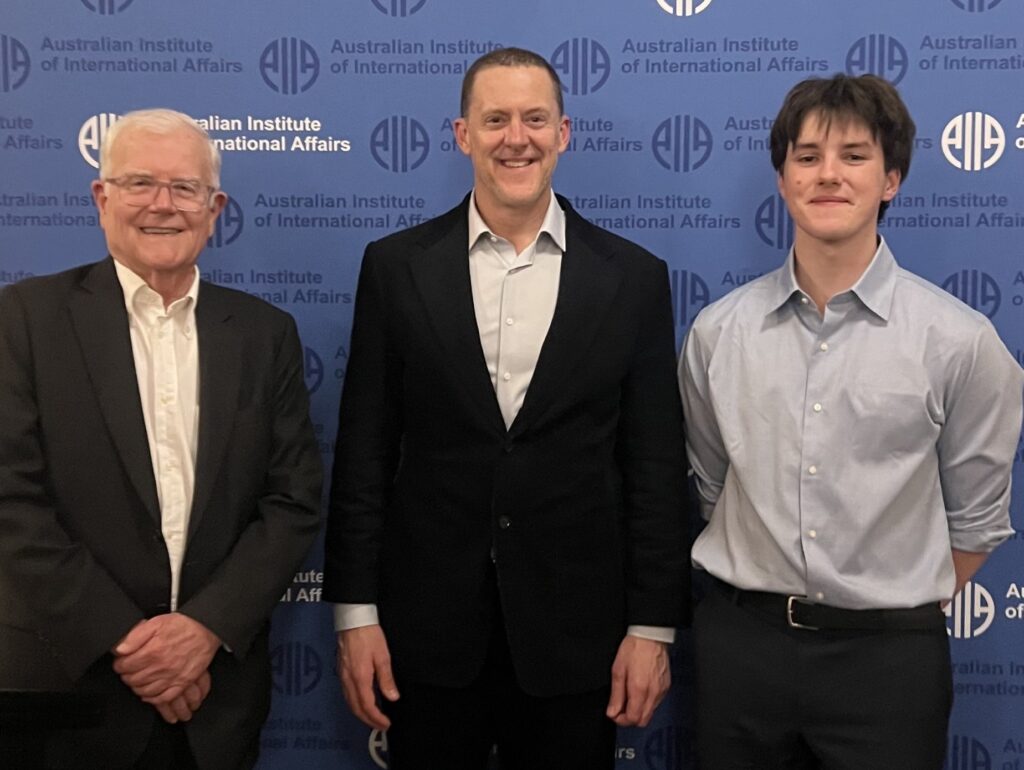
James Laurenceson (centre), AIIA NSW president Ian Lincoln (left) and AIIA NSW intern Lachie Doyle (right)